-
How to control bean hawkmoth in soybean cultivation
How to control bean hawkmoth when growing soybeans? Please introduce the soybean bean hawkmoth: Damage symptoms The bean hawkmoth feeds on leaves as larvae. Young larvae eat them into a net-like, notched pattern, and after the third instar the larvae can eat all the soybean leaves, preventing the plants from setting pods, which has a huge impact on yield. Occurrence pattern From mid-to-late July to August...
-

Wang Xiaokang of Dawanglou Village hawks tourism on WeChat Moments
Wang Xiaokang of Dawanglou Village: "Hawking" tourism in WeChat Moments
-
Zhejiang Suichang's original-ecology agricultural products go to the provincial capital to hawk their wares
Suichang people from Zhejiang hawk "original-ecology" agricultural products in the provincial capital
-
Occurrence Patterns and Control Methods of the Soybean Hawkmoth
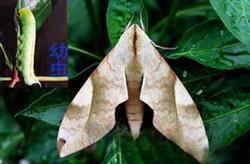
Damage symptoms: The soybean hawkmoth feeds on leaves as larvae. Young larvae eat leaves into a net-like, notched pattern, and after the third instar the larvae can eat all the soybean leaves, preventing the plants from setting pods and greatly affecting yield. Occurrence patterns: Mid-to-late July to early August is the peak period for adult egg-laying, late July to late August is the peak period of larval damage, and in early September the light-yellow mature larvae enter the soil to overwinter. Life habits: Adults: Adults hide by day and come out at night, and have a strong tendency toward black light lamps. They begin activity in the evening and are strong fliers with strong migratory ability. They mate at night, and lay eggs 3 days after mating. Eggs are mostly scattered on the undersides of soybean leaves, generally 1 to 2 eggs per leaf, and the eggs hatch into larvae after about 7 days. Larvae: Larvae are photophobic, mostly staying on the undersides of leaves or on stems during the day, and feeding strongly at night; on cloudy days they can feed all day. First and second instar larvae eat little and generally do not move between plants to cause damage; after the fourth instar they have the habit of moving to cause damage; fifth instar larvae show a sharp increase in food intake, accounting for about 90% or more of the total food consumption. The larval stage lasts 30 to 35 days.
-
Symptom Identification and Control Methods for Soybean Hawk Moth
Symptoms and Control of Soybean Hawk Moth
-
Identification and Control Methods of the Impatiens Hawk Moth
The scientific name of the impatiens hawk moth is Deilephila elpenor lewisil Butler. It is a major pest of impatiens and is distributed in Northeast, North, East and Northwest China. Besides impatiens, its host plants also include autumn orchids, herbaceous flowers and others. Damage characteristics: this insect feeds on leaves in the larval stage, affecting the growth and development of the plant, and is a major pest of impatiens. Morphological characteristics: the adult body length is 33-40 mm, and the wingspan is 55-70 mm. The wings and body are red
-
What are the morphological characteristics of the Privet Hawk Moth?
The Privet Hawk Moth is also called the Soybean Hawk Moth. It mainly damages black locust (Robinia pseudoacacia), and also harms soybeans, wisteria, and so on. The larvae feed on the leaves, and in severe cases can strip the trees bare. Adult: body length 40-50 mm, wingspan 100-120 mm, body and wings yellow-brown, head and pronotum dark purple; near the center of the forewing costa there is 1 pale white semicircular spot, the wing surface has 6 wavy transverse lines, and the wing apex has 1 dark brown oblique line dividing the apex angle into two parts; hindwings dark brown, with the middle part deep brown. Egg: oval, yellow-white. Larva: final instar about 80 mm long
-
-
What are the control methods for the Privet Hawk Moth (Clanis bilineata)?
Control methods for the Privet Hawk Moth (Clanis bilineata): 1. Use light traps to kill adult moths. 2. After larvae enter the soil or before adults emerge, dig the soil as appropriate to destroy larvae and pupae. Or spray 25% phoxim on the ground to poison the pupae in the soil. Or apply drip irrigation. Before applying the pesticide, first clear weeds, dead branches and fallen leaves from the ground. After applying the pesticide, mix the soil evenly with a hoe to improve the control effect. 3. During the larval occurrence period, spray a 500-fold dilution of Bt emulsion containing more than 100 billion spores per milliliter, or a 1000-fold dilution of 90% trichlorfon crystal.
-
What are the occurrence patterns of the privet hawk moth (Clanis bilineata)?
Occurrence patterns of the privet hawk moth (Clanis bilineata): In Hebei, Shandong, Jiangsu, Anhui and other places, 1 generation occurs per year, and the mature larvae burrow into the soil at a depth of 10 to 15 cm to overwinter. In early to mid-June of the following year, pupation begins. The pupal stage lasts 10 to 15 days. In early to mid-July, adults emerge, with mid-month being the peak emergence period. During the day, adults rest quietly among branches and leaves, and begin activity in the evening; adults are phototactic. Generally, egg laying begins 3 hours after mating, with eggs mostly laid on the underside of leaves and a few on the upper side. Each female lays an average of about 350 eggs. Adults live 7 to 10
条件筛选