-

Winter control of rice pests and diseases can yield twice the result with half the effort
In winter, rice pests and diseases are in a dormant state: pests stop feeding and pathogens stop infecting. If farmers seize this favorable opportunity to carry out control, they can achieve twice the result with half the effort. 1. Dispose of diseased rice straw. Diseased straw is the overwintering site for the pathogens of rice bacterial leaf streak, bacterial blight, rice blast and many other diseases, and is the main source of infection the following year. Before the end of March, farmers can compost diseased straw at high temperature, or process it as feed or fuel, which can greatly reduce the number of pathogens. For diseased rice straw that cannot be fully processed before the end of March,
-
Rice seedling raising is key: good seedlings mean half the rice is already grown, and strong seedlings lead to high yields.
Seedling-stage management for machine transplanting is key. Cultivating robust seedlings suitable for machine transplanting is the key to the success of promoting mechanized rice transplanting. "Good seedlings mean half the rice is grown, and strong seedlings lead to high yields." The quality of the seedlings plays an important role in the number of panicles, number of grains and grain weight in the later growth stages of rice. The basic requirements of mechanized transplanting for seedlings are overall uniformity and individual robustness, requiring that "a tray of seedlings has no tall and short ones, and a handful of seedlings has no thick and thin ones." High temperature and high humidity promote uniform emergence. Germinated rice seeds, after sowing, need to go through a period of high temperature and high humidity for seedling establishment.
-
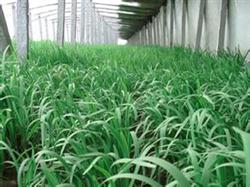
Chives have the most pesticide residue at the roots; remove half an inch of the root and first soak them in lightly salted water.
1. Temperature management. Chives like cool conditions, with an optimum growing temperature of 15-24°C, and should be ventilated appropriately during the day. To promote sprouting, after covering with a plastic tunnel the daytime temperature should be kept at 18-25°C, and after sprouting the daytime temperature should be controlled at 17-23°C. Before harvesting the first cut of chives, the daytime temperature should be 15-22°C and the nighttime temperature 10-12°C. After that, with each cut...
条件筛选