-

Rice quality amylose tester successfully developed through the 948 Program
To fundamentally improve the current rice quality, namely the amylose content of rice, in 2001 the Ministry of Agriculture included the "Rice Quality Amylose Tester" project in the "948" Program. Organized and implemented by China Agricultural University, the project aimed to develop, through this research, a high-quality paddy quality testing instrument suitable for all stages and all levels. Under the leadership of project leader Professor Jia Guiru, Director of the Department of Applied Physics at China Agricultural University, the project has now been completed and has achieved remarkable results. It is reported that the rice
-
A Complete Analysis of Traditional Chinese and Western Medicine Prevention and Treatment Methods for Pig Eczema
1. Dual flowers (honeysuckle and chrysanthemum) and Isatis root 200 g each, grind into powder and feed to pigs; externally take an appropriate amount of loofah leaves, crush and squeeze juice to rub the affected area, 2 times a day. 2. Fresh Eclipta prostrata 500 g, borneol 10 g. Crush fresh Eclipta prostrata and add borneol, use gauze to press out the juice, then apply the juice to the cracked skin or the affected area of impetigo, 3 times a day, for 2-3 consecutive days. 3. Yinchen (Artemisia capillaris) and honeysuckle 60 g each, decoct in water for oral administration; wash the affected area with 2%-3% alum, 2 times a day. 4. An appropriate amount of Chinese tallow tree leaves
-
How to treat swine winter diarrhea? A detailed explanation of integrated Chinese and Western medicine therapy
Porcine epidemic diarrhea in winter, commonly known as winter diarrhea, has its peak incidence from mid-December each year to mid-January of the following year; it strikes suddenly, spreads over a wide area and spreads rapidly; the incidence rate is high, seriously affecting the growth and development of pigs. 1. Symptoms The incubation period of the disease is generally 12-18 h. After infection, adult pigs show symptoms of watery diarrhea; the feces are initially grayish-white, gradually becoming yellowish-green, with an offensive fishy odor. Abdominal distension, vomiting, body temperature rises to 40-41°C in the initial stage, and once the diarrhea passes, the body temperature drops. Thirst and a desire to drink. 10 days
-
How to Treat Stunted Pigs: An Introduction to Integrated Traditional Chinese and Western Medicine Therapy
Stunted pigs are underdeveloped piglets with stunted growth, also called "little old pigs", "runts", or "hedgehog pigs". These pigs only eat feed without gaining meat, causing great waste of manpower, feed, and pen space in pig production as well as economic losses. 1. Symptoms: Stunted pigs have rough, disordered hair, are thin and small in build, with arched backs and sagging bellies, large heads and thick tails; some are anemic, eat normally but grow slowly, and some have alternating constipation and diarrhea; scabies or internal and external parasites are often present. 2. Causes
-
Why isn't my yesterday-today-tomorrow (Brunfelsia pauciflora) blooming?
When seeing other people's yesterday-today-tomorrow plants full of flowers and lush leaves, some flower lovers find that their own yesterday-today-tomorrow isn't blooming, and search everywhere for the reason, trying all kinds of fertilizing, lighting and watering, but still can't find the cause. If you want your yesterday-today-tomorrow to bloom on time, the correct care method is the most important thing.
-
How to Choose a Half-Feed Combine Harvester? Principles, Advantages, and Key Points for Use and Maintenance Explained
Half-feed combine harvesters have a high threshing rate, cause little breakage, and keep the straw intact, making them suitable for rice harvesting. This article introduces their working principles, the differences from full-feed models, and key points for purchase, trial harvesting, and daily maintenance, helping growers choose and use their harvesters well.
-
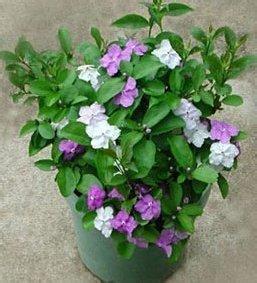
What are the cultivation methods for yesterday-today-and-tomorrow (Brunfelsia pauciflora)?
Yesterday-today-and-tomorrow, also known as morning-noon-and-night (Brunfelsia pauciflora), five-color jasmine, or Brunfelsia, belongs to the Solanaceae family and the genus Brunfelsia. It is an evergreen shrub with a height of 30-100 cm. It is native to tropical America. When the flowers open from bud to first bloom, the color is deep blue, but after two or three days, under the influence of light, temperature and various other factors
-
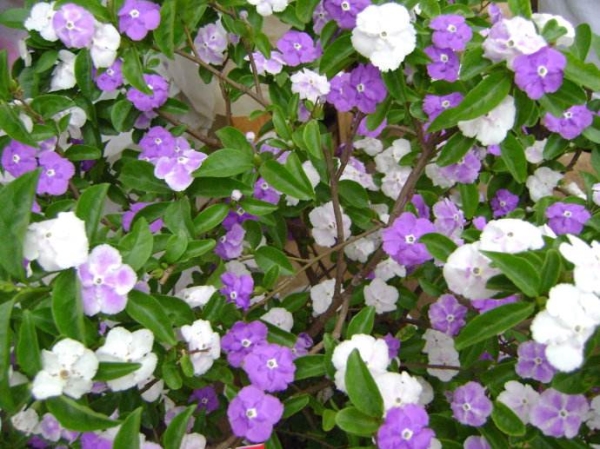
What are the reasons why yesterday-today-and-tomorrow (Brunfelsia pauciflora) does not bloom
Improper watering. If watered too much, it easily causes leggy leaf growth, and the branches and leaves absorb the nutrients, thus affecting flowering, so watering should follow the principle of "dry before wet". To keep the air moist, you can spray clean water on the leaves. Improper fertilizing. Choosing a fertilizer with too much nitrogen will cause vigorous branch and leaf growth
-
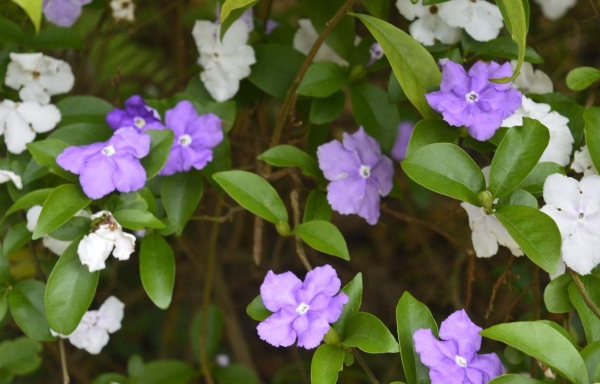
What are the care precautions for growing yesterday-today-and-tomorrow (Brunfelsia pauciflora)?
Yesterday-today-and-tomorrow loves a sunny environment, but it cannot be exposed to harsh direct sunlight, because excessive exposure easily causes the flowers and leaves to wither. It is best to ensure 4 hours of light each day. Also, to keep the air humid, you can spray plain water on the leaves. In winter, keep the potting soil dry, and in the rainy season reduce watering as well.
-
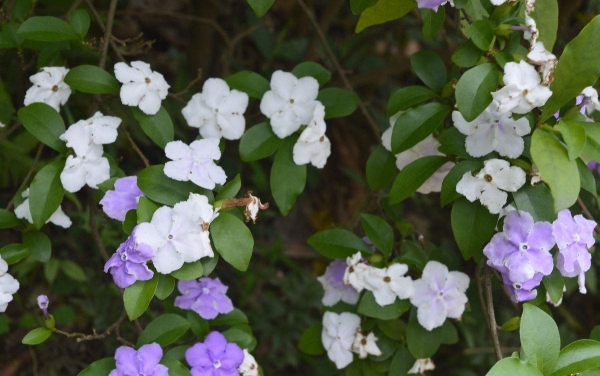
What are the care methods for yesterday-today-tomorrow (Brunfelsia pauciflora)?
Timely pruning: When you notice the yesterday-today-tomorrow plant growing too tall, you can promptly cut off the leaves and flower buds at the top. This not only encourages more side branches to grow, but also reduces poor development of flower buds on the branch tips. Fertilizing before flowering: Start fertilizing one month before flowering to provide nutrients, focusing on phosphorus and potassium fertilizers while reducing nitrogen fertilizer.
条件筛选