-

After confirmation of rights, farms can apply for mortgage loans
"Cowsheds can be mortgaged for loans too!" When Xu Ying, a large-scale dairy cow farmer, received a bank loan of 5 million yuan, her surprise was written all over her face. Xu Ying is the chairman of Hedasifang Dairy Cow Breeding Farmers' Professional Cooperative in Qiqihar City, Heilongjiang Province. In the past two years, Heilongjiang Province has innovated livestock
-
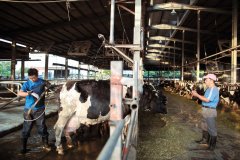
Dairy Cattle Farming Has a Promising Future: Reasons for Increased Milk Yield and Handling Milk from Sick Cows
Dairy cattle are great partners for dairy farmers to make money, and whether they live comfortably on the farm is tied to their health. Wu Jinlong, Secretary-General of the Dairy Farmers Association, said that sick cows affect dairy farmers' income, and once milk from a sick cow is mixed with other milk, the entire batch of raw milk is ruined
-
What to Do About Cattle Pregnancy? Key Points for Feeding and Management of Cows During Pregnancy
Cattle in pregnancy have relatively poor immunity and resistance, so during breeding you must pay attention to observing the cattle's mental state and learn some breeding techniques and disease prevention methods; only then will raising dairy cows in pregnancy avoid illness and economic losses
-
What to Do About Dairy Cow Infertility? Identifying the Key Contributing Factors Is Essential
What to do about infertility in dairy farming? What factors influence it? Dairy cow infertility refers collectively to a cow failing to conceive after 3 services postpartum and to a long period postpartum during which she cannot be bred. Infertility is not a disease caused by a single factor; it is influenced by a variety of different causes,
-
Symptoms and Prevention and Treatment Methods of Pregnancy Toxemia in Dairy Cows
Dairy cows are yellow cattle of the dairy breed, an excellent breed developed through highly intensive selective breeding. In China, dairy cows are mainly Holstein-Friesian cows. This breed was first introduced in 1980 by the cattle and sheep breeding base of the Shandong Provincial Animal Husbandry Bureau. This breed has strong adaptability, a wide distribution range, and high milk production
-
Key Technical Points for Feeding and Management of Dairy Cows During the Dry Period
In order to raise dairy cows well during the dry period, the dry period is generally divided into two stages for feeding: the early dry period and the late dry period. The entire stage from the start of drying off to 15 days before calving is called the early dry period, and the 2 weeks before calving to parturition is often called the late dry period (also known as
-
What are the key points for preventing mastitis in dairy cows?
Maintain environmental hygiene. 99.5% of dairy cow mastitis is caused by bacterial infection of 1 to 4 quarters, and these bacteria mostly enter through the teats. Therefore, attention should be paid to maintaining environmental hygiene. The cow bed should be designed reasonably, with enough bedding straw that is replaced in time; manure should be cleaned up promptly.
-
Key Points for Disease Management in Late Dry Period of Dairy Cows
The late dry period refers to the period from the end of the early dry period to before calving. It is also commonly called the pre-periparturient period, that is, the 2 weeks before calving. When cows approach calving in the pre-periparturient period, improper feeding and management can make them prone to various diseases. Therefore, at this stage
-
How to diagnose and treat selenium deficiency in dairy cows? Farmers need to master these methods
1 Symptoms The affected animals show depression, decreased appetite, emaciation, curled coat, standing apart from the herd in a daze, unsteady standing, tendency to lie down, movement disorders, muscle tremors, numbness of the limbs, arched lower back, and a sharp drop in milk production. In severe cases, appetite is completely lost, milk production stops,
-
What are the prevention methods for abomasal displacement in dairy cows?
Under normal circumstances, the abomasum of a dairy cow is located on the right side of the abdominal cavity, with the left side adjacent to the rumen. However, due to certain internal or external causes, the normal position of the abomasum changes abruptly, either lying below the rumen or shifting to the left side of the rumen, all of which can cause the dairy cow to lose its appetite entirely.
条件筛选