-
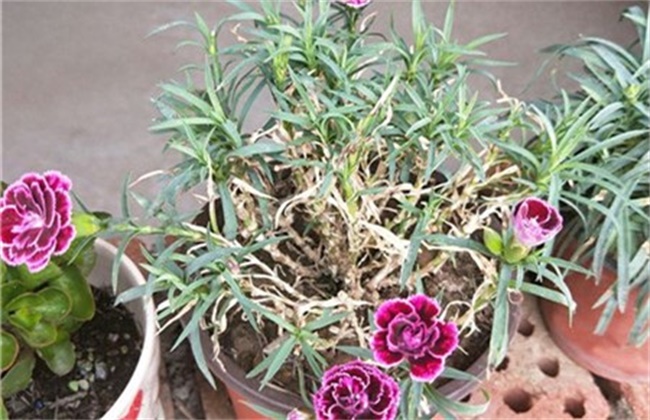
Reasons for Yellowing Leaves on Carnations and How to Fix Them
Carnation Yellow Leaves: Causes and Solutions
-

-

-

Key Techniques for Winter-Spring Cutting Propagation of Carnations
Carnation is an annual or perennial clump-forming herbaceous flower of the genus Dianthus in the family Caryophyllaceae. Its propagation can be carried out by sowing, cuttings, layering, tissue culture and other methods, but cutting propagation is generally the most commonly used, carried out in winter and spring. Generally speaking, carnation cuttings can be taken from December to April of the following year, with January to February being the most suitable; at this time the lateral buds used as cuttings grow vigorously and are of the best quality. At the same time, cuttings taken during this period can control the plants to bloom at New Year's Day and Spring Festival of the following year. The survival rate of cuttings taken in March is also
-
What are the methods for controlling Phytophthora disease in carnations?
Symptoms The stems and roots are affected. When infected at the seedling stage, it causes root rot and the plants die. After planting out, the main stem and branches become infected; the affected areas appear water-soaked and turn grayish-white when dry, and the stems and leaves above the affected area wither. The pathogen Phytophthora nicotianae Breda is called tobacco Phytophthora and belongs to the fungal subdivision Mastigomycotina. The sporangiophores emerge from the stomata and measure 10-744 microns long; the sporangia are borne singly, long elliptical or oval, measuring 28.8-67.5 x 12.5-30 mic
-
What are the two main diseases of carnations?
Carnations are most susceptible to leaf spot and stem wilt, and calyx rot. The fungal spores of leaf spot and stem wilt persist in carnation plants and in decayed, rotting plants, and spread through the air. When water remains on the plant surface for 8-10 consecutive hours, the pathogen can penetrate through the moisture. The symptoms of leaf spot and stem wilt are: grayish-brown leaves or spots with purple edges appearing on the petals. The spots are formed by clusters of black spores, and the stems begin to yellow and wither from the internodes, then develop into a wilt that encircles the stem completely. The pathogen of calyx rot persists in the old leaves, lower stems and branches, or decayed and rotting plants of carnations. High
-
How to prevent and control gray mold in carnations? These methods are very practical
Carnation gray mold, also known as carnation flower blight, is a common disease of carnations grown in greenhouses and plastic tunnels. The disease damages the petals of the plant, causing brown spots and rot on the petals, and seriously affects the quality of cut flowers. Symptoms: The disease mainly occurs on petals and flower buds, and occasionally stems and leaves are also affected. In the early stage of the disease, affected flowers begin to show light brown water-soaked areas from the petal edges, and then several petals become tangled together by gray fungal growth. In the later stage of the disease, if the environment is humid, the petals rot, and a gray
-
Symptoms and Control Methods of Gray Mold in Carnations
[Introduction] This disease is a common disease of carnations grown in greenhouses and plastic tunnels. It can cause brown spots on petals or cause petals to rot, seriously affecting the quality of cut flowers. [Symptoms] Gray mold in carnations mainly begins at the edges of petals, where light brown water-soaked spots appear, after which several petals become entangled together by the growth of gray fungus. If the environment is humid, the petals rot and bear gray mold. When flower buds are affected, there are irregular water-soaked spots, which become soft and rot, and gray mold also develops.
-
How much do you know about the basic facts of carnations?
Carnation, also known as Carnation (transliteration of the English word Caxnation) and musk carnation. It is a perennial herbaceous plant of the genus Dianthus in the family Caryophyllaceae, but it is usually cultivated as a biennial. The plant height is 60-100 cm, the stem is upright, the leaves are linear-lanceolate and opposite, the stems and leaves are elegant, and the flowers are beautiful with delicate colors. There are many flower colors, commonly including red, yellow, pink, white, purple, orange and various bicolor types. Because the flowers are beautiful and the colors are rich, their uses are extremely wide. The yield is high and the price is relatively cheap. The single-flower period is long, and it is cultivated in many countries around the world, along with roses, chrysanthemums, and gladioli
-
What to Do When Carnations Get a Viral Disease? Detailed Control Measures
A. Strict quarantine should be carried out when importing carnation seedlings to avoid the spread of virus-carrying plants. B. Large-scale production bases should use shoot-tip virus-free seedlings to establish virus-free mother plant gardens for cutting propagation. C. Remove infected plants as much as possible to reduce sources of infection. During cultivation and management, care should be taken to disinfect and clean tools used for taking cuttings, cutting flowers and pruning, to avoid contact transmission. D. Pay attention to controlling the transmission vector, aphids. Spray 50% menazon wettable powder at 1500 times dilution or 2.5% deltamethrin emulsifiable concentrate at 5000 times dilution to kill aphids. E. Heat treatment
条件筛选