-

How to propagate the money tree? A detailed introduction to common propagation methods
The money tree (Pachira aquatica) is mainly propagated by seed, and seeds are not easy to obtain at home. Its seed is like a large melon, and once it grows to a suitable size it is suitable for ornamental display. Growers completely cut off its roots and canopy, ship its trunk to florists, then place the trunk in a greenhouse to re-root it as a cutting, letting it grow new roots and send out new shoots, and then plant it in a pot.
-
How much does a money tree usually cost? A look at market prices
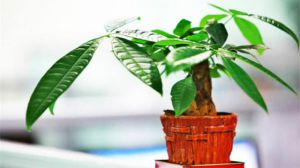
The price of a money tree varies depending on the variety and height. Generally, a small money tree costs around 18-40 yuan; while plants over 1.4 m tall cost more than 180 yuan. In addition, a braided money tree usually costs about 20 yuan more than a single-trunk money tree of the same height.
-
How much does a money tree usually cost? Market price overview
The price of a money tree varies depending on the variety and height. Generally, a small money tree costs around 18-40 yuan; while plants over 1.4 m tall cost more than 180 yuan. In addition, a braided money tree is usually about 20 yuan more expensive than a single-trunk money tree of the same height.
-
What is the difference between a money tree (Pachira aquatica) and a money plant (Zamioculcas zamiifolia)? A quick guide to telling them apart
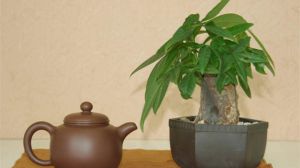
Different families and genera: the money tree belongs to the family Malvaceae, genus Pachira, while the money plant belongs to the family Araceae, genus Zamioculcas. Different places of origin: the former comes from Central America, while the latter comes from East Africa. Different habits: the former prefers relatively moist growing conditions, while the latter prefers relatively dry growing conditions. Different forms: the leaves of the former are not opposite, while the leaves of the latter are opposite.
-
How many varieties of money tree are there? Introduction to common money tree varieties
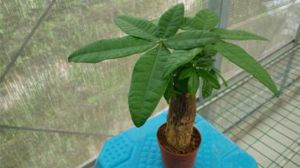
There are mainly three varieties of money tree, namely Taiwan money tree, large money tree and money beauty tree. Taiwan money tree is the money tree we most often refer to, native to Central America; the large money tree is native to Europe and has very attractive leaves; the money beauty tree, namely Schefflera (umbrella tree), is native to tropical regions and has excellent ornamental value.
-
How many varieties of money tree are there? Introduction to common money tree varieties
There are mainly three varieties of money tree, namely Taiwan money tree, large money tree and money beauty tree. The Taiwan money tree is the money tree we most commonly refer to, native to Central America; the large money tree is native to Europe and has very attractive leaves; the money beauty tree is the Schefflera (umbrella tree), native to tropical regions, with excellent ornamental value.
-

How to water a money tree? Master the correct watering method
Do not water a money tree on a fixed schedule; keep the potting soil slightly moist, never let it dry out completely, and do not let it sit in waterlogged conditions for long periods. In summer, when the potting soil evaporates less, extend the watering interval appropriately. The water used should be clean, and its temperature should be close to the air temperature. In summer, water in the morning or evening; in winter, water at noon.
-
How to water a money tree? Master the correct watering method
The frequency of watering a money tree should not be fixed; keep the potting soil slightly moist, neither letting it dry out completely nor letting it sit in waterlogged conditions for long periods. In summer, the evaporation from the potting soil decreases, so the watering interval should be extended appropriately. When watering, the water should be clean and its temperature should be close to the air temperature. In summer, water in the morning or evening; in winter, water at noon.
-
Causes and Solutions for Leaf Drop in the Peace Lily (Ping'an Tree)
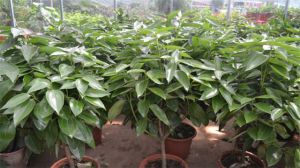
There are many reasons why a Ping'an tree drops its leaves: if it is caused by improper temperature, the temperature needs to be adjusted; if it is caused by insufficient light, the time of sun exposure needs to be increased; if it is caused by a lack of nutrients, nutrients need to be supplemented; if it is caused by pest infestation, the pests need to be treated.
-
Causes and Solutions for Leaf Drop in the Peace Lily Tree (Cinnamomum kotoense)
There are many reasons why a peace lily tree drops its leaves: if it is caused by improper temperature, the temperature needs to be adjusted; if it is caused by insufficient light, the time of sun exposure needs to be increased; if it is caused by insufficient nutrients, nutrients need to be supplemented; if it is caused by pests, the pests need to be treated.
条件筛选