-
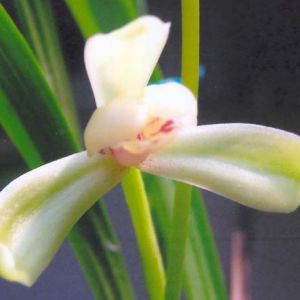
Narcissus King Jianlan Variety Introduction and Care Tips
A true narcissus-petal form, with large, elegant flowers, standing as one of the three pillars alongside He Wang (Lotus King) and Mei Huang (Plum Emperor) among the four-season petal-type flowers. It has been off the mountain for many years, yet the quantity remains small, and those able to introduce it are few. Among those who praise this variety, none surpasses Teacher Shuima: "Compared with Yipin Mei, this flower will make Yipin Mei 'automatically spring open' (Cantonese, meaning to shyly retreat)." When this flower reaches its utmost bloom, then...
-
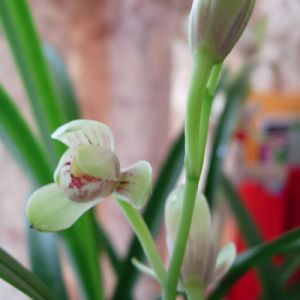
Four Seasons Color Lotus Cymbidium Variety Introduction and Care Tips
Variety name: Four Seasons Color Lotus. New variety, not yet named. Details: first collected from the wild three years ago, bloomed last year.
-
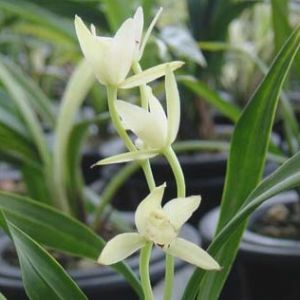
Introduction to the Small White Lotus Cymbidium Variety and Key Care Tips
Flower name: new variety, Small White Lotus (tentative name); origin: selected in Hong Kong, China. Details: dwarf variety, white flowers, upward-facing blooms, lotus-type, extremely cute.
-
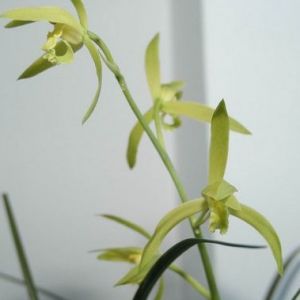
Cymbidium faberi 'Ruyi Su': Variety Characteristics and Care Tips
The three outer petals are narrow and long, shaped like bamboo leaves, with tightly rolled edges. The lip petals are pointed and long, with a green moss-green tongue; the flower has level shoulders, and the leaves stand at a slant.
-
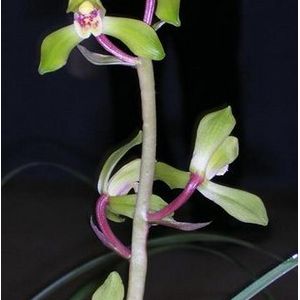
Variety Characteristics and Care Tips for the Famous Cymbidium faberi Orchid 'Ding Xiaohe'
Petal type: Red-to-green shell type lotus-form narcissus petal. History: Selected by someone surnamed Ding during the Xianfeng period of the Qing Dynasty. Characteristics: The three petals are halberd-shaped (petal tips pointed, edges tight, roots finely tapered), with small lotus-style scissor-shaped inner petals, green color tinged with yellow, level shoulders, trailing tongue, and an upright flower form; it is an outstanding famous variety among the floating-gate narcissus-type orchids.
-
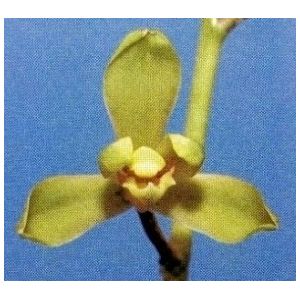
Characteristics and Care Tips of the Yongchun Meihui Orchid Variety
Plum-petal type, a traditional famous variety. History: produced around 1887 AD on Sandstone Mountain in Fuyang, Zhejiang. Characteristics: leaf habit semi-pendulous, with graceful curves; leaf substance thick, leaf surface glossy; leaf width medium; leaf groove a shallow V shape. New shoots green, leaf shape broad and ring-like, leaf substance thick, sheaths turning green layer by layer, spathe shell clean green, glutinous and thick, green flower scape...
-
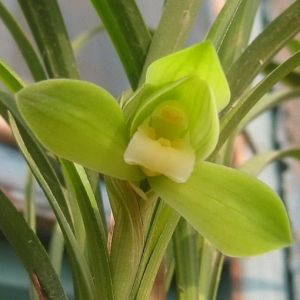
Cangyan Suchun Orchid Variety Introduction and Care Tips
: Plain petals: Selected and bred by the Qian family of Changle Town, Sheng County before the Guangxu reign of the Qing Dynasty. When the Qian family's daughter married, this flower was given as part of her dowry to the Yu family of Ganlin. When the Yu family's daughter married, the flower was given as part of her dowry to Yu Jicheng's family of Cangyan, and it was passed down through generations. People of Sheng County pronounce "Cang" as "Wu". In the 1980s, Wu Shufu of Shaoxing entered it in the national orchid exhibition as "Fuhe Su", hence it is also known as Fuhe Su....
-
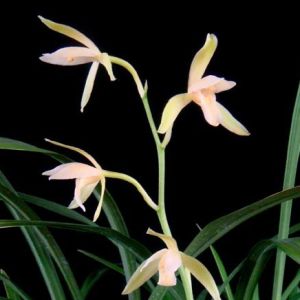
-
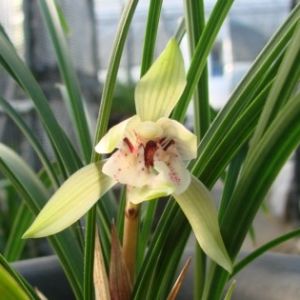
Chunfei Cymbidium Variety Introduction and Care Tips
Originating from Taiwan, China. Leaves are dark green, upright. The flower is a rare three-lipped form, with the three lips arranged in a triangular pattern, white with red spots.
-
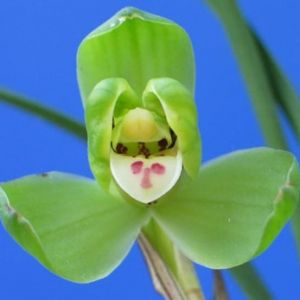
Guiyuan Mei Cymbidium goeringii Variety Introduction and Care Tips
Also known as Saijinxuan, selected by Zhu Xiangbao of Shaoxing in the early years of the Republic of China. It gets its name from its shape, which is round and upright like a longan. The leaves are deep green; the basal leaves are broad with shallow longitudinal veins, the middle leaves are narrow with V-shaped leaf grooves, the leaf margins have medium serrations, and the leaf texture is thick, hard and elastic. The leaf tips taper sharply, forming a dew-catching shape, the leaf base narrows inconspicuously, the leaf posture is a mix of semi-pendent and semi-upright, and the basal leaves have a fish-belly shape...
条件筛选