-

Growing roses to extract essential oil, forging a path to prosperity amid green mountains and clear waters
Growing roses and extracting essential oil has opened up a path to prosperity amid green mountains and clear waters
-
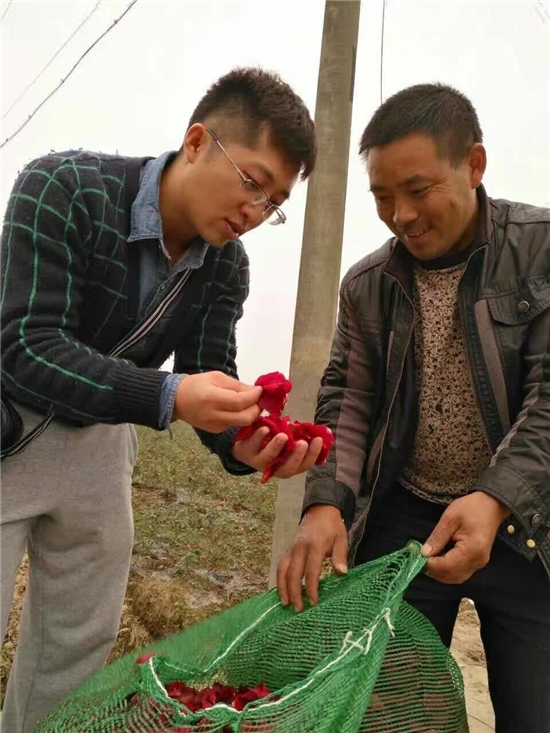
A college graduate returns home to start a business growing roses, blossoming into a "flower of prosperity"
A college graduate returns home to start a business growing roses, blossoming into a "flower of prosperity"
-

How to grow potted roses? Learn six key techniques
In daily life, many friends grow flowers at home because they love them, such as potted roses. But how do you grow potted roses? Let us take a look at the cultivation methods for potted roses. Soil: when growing roses in pots, the soil does not need to be too strict; generally, loose soil that is fairly rich in nutrients
-

How do you grow roses so they bloom abundantly with lush foliage? An introduction to common rose colors
Roses are a symbol of love. Every Valentine's Day, these flowers sell especially fast, and many people grow roses in large quantities, so that at a glance along the streets and alleys almost all you see are roses. So what is the secret to growing roses? Let's find out.
-

How Many Days Can Cut Roses Last in Water? Detailed Guide to Water Cultivation
Roses are the most common flower in love, usually given by men to women, and these roses are generally fresh cut flowers. Let's see how to keep roses in water and how many days they can last: How to keep roses in water: 1. Break off a small piece of vitamin C, crush it, and put it in the water, or add a little white sugar to the water.
-

How to propagate Chinese roses by cuttings? Learn to tell the difference between Chinese roses and roses
Chinese roses and roses are both very popular, and many people in daily life cannot tell them apart. How to propagate Chinese roses by cuttings? And the difference from roses? How to propagate Chinese roses by cuttings: 1. Selecting branches. At the end of autumn when winter is approaching, when pruning Chinese roses, take healthy and thick branches, and they must not be new branches of the current year
-
Detailed Explanation of Key Fertilization Techniques for Lilies and Roses
Ms. Xi from Quanjiao, Anhui, asks: I grow lilies for their bulbs. How should I fertilize them to achieve high quality and high yield? Expert: Lilies are perennial plants and should be given heavy applications of organic fertilizer. The seedling stage is relatively long, so organic fertilizer should be the mainstay, reasonably combined with nitrogen, phosphorus and potassium chemical fertilizers. First, choose a sandy loam soil with deep soil layers and good drainage. Before planting, in conjunction with deep plowing and soil preparation, apply 2000-3000 kg of decomposed organic fertilizer, 10 kg of urea, 20-30 kg of superphosphate, and 10-15 kg of potash fertilizer per mu. Topdressing is divided into three applications, applied in conjunction with shallow plowing and weeding
-
How to prevent and control bacterial leaf spot in primroses
Symptoms On the common primrose (Primula malacoides), leaves and flower receptacles are affected. Initially, water-soaked irregular lesions form along the leaf veins, which later turn yellow, then the lesions turn brown, enlarge, and marginal blight symptoms occur. In severe cases, the lower leaves die. On the polyanthus primrose, dark water-soaked spots initially form on the leaves, which later turn light brown with a distinct yellow halo around them. Pathogen: Pseudomonas syringae pv. primulae (Arke et Gardner) Young, Dye et Wilkie
-
A Detailed Guide to the Prevention and Control of Brown Spot Disease in Primroses
Symptoms are prone to occur on the fairy primrose (Primula malacoides). Brown spots form on the leaves. The pathogen Alternaria sp. belongs to the deuteromycete Alternaria fungi. Transmission route: conidia are spread by wind and rain. Prevention and control method: spray 70% chlorothalonil wettable powder at 1000 times dilution or other fungicides at the early stage of the disease.
-
How to identify and control black spot on roses
This disease occurs commonly and causes severe damage, leading to massive leaf drop in roses and huge losses. The pathogen is a fungus of the genus Actinonema in the subphylum Deuteromycotina. 1. Symptom identification: In the early stage of the disease, brown radial spots appear on the leaf surface, which then gradually expand into circular or nearly circular spots with a diameter of 4-12 mm; in severe cases, the lower leaves drop early, and the disease gradually spreads upward until the upper leaves also fall off completely. Rainy and humid conditions are the main requirements for spore production; when there are water droplets on the leaf surface and the temperature is suitable, infection can occur in 6-10 hours, and symptoms appear in 3-6 days
条件筛选