-

Three-Row Narrow-Furrow Dense Planting Supporting Cultivation Technology for Soybean on Ridges
The three-row narrow-furrow dense planting supporting technology for soybean on ridges is a new soybean cultivation model independently developed by agricultural science and technology personnel in the reclamation area, and it passed the scientific research achievement appraisal of the Inner Mongolia Science and Technology Department in December 2005. On the whole, this technology has reached the advanced level of soybean cultivation technology in similar areas in China, and in terms of mechanized rational dense planting...
-
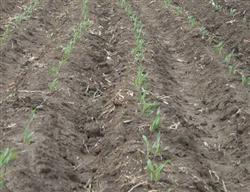
Key Technical Points for High-Ridge, Sparse-Planting, High-Yield Cultivation of Spring Corn
Many excellent spring corn varieties now require high ridges and sparse planting, but farmers generally adopt low ridges and dense planting, so the superior traits of corn cannot be fully expressed, seriously affecting farmers' income growth. This is especially true for excellent varieties such as Dongdan 60, Sanbei No. 6, Dongdan 13, and Zunyan No. 1, whose planting density per mu must not exceed 3000 plants, while...
-

A Detailed Guide to the Cultivation Methods and Key Techniques of the Eight-Ridged Gourd
Cultivation Methods of the Eight-Ridged Gourd
-
Key Points of High-Ridge Double-Row Potato Cultivation Technology
High-ridge double-row potato cultivation refers to a planting method using wide and narrow rows, where soil from the wide rows is hilled onto the narrow rows, forming raised beds that stand more than 25cm above the ground. Trials have confirmed that potatoes grown on ridges and beds have the advantages of earlier emergence, a higher proportion of large and medium tubers, and higher yields; ridge-bed cultivation increases yield by 19.1% compared with flat-bed cultivation. The specific cultivation techniques are as follows: 1. Fine seedbed preparation. Potato is a shallow-rooted crop. After the tubers are planted and before emergence, the better the root system develops in the soil, the stronger the plant growth after the seedlings emerge.
-
Full-film double-ridge furrow sowing cultivation technique for potato, suitable for arid regions
The full-film double-ridge furrow sowing cultivation technique for potato is a drought-resistant planting technique suitable for the arid and semi-arid regions of northern China, achieved by forming large and small ridges according to belt width and implementing full-ground coverage, integrating moisture conservation, rainwater harvesting, warming and yield increase. Its main advantages are: (1) By fully covering the large and small ridges with plastic film, all rainfall during the potato growing period is fully collected; in particular, the tiny rainfall of about 5 mm in spring is gathered through the film surface into the rainwater harvesting furrows, effectively solving the problem of sowing being seriously affected by spring drought in dryland farming areas, thereby ensuring normal emergence of potatoes;
-
Detailed Explanation of Key Points of Potato Wide-Ridge Cultivation Technology
The potato wide-ridge cultivation technology uses 180 kg/hectare of virus-free seed potatoes, adopts 80-90 cm wide-ridge cultivation, 30 cm deep loosening, changes single-layer tuber formation to multi-layer dispersed tuber formation, mixed application of farmyard manure and chemical fertilizer, chemical control of pests and diseases, and a comprehensive cultivation method combining chemical weeding with manual weeding. 1. Seed treatment: select virus-free seed potatoes Kexin 13 or Kexin 18. 30-40 days before sowing, take the seed potatoes out of the cellar and store them in a place above 10°C to break dormancy and promote sprouting. At the same time, remove diseased and rotten potatoes. 5-7 days before sowing,
-
What are the technical advantages of dense planting cultivation of potatoes in wide ridges?
China has a history of more than 400 years of potato cultivation, but what continues to this day is still the 65cm narrow-ridge potato planting method, with an average yield of 26,000 kg/hm. This planting method results in shallow hilling, insufficient soil storage capacity, tubers that are easily exposed, and an increase in deformed tubers. At the same time, because the ridge spacing is small and the plants are large, the spaces between ridges become congested, which is unfavorable for ventilation, makes humidity too high, and forms a field microclimate, making it extremely easy for the devastating disease -- potato late blight -- to occur and spread, producing large numbers of diseased tubers and even causing total crop failure.
-
New Technique for Whole-Seed Potato Cultivation with Plastic Mulch and Double Rows on High Ridges
1. Reasonable crop rotation and stubble reversal To economically and effectively utilize soil fertility and prevent soil-borne diseases, pests, and weeds, avoid continuous potato cropping or planting potatoes on the stubble of other root and tuber crops. Also, do not rotate with other Solanaceous crops such as eggplant and tomato, otherwise yields will be reduced by 15%-20%. Potatoes can be rotated with cereal crops and legume crops for more than 3 years. 2. Land preparation and ridge formation Potatoes are suitable for planting in deep, loose soil, with deep plowing and fine land preparation. After harvesting the previous crop, promptly clear the stubble, plow deeply about 25 cm
-
Detailed Explanation of the Double-Ridge High-Mound High-Yield Cultivation Technique for Potatoes
Potatoes grown with the double-ridge high-mound cultivation method are deeply favored by the vast number of farmers because they are free of disease, show a large yield increase, have good tuber shape, and a high marketable rate. As a result, double-ridge high-mound cultivation has become a technical measure commonly adopted by farmers in Xuanwei. The characteristics of the "double-ridge high-mound" potato cultivation method are the optimized integration of good varieties, good methods, and a good growing environment; the goal is to increase potato yield and the marketable rate and raise farmers' incomes; the core of the technique is the "six changes," namely: first, change from using multiple, inferior, and mixed varieties to applying leading improved varieties; second, change from intercropping corn with potatoes to growing potatoes alone;
-
Key Techniques for Ridge Cultivation of Potatoes with Plastic Mulching
After the seed potatoes are planted, flatten the ridge surface with a flat shovel, which helps with weed control and film covering. For 667 sq m, use 80 ml of the herbicide Dual mixed with 40 kg of water and spray it on the ridge surface. The herbicide should not be sprayed all at once; leave a small portion and spray it in the furrows after the film is covered. To prevent weeds, 667 sq m requires 4 kg of 90 cm wide micro-film. When covering the film, be sure to seal the two sides and the ends of the ridge tightly with wet soil, and seal another horizontal line with wet soil on the ridge surface every 6-7 m to prevent strong winds from lifting the plastic film and affecting the heat preservation effect. After the seed potatoes emerge
条件筛选