-

How to Distinguish Orchids from Hui Orchids? A Detailed Explanation of Traditional Identification Methods
Traditionally, people call the flower spikes that orchids send up (or "push out") "lan" when a single stem bears a single flower, and "hui" when a single stem bears multiple flowers. That is why Chinese orchids are also known as "lan-hui." Huang Tingjian of the Song Dynasty wrote in "Record of the Secluded Fragrance Pavilion": "A single stalk with one flower and lingering fragrance is lan; a single stalk with five to seven flowers and insufficient fragrance is hui,"...
-
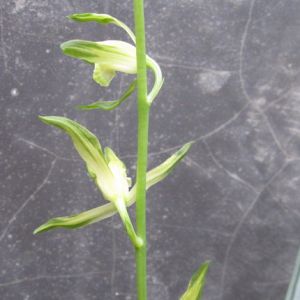
Characteristics and Care Methods of the Blue-and-White Porcelain Cymbidium sinense Variety
Cymbidium sinense 'Blue-and-White Porcelain'
-
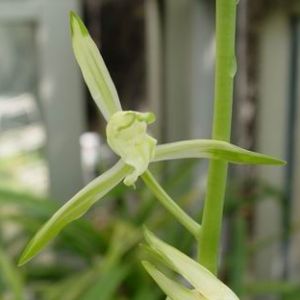
Introduction to the Characteristics and Care Methods of the Zhongban Baimo Cymbidium sinense Variety
Zhongban Baimo Cymbidium sinense
-
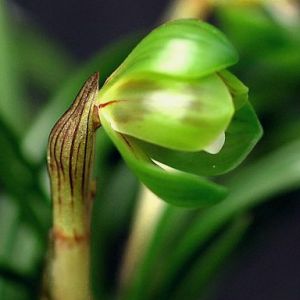
Cultivation Methods and Daily Care Tips for Cold-Growing Orchids
It is said that in January 2005, a handsome guy named Wang Baiqing from Xinchang dug up this plant on Jintang, the sacred island of orchid production, and named it Wanqing. Baiqing working on Wanqing - anyway, he got involved with "qing." It rebloomed in 2007, with the three outer petals having constricted bases and flared angles, mussel-shell-shaped petals, a large round lip, and a compact round center. The key points are that the flower scape rises well above the leaves, and the flower does not lose its shape even after blooming for a long time, truly...
-
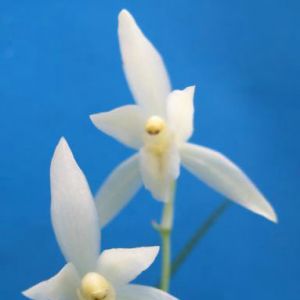
Introduction to the Characteristics and Care Methods of the Lijiang Snow Jianlan Variety
Among the colored and white flowers of Jianlan, there has been since ancient times the "Yuzhen" su, said to have flowers so white they are transparent, disappearing when placed in water; I have never seen it and believe it to be a legend. Lijiang Snow is pitifully white, exquisite and translucent, almost transparent; I trust my eyes. Among the white flower lines of Sijilan, none has yet surpassed the whiteness of Lijiang Snow. Lijiang Snow petals...
-
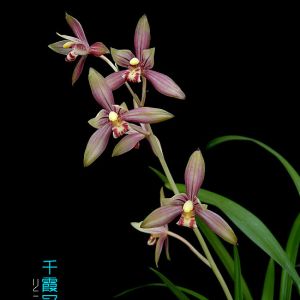
Introduction to the Characteristics and Care Methods of the Jianlan 'Qianxia Guan' Variety
This is a colored-flower variety produced in Taiwan, China. I introduced it in the spring of this year. After more than half a year of growing it, my impression is: this variety is easy to grow, readily sends up new shoots and readily blooms. A pot of 5-6 plants can produce three rounds of flowers in summer, and the round in early August has the most flowers. The flowers are large and stand above the leaves; even the first flower can rise above the leaves. The flowers are large, 5-6 cm; the sprouting rate is high, with two rounds of shoots a year.
-
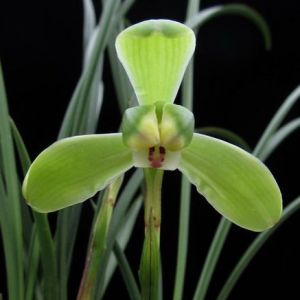
Cultivation methods and precautions for Anmei Chunlan
1) After three years of observation, the saying that An is difficult to grow does not seem to be entirely unfounded, but it is not as frightening as imagined: this grass has slightly weaker disease resistance than ordinary famous Chunlan varieties, and is also more sensitive to fungicides than other Chunlan (applying conventional fungicides at normal doses will not cause An to show obvious disease spots, but its growth rate and recovery speed will slow down noticeably)...
-
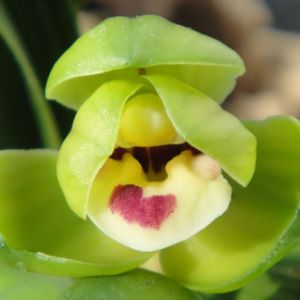
Characteristics and Care Methods of the Chunlan 'Biyu Yuanhe' Variety
The flowers are jade-like in color, and the leaves are short with a moist, glossy texture. It is an artificially hybridized variety, propagated through tissue culture, and is now quite numerous.
-
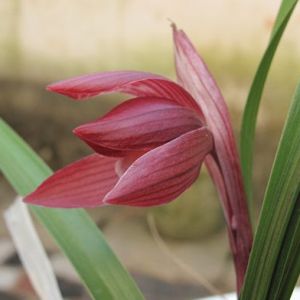
Introduction to the Characteristics and Care Methods of the Zui Hong Cymbidium goeringii Variety
This flower was collected in the wild in Mile County, Yunnan Province in 2003. Because its flower color is cherry red, it was named Zui Hong (Drunken Red). This flower is a natural hybrid of Cymbidium goeringii and Cymbidium faberi 'Douban'. The petals are fleshy, and the lip is peach pink. The whole flower is brightly colored, with a tall scape. The bloom is generous and the fragrance is rich. It is a rare treasure among Cymbidium goeringii.
-
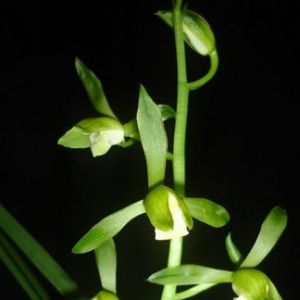
Introduction to the Characteristics and Care Methods of the Wu Zicui Cymbidium sinense Variety
Cymbidium sinense, pure-hearted type, a traditional famous variety. Discovered in Taiwan, China around 1926, introduced to the mainland in 2006. Cymbidium sinense, also known as the New Year orchid, Baosui orchid, and Fengsui orchid. Cymbidium sinense has broad leaves, generally 2-4.2 cm wide and about 25-80 cm long. 2-5 leaves grow on the pseudobulb. The pseudobulb is relatively large, with a diameter of 1.5-2.5 cm...
条件筛选