-
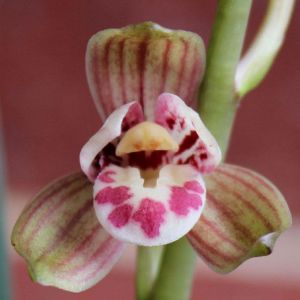
Introduction and Appreciation Highlights of the Cymbidium ensifolium 'Hongheguan' Variety
One of the new standard lotus-petal varieties of Cymbidium ensifolium, discovered in 2004 in Rong County, Guangxi. The plant has a graceful form, with upright, broad, thick, and glutinous-textured leaves. The flower has good overall structure, clam-shell-shaped petals (holding petals), a large round lip that does not curl back, and vivid flower color. The three outer petals have constricted bases and broad angles, with thick, fleshy petals. The whole flower carries an air of kingly majesty, its fragrance is far-reaching, and its flowering period is long...
-
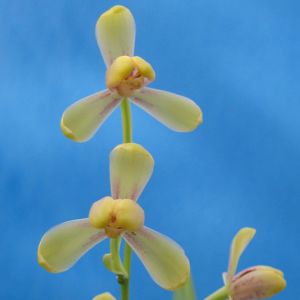
Introduction to the Characteristics and Care Methods of the Cymbidium 'Huang Yipin' Variety
Huang Yipin: a Cymbidium ensifolium (Fujian cymbidium) cultivar, plum-petal type, a famous variety. History: Huang Yipin was originally named "Pan'an Mei" and originated in Sichuan. Characteristics: the foliage is short and sturdy, the bloom form is stable, and the flowers rise above the foliage. The flower shape and style are elegant, with little change from first opening to fading; the flower color is green with a yellow tinge, the flowers are about 3 cm large, bearing 5-8 flowers per scape, with good flower retention and a delicate fragrance. It belongs to the green-stem...
-
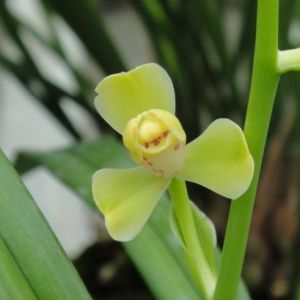
Introduction and Appreciation of the Cymbidium ensifolium Variety 'Lü Guang Deng'
'Lü Guang Deng' (Mei), also known as 'Shu Mei', is a Cymbidium ensifolium plum-petal variety. Each plant has 3-4 leaves; the leaves begin to spread from the top of the pseudobulb, giving a loose plant shape; the leaf posture is semi-arching; the leaves are 23.4-38 cm long and 1.1-1.3 cm wide, and the leaf color is emerald green. The flower is a true-form yellow plum petal, with a well-proportioned center, the three outer petals narrowing at the base and flaring at the corners, thick and velvety petals, and the flower...
-
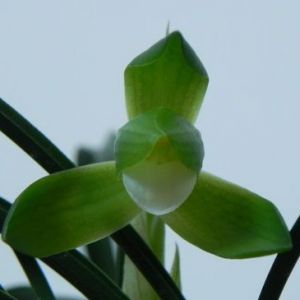
Introduction and Characteristics of the Chunlan 'Zhuiyue Su' Variety
Chunlan 'Zhuiyue Su' (Chasing the Moon Plain). This flower was selected and named by chance, and the total quantity is currently very small. It has a perfect central structure, with a tongue as pure white as the moon that does not curl even after prolonged blooming, and the three outer petals arch and embrace inward. Its flower form holds exceptionally well. It is another classic fine plain-flower variety discovered locally in Xinchang. Its leaf shape resembles that of 'Zhizu Sumei', with an arching, drooping form, and when fully open the flower rises above the leaves.
-
Introduction to the Variety Characteristics and Care Methods of Rainbow Jianlan
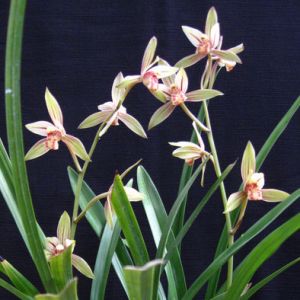
Rainbow is an evolved variety of Xiaotaohong. Rainbow is an old variety of four-season orchid with both leaf and flower art, and it is a practice plant worth growing for beginners: 1. Cheap, everyone can afford it. 2. Easy to grow and bloom, tolerant of rough management. 3. Leaf art evolves, often bringing surprises.
-
Introduction and Characteristics of the Cymbidium faberi 'Buxianxian' Variety
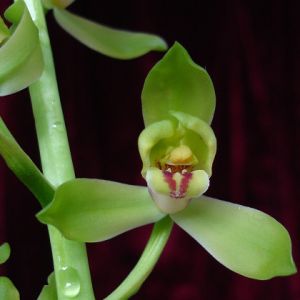
This variety is a high-grade new narcissus-type Cymbidium faberi, a rare fine narcissus type among Cymbidium faberi. 'Buxianxian' is a green Cymbidium faberi with narcissus-type petals collected from Hubei. Its leaves are semi-arching and drooping, relatively thin in texture, forming a V shape and prone to folding in half. Breeder: Mr. Wu Jianeng of Yixing, Jiangsu.
-
An introduction to the variety characteristics of the Wang Xiaoshang Chunlan (Cymbidium goeringii)
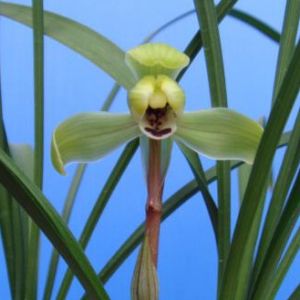
Wang Xiaoshang is an old variety of the Narcissus-type (Shuixian) group. It is recorded in Shen Yuanru's book "Orchids", and in Wang Shuping's book "Fifty Years of Orchid Growing Experience" it is rated as a first-class Narcissus-type variety without any flaws. It is a top-grade Narcissus-type variety: the scape is tall, the flower is large, and its structure is excellent. The large red patch on the lip is very eye-catching, and its charm is excellent. The leaf tips are blunt, and the two lateral petals curve forward and embrace like soup spoons.
-
Introduction to the Xiaoyuanbao Cymbidium goeringii Variety and Key Appreciation Points
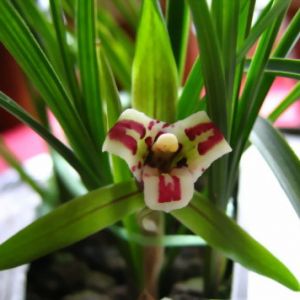
The leaves are slanted and upright; in robust plants the leaves carry a crystalline, translucent quality, and the plant shows slight butterfly-like variegation. The leaves are noticeably shortened, only about 20 cm long and 0.8-0.9 cm wide. Weak plants lack the crystalline, translucent quality, with leaves about 28 cm long and a lusterless leaf color. The flower scape is 10-12 cm tall; the petal-like segments (peng ban) have become butterfly-like (die hua), forming three tongues, with symmetrically arranged red markings, vivid colors, and a pure, mellow fragrance. Xiaoyuan...
-
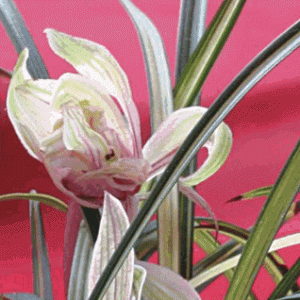
An Introduction to the Characteristics of the Dahua Lotus-Petal Variety
A famous Yunnan lotus-petal orchid; this flower combines leaf variegation and unusual flower forms in one, with chrysanthemum-like petals and a central translucent stripe. Its leaf variegation shows edges, stripes, threads, and central translucent striping; the leaves curve and droop, with twisted leaf tips, 5-8 per plant. The leaf buds emerge red, and when they grow to 2 cun the linear variegation becomes fairly obvious. One scape bears 1-2 flowers, with as many as 10-plus petals, willow-leaf shaped...
-

A Detailed Introduction to Appreciating Orchid Leaf Variegation
White or yellow stripes and speckled patterns on orchid leaves are called "leaf variegation" in Hong Kong, China and Taiwan, China, and since the 1980s they have drawn attention in orchid circles. Flowers can only be enjoyed for half a month, while leaf variegation can be enjoyed all year round. 1. Claw: white or yellow on the edge of the leaf tip is called a "claw." Claws are divided into deep claws and shallow claws. 2. Rim: the entire...
条件筛选