-

Control Methods for Red Spider Mite Infestation in Perilla
Perilla, alternate names: Guiren, white perilla, red perilla, etc.; it is an annual herbaceous plant of the Lamiaceae family. It has a distinctive aroma. The leaves are mostly wrinkled and curled; when flattened, complete leaves are ovate, 4 to 11 cm long and 2.5 to 9 cm wide, with a long-tapered or acute apex, a rounded or broadly cuneate base, and serrate margins. Both surfaces are purple, or the upper surface is green, and the lower surface has numerous sunken glandular scales. The petiole is 2 to 5 cm long, purple or purple-green, and brittle. The young branches are purple-green, with pith in the center of the cross-section, a fresh fragrance, and a slightly pungent taste. Perilla leaf can disperse exterior cold and has a relatively strong diaphoretic effect. It is used for wind-cold exterior patterns with symptoms such as aversion to cold, fever, and absence of sweating, and is often used together with ginger; if the exterior pattern is accompanied by qi stagnation, it can also be used together with Cyperus rotundus and dried tangerine peel. In moving qi and relieving middle fullness, perilla leaf is used for spleen-stomach qi stagnation, chest oppression, and nausea. It is native to China and is mainly distributed in countries such as India, Myanmar, Japan, Korea, South Korea, Indonesia, and Russia. In China, wild and cultivated varieties are found in North China, Central China, South China, Southwest China, and Taiwan, China.</p><p></p><p>Perilla is highly adaptable and not strict about soil requirements. It grows well in well-drained sandy loam, loam, and clay loam, and when cultivated in fertile soil in front of and behind houses and along ditches and field edges. The previous crop is best as vegetables. It can also be planted under young fruit tree groves. Perilla is commonly used as a traditional Chinese medicine in China, while Japanese people mostly use it in cooking, especially as an indispensable accompaniment when eating sashimi. In a few areas of China, it is also used as a vegetable or made into tea. Perilla leaf is also called Su Ye, and has the functions of releasing the exterior and dispersing cold, moving qi, and harmonizing the stomach. It mainly treats wind-cold common cold, cough, chest and abdominal distention and fullness, nausea and vomiting, and other conditions. The seed is also called Su Zi, and has the functions of relieving cough, calming wheezing, and eliminating phlegm. The whole perilla plant can be distilled into perilla oil, and the oil obtained from the seeds is also called perilla seed oil. Long-term consumption of perilla seed oil has a clear therapeutic effect on coronary heart disease and high blood lipids.</p><p>Control of the pest red spider mite in perilla</p><p>Symptoms of red spider mite damage in perilla: red spider mites harm perilla leaves. It occurs most severely from June to August when the weather is dry, with high temperature and low humidity. Adult red spider mites are tiny, generally red, and sometimes yellow. Red spider mites gather on the back of leaves and pierce and suck the sap. At first, yellow-white small spots appear at the damaged areas, and later larger yellow-brown scorched spots can be seen on the leaf surface. After expansion, the entire leaf turns yellow and loses greenness, and leaf drop is commonly seen.</p><p>Control methods for red spider mite in perilla:</p><p>1. At harvest time, collect fallen leaves in the field and burn them in a concentrated manner; in early spring, clear weeds on field ridges, along ditches, and beside roads.</p><p>2. During the occurrence period, spray early with 40% dimethoate emulsion at 2000 times dilution. However, spraying must be stopped half a month before harvest to ensure that no residual toxin remains on the medicinal material.</p><p>(3) Silver-striped noctuid: from July to September, the larvae harm perilla, and the leaves are bitten into holes or notches. The mature larvae make thin silk cocoons on the plant and pupate. Control method: spray with 90% crystalline trichlorfon at 1000 times dilution.</p>
-
How to Grow Guiren Fruit? A Detailed Guide to Cultivation Methods
Summary Choosing a flower pot: Choose wooden barrels, wooden boxes or clay pots with good permeability. Making your own substrate: You can choose river sand, garden soil, fine sandy soil, compost soil, humus, plant ash, etc., and mix them in a certain ratio. Potting and planting: Place broken tile pieces at the bottom of the pot, sprinkle in an appropriate amount
-
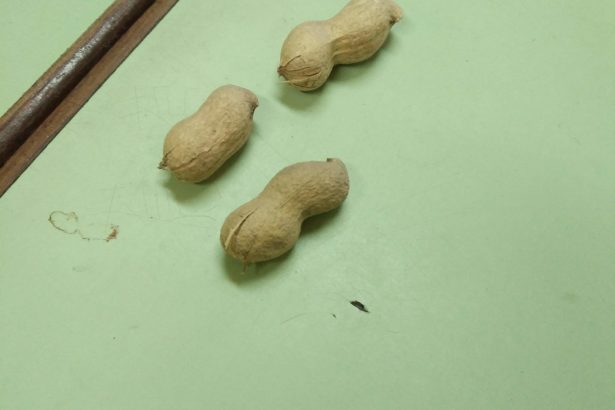
Tainan No. 9 peanuts reappear in Guiren, passing on the old taste of the locals
Old taste, new legacy - rediscovering the "Tainan No. 9" peanuts that evoke memories for the people of Guiren
条件筛选