-
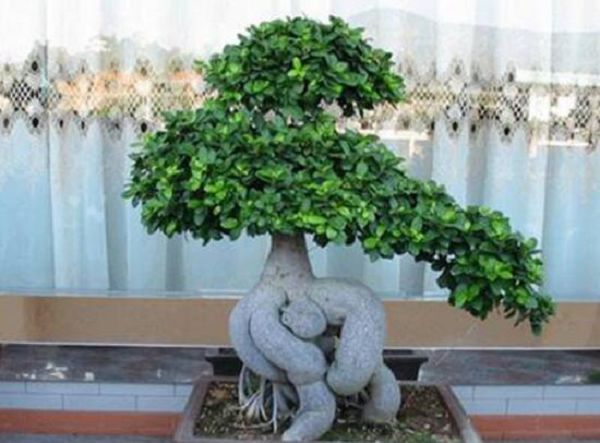
How to Care for a Bonsai Ficus in Winter and Points to Note
How to Grow a Bonsai Ficus in Winter, Winter Precautions for Bonsai Ficus
-

What are the main pests and diseases of bonsai ficus trees?
1. Sooty mold. Sooty mold mostly occurs under high temperature and high humidity conditions, accompanied by aphids and scale insects. Control measures are: (1) create conditions of ventilation and light penetration for the plant; (2) reduce air humidity; (3) scrub the diseased spots with a brush dipped in water; (4) promptly eliminate aphids and scale insects; (5) spray for protection. From June to August, spray once every 10 to 14 days with 120-160 times equal-amount Bordeaux mixture, or 70% thiophanate-methyl 700-800 times solution, or 50% carbendazim wettable powder 500-80
-
Causes of Leaf Drop in Bonsai Ficus in Northern Cultivation and Preventive Measures
Ficus (Ficus microcarpa L.) is an evergreen ornamental plant of the Moraceae family, generally grown as bonsai in the north. Its leaves are bright green, its branches and trunk are vigorous and rugged, and its forms are endlessly varied; the coiled and twisting aerial roots in particular give a sense of antiquity, desolation and richness. It is an excellent bonsai plant. However, bonsai ficus grown in the north always drops its leaves, seriously affecting its ornamental effect. The author has investigated this for many years, analyzed the causes, and summarized preventive methods. 1 Causes of leaf drop Leaf drop of bonsai ficus in the north can be divided into two
-
Cultivation Methods and Care Techniques for Bonsai Ficus
Ficus is one of the flagship bonsai of Lingnan bonsai, and has always been favored by bonsai enthusiasts. The author has devoted years to the study of ficus bonsai, and now describes its cultivation methods, and welcomes correction from fellow enthusiasts. 1. Selection of materials. There are three sources of ficus bonsai material: wild stumps, cuttings, and seedlings. This article mainly discusses the cultivation of wild stumps. The collection time for wild stumps is between February and October each year, among which April to July is most suitable. During this period the climate is mild and the air is humid, the stumps take root and sprout quickly, and the survival rate is high. Collecting wild stumps
-
What to Do When a Ficus Bonsai Drops Its Leaves? A Detailed Guide to Prevention and Treatment
When a newly purchased healthy ficus drops its leaves, it is mostly due to insufficient nutrition and a hidden decline in tree vigor, triggered by sudden changes in its habitat (such as temperature, humidity, light, etc.). If a long-cultivated potted plant drops its leaves, factors such as soil nutrient deficiency, alkalization, or pests and diseases should also be considered. For this situation, we can summarize the prevention and treatment measures as follows: 1. When purchasing, choose a healthy, long-potted plant with spreading leaves, deep green and glossy, and free of pests and diseases on the whole plant, and the growing medium should be loose, fertile, and airy. 2. Place it in a relatively bright indoor spot, with the temperature between 10°C and 30°C and with little fluctuation
-
Soilless Cultivation Methods and Techniques for Miniature Ficus Bonsai
Ficus is native to China, India and other places, and is commonly cultivated in Guangdong, Fujian and other areas of China. Ficus is very easy to propagate by cuttings. During the growing season, in combination with shaping, cut off a portion of a branch, disinfect it with plant ash, and after the sap has drained, insert the cutting into sand; after one and a half months it will survive and take root. Once the root system grows normally, it can be potted for cultivation and care. After potting, with careful management, after one year of growth the tree shape will be full with luxuriant branches and leaves. In the spring of the second year, soilless cultivation can be carried out to cultivate a miniature bonsai. First, the soil
-

-

条件筛选