-

How to Grow Eupatorium for High Yield? A Full Analysis of High-Yield Cultivation Techniques
High-Yield Cultivation Techniques for Eupatorium
-

Detailed Explanation of Key Points for High-Yield Cultivation Techniques of White Cardamom
High-Yield Cultivation Techniques for White Cardamom
-
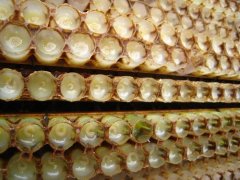
Is China's royal jelly production high, and how can royal jelly production be increased?
Nowadays more and more people are keeping bees, and at present we want to increase royal jelly production, which is an important guarantee for improving the economic benefits of beekeeping. So how should royal jelly production be increased? Do you know? 1. Build up strong colonies so that the bee colony strength for royal jelly production reaches
-

Key Techniques for High-Yield Cultivation of Dense-Capsule Sesame
Dense-capsule sesame Yizhi No. 1 is one of the higher-yielding types of sesame today. It is drought-tolerant and lodging-resistant, with extremely dense capsules, 3 to 7 capsules per leaf, layer upon layer so thick that the stems are hidden from view. The seeds are pure white, with an oil content of over 55%. The growth period is 110 days for spring sowing and 85 to 90 days for summer sowing. It yields 100 kg to 150 kg of sesame per 667 sq m, and up to 220 kg per 667 sq m in high-yield fields. 1. Land preparation and fertilization: Before plowing, apply 1000 kg of farmyard manure, 40 kg of superphosphate, and 10 kg of potassium sulfate or potassium chloride per 667 sq m
-
Timely Early Sowing Measures and High-Yield Cultivation Techniques for Summer Sesame
The main sesame-producing areas in China mostly practice summer sowing, and for a long time yields have been low and unstable. This is certainly related to frequent disasters, but the more important reason is late sowing, a short growth period for sesame, and inadequate and irrational use of climatic resources. To solve this problem, in recent years we have carried out careful research on how to sow summer sesame earlier and on supporting cultivation techniques, and have preliminarily summarized a set of high-yield cultivation techniques. 1 Analysis of the reasons for increased yield from early sowing of sesame 1.1 Full use of climatic resources The main sesame-producing areas in China, including Henan
-
Detailed Explanation of Key Points for High-Yield Cultivation Techniques of Summer Sesame
Sesame belongs to the Pedaliaceae family, genus Sesamum, an annual herbaceous plant that prefers warmth, and its varieties include both black and white types. Besides being used for food, sesame oil is also a high-quality raw material for several daily-use industrial products and a lubricant and protective agent for the machinery industry, and its by-products are all good feed and fertilizer. In short, growing sesame well is of great significance for improving people's lives, developing industry and agriculture, supporting the country's socialist construction, and increasing the collective economy. In China, sesame cultivation is divided by sowing season into spring sowing, summer sowing, and autumn sowing.
-
Detailed Explanation of High-Quality and High-Yield Cultivation Techniques for Summer Sesame
With the adjustment of the planting industry structure, the summer sesame planting area in our province has been continuously expanding. In recent years, through practice, we have summarized a set of high-quality and high-yield cultivation techniques for summer sesame, and are now introducing them to everyone in order to improve the yield and quality of summer sesame in our province. 1. Crop rotation and field change: Selecting plots that have not been planted with sesame within two years is the prerequisite for achieving high-quality and high-yield summer sesame. 2. Selection of improved varieties: For summer sesame production, sesame varieties such as Yuzhi No. 8, Yuzhi No. 11, and Yuzhi No. 9, which are high-quality, high-yield, and strongly stress-resistant, should be selected. 3. Timely early
-
How to grow summer sesame? A detailed guide to comprehensive high-quality pollution-free cultivation techniques
Sesame is a major oil crop in Linquan County and a leading industry among cash crops, renowned both at home and abroad for its large area, high yield and excellent quality. The "Shenghe" brand sesame oil, "Longmao" brand refined sesame and "Yingxian" brand washed sesame produced by several leading sesame processing enterprises such as "Baoding Grain and Oil Co., Ltd." in the county have obtained China Green Food Grade A standard certification and pollution-free agricultural product certification. In order to improve sesame quality and meet the production requirements of pollution-free agricultural products, on the basis of promoting the results of the "six reform measures for sesame" researched in the county, after many
-
Key Technical Points for High-Efficiency Cultivation of Straw Mushrooms in Winter
Straw mushrooms (Volvariella volvacea) are a high-temperature, high-humidity type of fungus, suited to growing in an environment of constant temperature and stable humidity. The suitable growing temperature for straw mushrooms is 23-25°C, and the relative air humidity is 85%-95%. Therefore, to move the high-temperature straw mushroom to cultivation in the lower temperatures of winter, it must be grown in greenhouses with good insulation capacity, which increases cost inputs such as heating. Moreover, straw mushrooms produced in winter sell for 2 times the price of those from conventional summer cultivation, so appropriate adjustments should be made in aspects such as the culture material formula and cultivation management, in order to
-
Analysis of the Reasons for the High Economic Returns of Winter Cultivation of Straw Mushrooms
Straw mushrooms (Volvariella volvacea) are a type of fungus that thrives in high temperature and high humidity, suited to growing in an environment of constant temperature and stable moisture. Therefore, moving the heat-loving straw mushroom to winter cultivation requires growing it in greenhouses with good insulation capacity, which increases cost inputs such as heating. However, straw mushrooms produced in winter sell for 2 times the price of those conventionally cultivated in summer, so appropriate adjustments should be made to the substrate formula and cultivation management, among other aspects, in order to increase the input-output ratio and improve economic returns. The main techniques for winter cultivation of straw mushrooms are introduced as follows: 1. Select a suitable substrate formula, build a pile and ferment the straw mushrooms.
条件筛选