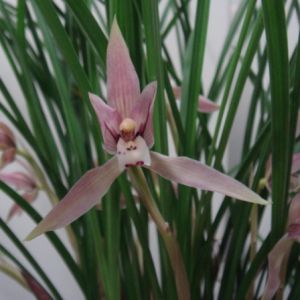
An Introduction to the Characteristics and Everyday Care of Wufeng Cymbidium
Wufeng is a cultivated variety of Cymbidium goeringii, and the orchid world often calls it Wufeng Cymbidium as well. Cymbidium goeringii belongs to the terrestrial orchids among Chinese cymbidiums, and it is fairly widely distributed in the Yangtze River basin and the mountainous areas to the south in our country. Its leaves are slender and it usually blooms in late winter and early spring, with mostly one to two flowers per scape. Its fragrance is delicate and subtle, and it is a type of orchid with a long history of cultivation and a high degree of popularity in China.
From the standpoint of variety, famous Cymbidium goeringii cultivars are mostly distinguished by the expression of petal type, flower color, leaf posture and fragrance, and Wufeng is a name quite familiar to orchid enthusiasts. According to introductions, it has its own identifying points in flower shape and leaf form, but different places of origin and different sources of stock may differ in the details. When buying, it is best to rely on the actual plant or the description of a reliable orchid grower, and avoid judging only by name and photographs.
In terms of care, Wufeng has habits similar to ordinary Cymbidium goeringii. It likes a cool, semi-shaded environment and is afraid of blazing sun and muggy heat in summer. The growing medium should be loose, airy and slightly acidic, and is commonly mixed from materials such as leaf mold, bark and Kanuma soil. Watering should follow the principle of watering when dry and withholding when wet; during the vigorous growth seasons of spring and autumn, dilute fertilizer can be applied frequently, and near the flowering period a supplementary phosphorus- and potassium-based fertilizer helps the flower scape grow taller and the plant bloom.
In routine management, attention must also be paid to ventilation. Too much watering easily causes root rot, while a closed environment easily breeds pests and diseases. In summer, shade and cool the plants; in northern regions in winter, they need to be moved indoors, and a certain day-night temperature difference should be maintained, which helps the plant accumulate nutrients and complete vernalization. Well-cared-for plants will divide into new shoots year by year, and are suitable for placing in a courtyard, on a balcony or in a study; when they bloom in early spring, they are elegant and pleasant.
Related Reading