Characteristics and Care of Taoye Lan (Cymbidium), Getting to Know the Terrestrial Orchid with Leaves Nested Layer upon Layer
Taoye Lan is a perennial terrestrial herbaceous plant of the genus Cymbidium in the orchid family. It is mainly distributed in the understory and mountain-slope shrublands of southwestern China and parts of the southern mountainous regions. Its name is quite vivid, because new leaves emerge from the leaf sheaths at the base of the old leaves, with the leaves nested layer upon layer and wrapping around one another, which is how it got its name.
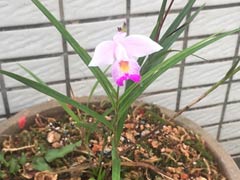
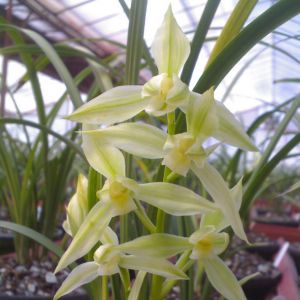
In terms of morphology, the leaves of Taoye Lan are mostly strap-shaped, leathery in texture and glossy, with their bases overlapping one another to form a distinct petiole-like structure; the pseudobulbs are relatively small and are often wrapped by the leaf bases. The flower scape emerges from the leaf cluster, bearing from a few to more than ten flowers, with the flower color mostly yellow-green tinged with purple-brown and a faint, delicate fragrance. It is precisely because its leaf shape resembles that of Songchun, Lulan, Qiuzhi and others that beginners often misidentify it; when identifying it, focusing on the characteristic of overlapping leaf bases is a fairly reliable approach.
As for care, Taoye Lan prefers a warm, humid, semi-shaded and well-ventilated environment, and it is best to use a loose, breathable, well-draining humus-based potting medium. For routine watering, follow the principle of watering when dry and letting it dry out between waterings; in summer, pay attention to shading and cooling, and in winter, keep it appropriately warm and reduce watering. During the growing season, applying light fertilizer frequently is sufficient. As long as the environment is stable, it is not particularly difficult to grow.
As a Cymbidium plant valued for both its foliage and its flowers, Taoye Lan has upright leaves, and although its flowers are not showy, they have a distinct wild charm. It is suitable for placement in scattered light in a courtyard or on a balcony. One thing to note is that wild orchid resources are protected by law, and digging them up at will carries risks; if you want to get one, it is advisable to choose artificially propagated seedlings through legitimate channels.