An Introduction to the Characteristics and Daily Care of the German Shiro Utsuri Koi
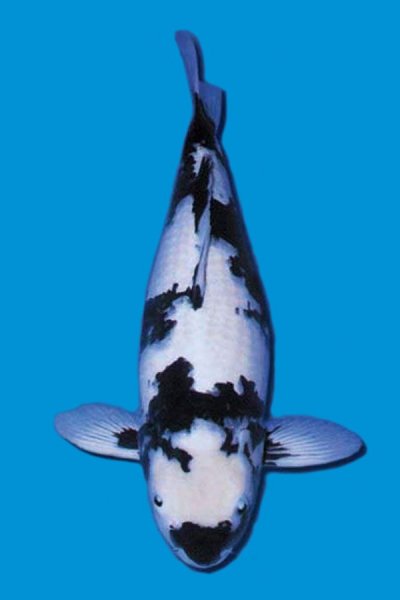
The German Shiro Utsuri is an ornamental koi variety developed by combining the Utsuri class of koi with German carp. Its body is basically scaleless, or has only a small number of large scales remaining along the line of the dorsal fin and near the lateral line; the skin is smooth, and the base color is mostly white, paired with large blocks of black markings, creating a striking black-and-white contrast and making it highly ornamental.
In terms of variety origin, German carp derives from the mirror carp and leather carp of Europe. After being introduced to Japan, it was crossed with Japanese koi, forming a series of German-system koi such as German Kohaku, German Sanke, and German Shiro Utsuri, and the German Shiro Utsuri belongs to this system. Compared with the ordinary scaled Shiro Utsuri, its sumi (black) markings appear directly on the bare skin, and the color often looks deeper with clearer edges.
In terms of care, the German Shiro Utsuri has habits similar to other koi, preferring clean water rich in dissolved oxygen and suitable for living in neutral to slightly alkaline water. Because its skin lacks the protection of scales, it is relatively delicate, so when netting or changing water, avoid bumps and scratches, and in daily care, also watch out for common problems such as parasites and water mold.
For feeding, a special koi compound feed can be used, with the amount adjusted according to water temperature and season; when the water temperature is on the low side, feeding should be appropriately reduced or stopped. When selecting one, you can observe whether the distribution of the sumi markings is even and whether the body shape is smooth; the sumi markings of young fish will change as they grow, so a certain amount of patience is needed to see what it will ultimately look like.