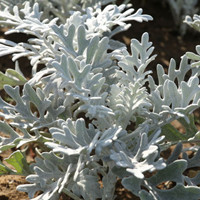
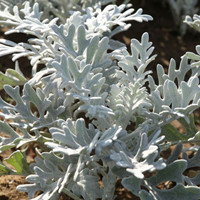
Dusty miller leaves are silvery white like snow, a common foliage plant
Dusty miller is a perennial herbaceous plant in the genus Senecio (ragworts and groundsels) of the family Asteraceae, also often called silver ragwort in horticulture, and is native to the Mediterranean coastal region. Its most striking feature is its leaves: the leaf surface is densely covered with silvery white hairs, and the pinnately deeply lobed leaf shape resembles snowflakes, giving the whole plant a grayish white or silvery gray tone that stands out particularly vividly among green plants.
Common cultivated types differ slightly in leaf shape; some cultivars have lobes that are finely divided like feathers, while others are relatively broad and thick, and the depth of the silvery white also varies. In the flower market, the two names dusty miller and silver ragwort are often used interchangeably, mostly referring to the same type of silvery white foliage plant, and when buying, it is enough to go by the actual leaf shape and the product description.
As for care, dusty miller prefers a cool climate, has a certain cold tolerance, and dislikes high temperature and high humidity as well as waterlogging. It is best planted in a spot with ample sunlight, good ventilation, and smooth drainage, and the soil is best a loose, fertile sandy loam. Water according to the principle of watering when dry and letting it dry out between waterings, avoiding long-term dampness of the potting soil that causes root rot. When the weather is hot in summer, the plant's growth slows, so it can be appropriately shaded and cooled, and dead leaves should be promptly cleared away to keep the plant's shape neat.
In garden applications, dusty miller is often used as an edging plant for flower beds and flower borders; the silvery white leaf color paired with dark-colored flowers such as red and purple creates a very striking contrast. It is also suitable for growing in pots, and the cut leaves are also a commonly used foliage material in flower arranging, adding layers and texture to the work.
Propagation is mainly by sowing and cuttings, mostly carried out in spring and autumn, and the operation is not complicated. In daily care, pay attention to preventing diseases caused by high temperature and stuffy humidity; by maintaining ventilation and controlling moisture, the plant can keep its silvery white, lush state.