An Introduction to the Morphological Characteristics and Cultivation Methods of Firebush
Firebush is an evergreen shrub in the madder family (Rubiaceae), genus Hamelia, also known as scarlet bush or redhead, native to tropical America, and is now fairly common in warm-climate regions such as South China. Although its name contains the word "jasmine," it is not the same type of plant as true jasmine; it is a typical woody flowering shrub.
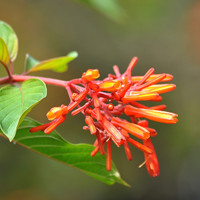
Its branches are soft, and the leaves are mostly arranged in whorls of three, elliptical in shape, with the whole plant a lush green. The cymes are borne at the tips of the branches, and the corolla is slender and tubular, bright orange-red in color, with a very long blooming period; in warm regions it can bloom in succession almost all year round, and the flower color changes in depth as the blooms open, giving it strong ornamental value.
In terms of care, firebush prefers a warm, humid environment with plenty of sunlight; when light is abundant it blooms profusely, while long-term shade causes thin, weak branches and fewer flowers. It is best planted in loose, fertile, well-drained soil, watered by the "dry-wet" principle, avoiding waterlogging that can cause root rot. It is not cold-tolerant and needs protection from the cold when temperatures drop in winter; in northern regions it is mostly grown as a potted plant and moved indoors after the onset of winter. During the growing season it can be pruned appropriately to encourage branching and keep the plant shape attractive; propagation is mainly by cuttings, with a fairly high survival rate.
In terms of use, firebush has brilliant flower color and a long blooming period, making it suitable for flower beds and borders, and it can also be planted in clumps in courtyards or grown in pots for ornament. Its flowers are rich in nectar and often attract butterflies, hummingbirds and other flower-visiting animals, adding vitality to the garden. If the leaves turn yellow in daily care, it is mostly related to waterlogging, lack of light or low temperatures, and the plant generally recovers after the growing environment is adjusted in time.
Related Reading