What Kind of Plant Is Pickerelweed? Characteristics and Water Landscape Applications
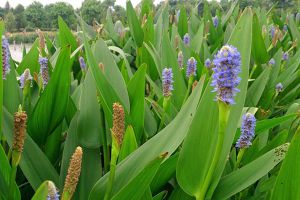
Pickerelweed (Pontederia cordata) is a perennial emergent herbaceous plant in the family Pontederiaceae, native to North America, and some people also call it "Hai Shou Hua". Its stems stand upright, its leaves are heart-shaped, and its foliage is emerald green and glossy. It prefers warm, humid conditions and plenty of light, making it a water plant valued both for its leaves and its flowers.
Every summer and autumn, pickerelweed sends up tall flower scapes from the leaf clumps, bearing strings of small blue-purple flowers at the tips; the dense spicate inflorescences stand above the water surface, creating a very striking ornamental effect. Its underground rhizomes are well developed and it divides readily, so propagation and care are relatively trouble-free; once planted in masses, it quickly forms a dense waterside scene.
In terms of application, pickerelweed is often planted in ponds, lakesides and constructed wetlands with still or slow-moving water. It can be grown alone in masses or combined with aquatic plants such as powdery alligator-flag (Thalia dealbata) and cattail (Typha), adding richer layers to the waterside. Its root system can absorb nutrients from the water and helps to a certain extent with purifying water quality and improving the aquatic environment, so it is also often seen in wetland landscapes and ecological restoration projects.
Many people easily confuse pickerelweed with powdery alligator-flag, but telling them apart is actually not difficult. Pickerelweed has somewhat heart-shaped leaves, a compact blue-purple spicate inflorescence, and a relatively shorter plant form; powdery alligator-flag is tall and upright, with slender ovate-lanceolate leaves and a more slender, loose inflorescence. Remembering these two points - leaf shape and plant height - is basically enough to distinguish them clearly.