Hollyhock Pictures: Appreciation, Morphological Characteristics and Common Variety Introduction
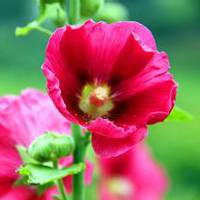
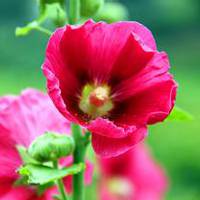
Hollyhock (Alcea rosea) is a perennial herbaceous plant of the genus Alcea in the mallow family (Malvaceae), commonly seen in courtyards, along roadsides and in flower borders. Its plants are upright and tall, with straight, sturdy stems, and its leaves are relatively large with a rough surface, nearly round and slightly lobed; it is highly recognizable from the pictures.
The most striking feature of the hollyhock is its flowers. The flowers open in succession along the stem from bottom to top, and the flower forms come in single and double types, with colors covering red, pink, purple, white, yellow and many others; the most common sight in pictures is flowers blooming in strings. The flowering period is mostly concentrated in summer, and at peak bloom a single plant often shows both buds and open flowers at the same time.
Judging from common pictures, hollyhocks can be roughly divided into two categories by petal form: single-flowered and double-flowered. Single-flowered varieties have spreading flowers with a distinct center, while double-flowered varieties have petals layered upon layered, resembling a small peony. When different varieties are planted together, the colors form rich layers, so they often become the star of flower photography.
The hollyhock is highly adaptable, cold-tolerant and fairly drought-tolerant, with low soil requirements and relatively extensive management, making it suitable for courtyard landscaping and roadside greening. Note that it looks similar to the mallow (Malva), and pictures are easily confused; the hollyhock plant is taller and its flowers are larger, while the mallow is relatively short and small. Grasping these two points allows for quick distinction.