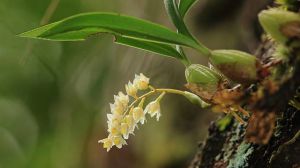
The Pholidota chinensis has an elegant appearance and offers both medicinal and culinary value
Pholidota chinensis is a perennial epiphytic herb in the genus Pholidota of the orchid family (Orchidaceae), commonly known among the public as stone olive or fruit-leaf. It mostly grows attached to rock surfaces or tree trunks in mountain forests, prefers warm, humid environments with diffused light, and is relatively common in valley woodlands across the southern provinces of China.
In appearance, Pholidota chinensis has oval pseudobulbs at its base, which usually produce two leathery, broad strap-shaped leaves that are deep green and glossy. Each year during the flowering season, it sends up a flower scape from beside the pseudobulb, with a cluster of small white flowers at the tip; its overall form is elegant and it has a certain ornamental value.
In terms of applications, Pholidota chinensis has long been regarded as a mountain material that serves both as medicine and food. Traditionally it is believed to clear heat and nourish yin, and to moisten the lungs and promote fluid production, and it is often used as medicine in the form of the whole plant or the pseudobulbs. In Fujian, Guangdong and other places, people are accustomed to using it together with ingredients such as pig lungs and lean meat to make soup; the broth is light and nourishing, and it is a popular traditional soup in those areas.
It should be noted that the genus Pholidota also includes similar species such as Pholidota chinensis var. gracilis, and the two differ in leaf width, pseudobulb size and other aspects, which can be used to distinguish them when digging or purchasing. In addition, wild Pholidota chinensis has high requirements for its growing environment, and excessive harvesting is not conducive to the continuation of the resource. If you intend to cultivate it, you can choose a loose, breathable substrate and keep the environment shady and moist.
Related reading