What Is Diphylleia: The Understory Herb Whose Petals Turn Transparent in Rain
Diphylleia is a perennial herb in the genus Diphylleia of the family Berberidaceae. It gets its name because its leaves are large and rounded, shaped like lotus leaves, and it grows on shaded mountain forest floors. It is mainly distributed in the cool, humid mountainous regions of East Asia, often appearing at forest edges, beside streams, or in damp, humus-rich shaded areas, and is a highly recognizable wild mountain flower.
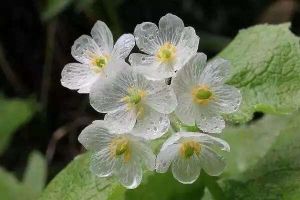
Its most famous trait is that the petals turn transparent when they meet water. When the flowers open they are pure white, and once they are wet with rain or dew, the petals become as clear as crystal, with the veins behind them faintly visible, and after the moisture dries they slowly return to white. This phenomenon is related to water entering the internal structure of the petals and changing the way light is reflected, which is why Diphylleia is also often called the crystal flower.
The rhizome of Diphylleia lies horizontally underground, while the above-ground parts sprout each spring and produce clusters of small white flowers in late spring and early summer. It prefers cool, moist conditions and loose, fertile soil, and dislikes strong direct sunlight and hot, dry weather. Cultivating it by hand requires simulating understory conditions as closely as possible, and the care threshold is relatively high, so it is more commonly seen in native wild colonies in the mountains.
In terms of uses, Diphylleia has a graceful plant form and elegant flowers, and together with its unique transparent-flower trait it has high ornamental value, making it much loved by flower enthusiasts. It should be noted that although its rhizome has a history of use in traditional medicinal records, it contains toxic compounds, so never dig it up and take it yourself; wild Diphylleia resources are limited, so when you encounter it outdoors it is better to stop and admire it rather than dig it up at will.