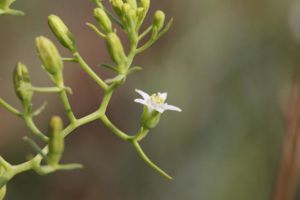
Thesium chinense is a semi-parasitic herbaceous plant whose whole plant can be used as medicine.
Thesium chinense is a perennial semi-parasitic herbaceous plant of the genus Thesium in the family Santalaceae, and in some regions it is also called Bairucao. The plant is slender and short, with thin, elongated, much-branched stems and narrow, linear leaves, and its overall appearance is unremarkable. Unlike most common green plants, its root system can grow haustoria that attach to the roots of other plants to absorb part of their nutrients, so in the wild it often grows alongside its host plants.
Every spring and summer, Thesium chinense produces tiny yellow-green flowers in the leaf axils, and after flowering it bears nearly spherical nuts. It is widely distributed in China and is mostly seen on sunny, dry hillside grasslands, at field edges and beside roads. Because its form is delicate and its flowers are plain in color, people unfamiliar with it find it hard to notice this little plant even when passing right by.
As a traditional medicinal material, Thesium chinense is usually used as medicine in the form of the dried whole plant, and after harvesting it can be preserved for later use through simple processing such as air-drying. Traditional Chinese medicine holds that it has the effects of clearing heat and detoxifying, reducing swelling and soothing the throat, and it is often used as supportive care for sore, swollen throat, cold with fever, and cough due to lung heat. Granules, tablets and other Chinese patent medicines made from Thesium chinense as a raw material are now fairly common in clinical practice and in pharmacies.
It should be noted that Thesium chinense is, after all, a medicinal material and not an ordinary food, so the specific usage and dosage should follow the guidance of a physician or pharmacist, and pregnant women, children and people with weak constitutions should be even less inclined to take it on their own. To learn more about the details of its effects and scope of application, you can also refer to the related reading content on this site.
Related Reading