What are the early-ripening honey peach varieties? A detailed introduction in this article
People who enjoy eating honey peaches always worry that the skin of honey peaches is too soft and easily damaged by bumps. They are also not easy to store, so this often puts people off. But if you still hold this preconceived notion now, then you can only be said to be really behind the times. Do you know about peach tree grafting techniques? Planting peach trees generally involves
In the 99th year of the Republic of China (2010), the Agricultural Research Institute of the Council of Agriculture (hereinafter referred to as the Agricultural Research Institute) had already used crossbreeding methods to improve peach fruit firmness, and further successfully bred a new variety that can be planted on flat land, Taichung Nong No. 4 "Hongyu." The Agricultural Research Institute stated that although ordinary honey peaches have tender, fine, and juicy flesh, their soft nature makes them very susceptible to damage during harvesting and selling, losing their commercial value. In addition to causing great losses to farmers, this also seriously affects the willingness of the general public to buy them, and the newly bred peach Taichung Nong No. 4 "Hongyu" completely overcomes this inherent weakness. Taking "Hongyu" peaches at 90% ripeness measured with a fruit firmness tester as an example, the firmness is far more than three times that of honey peaches at the same 90% ripeness on the market!
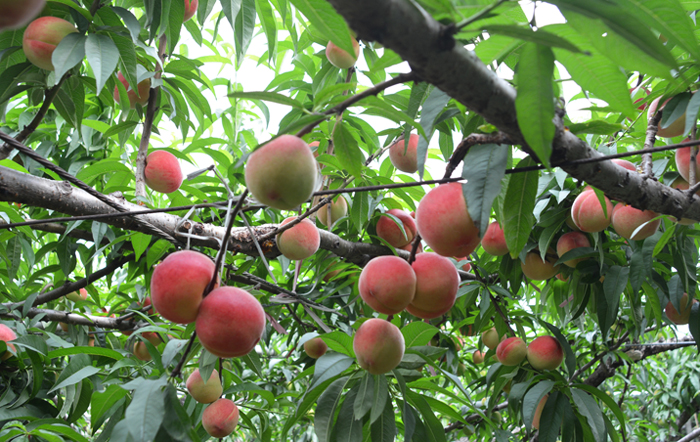
Here is the key point! Besides being resistant to bumps and easy to cultivate, tasting good is what really matters. According to members of the public who have actually tasted Hongyu peaches: "It is really Q and moderately soft and firm, different from ordinary ones." Tasting Hongyu peach for the first time made people excited and amazed; unlike ordinary honey peaches bought at the market that are soft, or else too crisp, Hongyu's appearance is very elastic and as rosy as a baby's cheeks, and the flesh tastes plump, juicy, and very sweet, while also having a faint, captivating aroma. Describing it as complete in color, aroma, and taste is not an exaggeration at all, and it completely beats other imported varieties.
The flowering period of Hongyu peach is around mid-January, and the low-temperature hours required for winter dormancy are few, so central Taiwan and areas north of it are all suitable for planting. The fruit matures from about late April to early May, and it already has sweetness at the green-ripe stage (70% ripe). At present, farmers are cultivating it from Dongshi in Taichung to the Tai'an area in Miaoli, and harvesting for market can begin successively from late April, so people who love eating peaches should seize this good opportunity to taste something fresh.