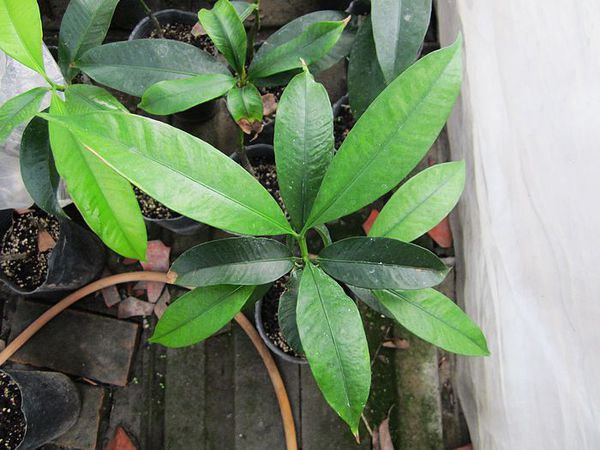
What happens when mangosteen is planted in full sun? Differences between common mangosteen and Mesta mangosteen leaves
Mangosteen varieties: there are currently no officially certified varieties. It is said that only a few variant varieties are known, for example in the Sulu Islands (Sulu Islands) the fruit is larger, the rind is thicker than normal, and the flesh flavor is more sour. How do you grow mangosteen?
Climate and soil
Mangosteen is a low-altitude humid tropical forest tree. An equatorial climate with highly uniform temperatures and high humidity is the ideal growing climate. The most suitable temperature range is from 20°C to 33°C. At temperatures below 5°C mangosteen trees may die, especially young trees. At temperatures below 20°C growth slows significantly, and at temperatures above 35°C the leaves will scorch and burn. Robust mature trees can tolerate a wider temperature range.
Mangosteen can adapt to a wide range of soil characteristics, needs good water-holding capacity, and prefers a high water table (1.5 m-2 m). However, it cannot tolerate waterlogged areas. With a soil pH in the range of 5 to 6, a slightly acidic soil with moderate clay and a high amount of organic matter is preferred. Soil with a pH higher than 6.5 is not recommended.
Mangosteen is an understorey species of the tropical rainforests (tropical rainforests), and during the early growth and development stage it needs shelter and shade. Young trees in particular need shade, otherwise their growth rate will drop greatly and the trees may die. It is recommended to provide 30-50% shade during the four-year seedling stage. If seedlings are in a spot full of sunlight:
•Poor development
•Scorched leaves
•Smaller leaves
•Fewer flushes of new shoots
•Death
General differences in leaf shape between common mangosteen and Mesta mangosteen
1. Leaf shape of common mangosteen (garnicia managosteen)
(1). Overall, the leaf shape is relatively wide
(2). The leaf tip is relatively flat and symmetrical
(3). The leaf is slightly long, but the leaf surface is flat, especially at the leaf tip
(4). The leaf width narrows evenly and gradually toward the leaf tip, and the leaf tip is relatively flat and symmetrical
2. Leaf shape of Mesta mangosteen (mesta mangosteen). I give 2 plants as examples to explain:
(1). Overall, the leaf shape is relatively narrow and long
(2). The leaf tip is longer, curls upward slightly in a V shape, and the leaf tip is a little bent to the side
(3). The other plant's leaves are likewise narrow and long
(4). The leaf tip is longer, curls upward slightly in a V shape, and the leaf tip is a little bent to the side
(5). The leaf tip curls and bends to the side,