Appreciation of common cliff-style star jasmine bonsai
Introduction: Star jasmine, scientific name: Trachelospermum jasminoides Lem. Also known as: wanzi moli. It belongs to the genus Trachelospermum in the dogbane family (Apocynaceae), and is an evergreen climbing shrub. It can grow up to 10 m long. The leaves are simple, with a glossy surface. The flowers are white with a fragrance and spiral in form, blooming from April to June. There are large-leaf and
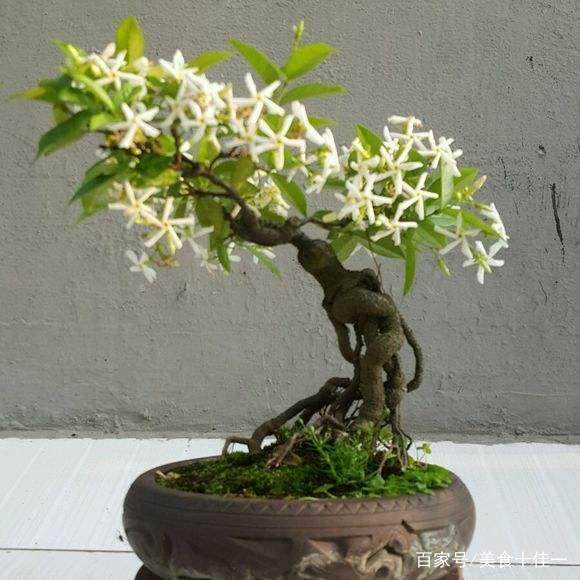
Star jasmine
Scientific name: Trachelospermum jasminoides Lem
Also known as: wanzi moli
It belongs to the genus Trachelospermum in the dogbane family (Apocynaceae), and is an evergreen climbing shrub. It can grow up to 10 m long. The leaves are simple, with a glossy surface. The flowers are white with a fragrance and spiral in form, blooming from April to June. There are large-leaf and small-leaf types. The small-leaf type blooms in April, while the large-leaf type has a later flowering period. It is native to our country and is distributed in many regions.
Star jasmine likes sunlight. It is fairly cold-tolerant and prefers moisture, and has no strict requirements for soil and fertilizer.
Star jasmine should have its soil changed once every 4-5 years, best in March or April in spring.
Propagation methods include sowing, cuttings and layering, with layering as the main method. Sowing is mostly carried out in spring. The cutting period is in June, using softwood cuttings. Layering can be carried out in both spring and autumn. In February and March, old branches are used for layering, while in June and July, softwood branches are used. Generally, spring layering roots more slowly, but the flowers and leaves are more vigorous.
In bonsai, star jasmine is often planted in cliff style, and is also planted on rockery stones or attached to dead tree roots
For more professional agricultural science and technology information, please scan the QR code to follow WeChat: NongXunNET

Please indicate the source when reprinting.