A Manual for Analyzing Items You Cannot Throw Away in Decluttering (Part Three)
Introduction: Disposing of unwanted items is a very important step in the organizing process. Broken items, expired food, worn-out clothes and shoes, appliances that cannot be repaired - these kinds of items with no use value at all are easy to throw away. So what is it that is not easy to throw away? Below, please see the top ten items that Chinese people cannot throw away at home
Disposing of unwanted items is a very important step in the organizing process.
Broken items, expired food, worn-out clothes and shoes, appliances that cannot be repaired - these kinds of items with no use value at all are easy to throw away. So what is it that is not easy to throw away?
Below, please see the top ten items that Chinese people cannot throw away at home (ordered by approximate floor space occupied):
1. Awkward furniture (neither useful nor discardable)
2. Awkward home appliances (neither useful nor discardable)
3. Ornamental potted plants
4. Recyclables waiting to be sold
5. Food
6. Children's toys (in households with kids)
7. Bedding
8. Books
9. Cleaning equipment
10. Pots, pans, bowls and dishes
The first article covered awkward furniture, and the second article covered awkward home appliances.
Now here is the third article: ornamental potted plants and recyclables waiting to be sold
Ornamental potted plants
Chinese households generally have one or two balconies, and the items that occupy the balcony long-term are either recyclables waiting to be sold or plants and flowers, or both.
As for ornamental potted plants, I actually think it is enough to go back and look at what flowers were planted on the balcony of the minimalist organizer's home in that earlier article.
Plants and flowers really can create a good atmosphere at home, but it is not advisable to keep too many.
1. They require a lot of time to care for
I have seen households with many flowers on the balcony, where watering alone takes seven or eight watering cans - chances are you will have to carry a large watering can back and forth seven or eight times, and adding pruning and trimming, spending an hour every day is a given. I said before that good looks that add housework to your life are just a painted skin. Depending on the size of your home, a few pots as appropriate decoration are enough, and average daily maintenance time should ideally be within ten minutes.
2. They occupy a large area of space
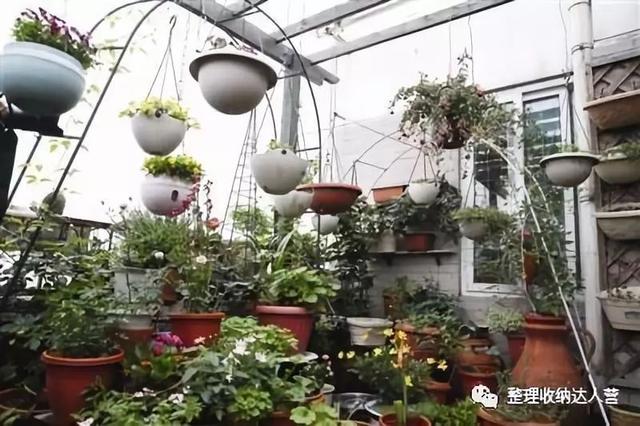
Actually, there is no need to say much. The main subject of a home is people, not plants. If a balcony could originally hold a tea table and a rocking chair, or a fitness machine or treadmill, must it all be given over to potted plants? A good method is not to spread them all out on the floor, but to use a vertical flower stand to make use of upper space and place them at high density. For example, as in the picture below.
Remember to measure the dimensions before buying the flower stand, and add the height of the flowers, so as not to block the window from opening.
For those with small homes, try not to keep large floor-standing potted plants, which at every turn occupy one or two square meters of space that originally belonged to people.
3. Plants that cannot be saved
Who has not had a few plants die at home?
Once you are sure they cannot be saved, deal with them quickly, together with the flower pots.
Trust me, even if you wait a month, it will not come back to life. Bad potted plants directly affect the overall beauty of the plants and flowers, directly affect your mood every time you see them, and after they rot they will also directly affect the air at home. And from a feng shui perspective, it is not advisable to keep dead potted plants at home.
Recyclables waiting to be sold
Recyclables mainly include: all kinds of packaging cardboard boxes, express delivery cardboard boxes, old paper and books, empty plastic bottles and cans, even sheet metal and screws.
Many households, especially elderly people, like to hoard recyclables that can be sold for a little money at the recycling station and keep them at home. They may wait one or two months or half a year, until enough has accumulated, and then sell it all at once.
If, unexpectedly, you are hoarding recyclables, then put down your phone and quickly escort the recyclables out of your home. There is no need to say much about the reasons: the floor area occupied by the recyclables, the terrible odor they bring to the home, the unpleasant impact on the environment, the large area of sunlight they block, the bad luck they bring to the home....... The combined value of these negative effects has definitely far exceeded a hundred times the price for which they are recycled.
From another perspective, if you are not so hard up that you must make a living by collecting garbage and selling recyclables, then you might as well sort out your household recyclables each day and place them beside the trash can, letting people who make a living by collecting recyclables take them away. This can also be considered an act of kindness.
Actually, what I mainly want to talk about is the following: you may have family members who like to hoard recyclables, especially elderly people, and you do not know how to change him or her.
You can try this:
1. Reason with them and appeal to their emotions
You insist that the recyclables must be thrown away promptly, while he insists that they must be saved up to sell for money later, and so conflict arises. But do not let the conflict expand and continue.
Reason with them: I admit that recyclables do have value, but they block most of the sunlight in our home and also block feng shui. And when friends come over to visit, it does not look good either. Too much recyclables brings lots of dust and odor, and the air becomes bad, which poses hidden risks to children's health and can easily cause skin diseases or bronchitis.
Appeal to their emotions: After working hard all day and coming home, I do not ask for a big house or fine renovations, nor do I ask for a hot meal; I just hope that the space I come home to is bright and spacious and that I can breathe freely. The time I spend at home each day is not much, and I hope that everywhere I look makes me feel comfortable, so that my mood will be good and everyone in the family will feel good too.
Appropriate inducement: Haven't you always wanted a rocking chair/flower stand? Or haven't you always lacked a place to dry things? You see, after all the recyclables are escorted out of the home, this vacated space is just right for you to put it there.
2. Ask property management staff for help
For a stubborn elderly person, what family members say may be of no use at all. However, if an unfamiliar staff member, such as property management staff or fire safety inspection staff, posts a notice on the door: We have observed from the outside that your home has accumulated too much recyclables and is prone to fire, so it must be cleared as soon as possible. Perhaps this one slip of paper will solve it.
3. Understand and be tolerant
Because the era or background of their life is different, perhaps his childhood experiences of social turmoil and material scarcity made him cling to material things. In adulthood he had self-control and would maintain an outward calm; as he aged and self-control declined, he began to show an obsession with material things. You do not know what happened to him between the ages of 2 and 7, so do not rashly judge his behavior.
If what he hoards is not very much and he disposes of it frequently, then for now set aside a space for him and let him be.
4. Pay attention to their mental health
When many elderly people begin hoarding, it marks the beginning of a mental abnormality. In some elderly people, recyclable-collecting behavior appears after their children become adults and leave home or after the death of a spouse, and this can be understood as a response to emotional deprivation.
We need to understand some common psychological knowledge and guide them slowly, showing deep care so that they have a sense of security and can replace the loneliness of feeling abandoned by the times and by their children. Even if the children are not by their side, let them know that you will not abandon them.
When persuasion has no effect on a family member's hoarding of recyclables, you should first help them disinfect and store the recyclables properly. After that, it is best to encourage them to regularly take part in outdoor recreational activities with people their own age or to develop beneficial hobbies, which can give their mind something to rely on and thereby reduce the hoarding behavior. The worst possible outcome may be that pathological changes or decline have appeared in the brain, or that it is a precursor to Alzheimer's disease, or a mental disorder or obsessive-compulsive disorder. In that case, they should go to a regular hospital for treatment as soon as possible and undergo tests of cognitive function, conversational function and motor ability, so as to further solve the problem.
5. Start with small things yourself
If you do not live with the elderly person, do not bring old things you consider useless back to your hometown for the elderly person to use, unless you are certain they need them.
If you visit the elderly person, remove the outer packaging of gifts as much as possible to reduce their chances of judging whether the packaging should be kept as recyclables, so as not to add to their troubles.
As for the recyclables they have collected, you can pretend that you need them yourself, that a charity needs them, or that a friend happens to want to use them, and take the opportunity to carry them away and dispose of them.
For more professional agricultural science and technology information, please scan the QR code to follow WeChat: NongXunNET

Please indicate the source when reposting.