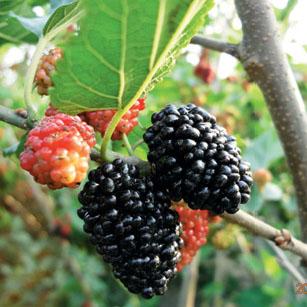
Mulberry Cultivation Techniques and Variety Introduction, and What Fertilizer Is Best
Can you grow mulberries at home too? Freshly picked purple-red berries, this scene is truly touching! It turns out that mulberries have vigorous vitality, tolerate both water and drought, are perennial trees, produce large yields, and are one of the easiest fruit tree potted plants to start with! The oval-fruited mulberry is the most common variety. Now let's take a look at mulberry cultivation techniques.
When growing mulberries in pots, it is recommended to use a pot with a diameter of one chi or more, so that the soil can provide sufficient nutrients. After each year's harvest, prune to maintain a height of about one person, making fruit picking easier the following year and preventing damage from typhoons in summer.
Cultivation Q&A
1. After repotting, mulberries grow very quickly. What should I do if I cannot reach the fruit at the top?
A: In a full-sun environment, with enough soil and nutrients, mulberries easily grow to more than one person's height, and wild mulberries can be seen at 2 to 3 meters tall. When growing them at home, it is recommended to carry out large-scale pruning of the whole plant after each year's harvest. This controls height on the one hand and promotes new branch growth on the other, so that when they bloom and bear fruit the following year, the fruit can be reached and picked by hand.
2. How do I care for mulberries grown at home? How should watering be adjusted? What fertilizer is best?
A: Mulberries tolerate both water and drought. If planted outdoors, rainwater is already enough for their growth; if not in an open-air environment, water about once a week, but water thoroughly so that moisture flows out from the bottom of the pot. As for fertilizing, it is recommended to mainly use comprehensive organic fertilizer and avoid chemical fertilizers. Apply once before flower buds appear in February, and apply a follow-up fertilizer once after pruning in May; in the second half of the year, watch for pests and remove them promptly.
3. When mulberries are in peak season, you cannot finish eating them all at once and they rot easily. How should they be stored?
A: Mulberries are not easy to store, so fresh mulberries are rarely seen on the market, and processed products are more common. If freshly picked mulberries cannot be eaten the same day, it is recommended to put them in the freezer, where they can be kept for 2 to 3 months. When eating them, dip them in a little honey and the flavor is quite good; they can also be blended into juice or made into jam for different ways to enjoy them.
Long-fruited mulberry is also called "Zijinmi Sang". Its shape resembles a caterpillar, but its flavor is sweet and it is suitable for eating fresh.
Mulberry Quick Facts
Scientific name: Mours alba L.
English name: mulberry
Other names: sangren, sangshi, sangzao, sangguo
Classification: Moraceae, Morus, deciduous tree
Best planting period: vitality is strongest from February to April.
Flowering period: March.
Best harvest period: March to April.
Varieties: The most common mulberry has oval fruit; there is also "long-fruited mulberry", also called "Zijinmi Sang", whose shape is similar to a caterpillar, but whose flavor is sweet and especially suitable for eating fresh.