How to Grow Ruby Grapes? Cultivation Methods and Care Tips for Japan's Heat-Tolerant Amethyst Grapes
I. Variety Introduction
The grape (Vitis vinifera L.) is a woody vine of the genus Vitis in the family Vitaceae, and one of the fruit tree species with the longest history of human cultivation. Its fruit can be eaten fresh, made into wine, dried, or processed into juice, giving it extremely high economic value. In recent years, with global warming, traditional black and red grape varieties have commonly suffered from poor coloration and worsening sunburn during the high-temperature summer period, seriously affecting yield and the proportion of marketable fruit.
To meet this challenge, the Aichi Prefectural Agricultural Research Center in Japan, after many years of selective breeding, has recently officially released two new heat-tolerant grape varieties developed in-house: Amethyst (アメジストアイ) and Ruby (ルビーアイ). Both varieties were bred from crosses between Beni Ballard and Shine Muscat, and were selected layer by layer from 255 primary lines, ultimately yielding excellent lines that combine appearance, flavor and stress resistance, and are expected to become leading varieties for grape-producing regions in Japan and even East Asia in coping with high-temperature climates.
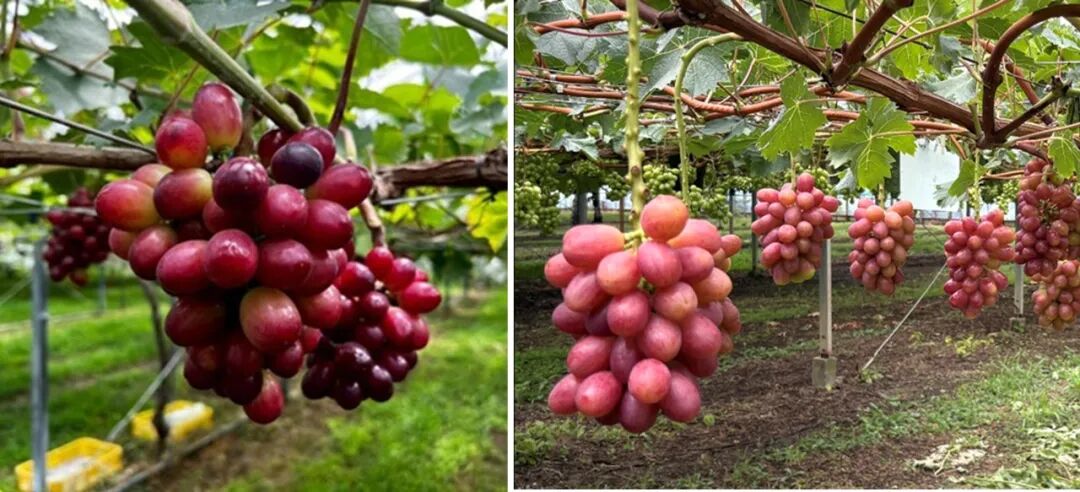
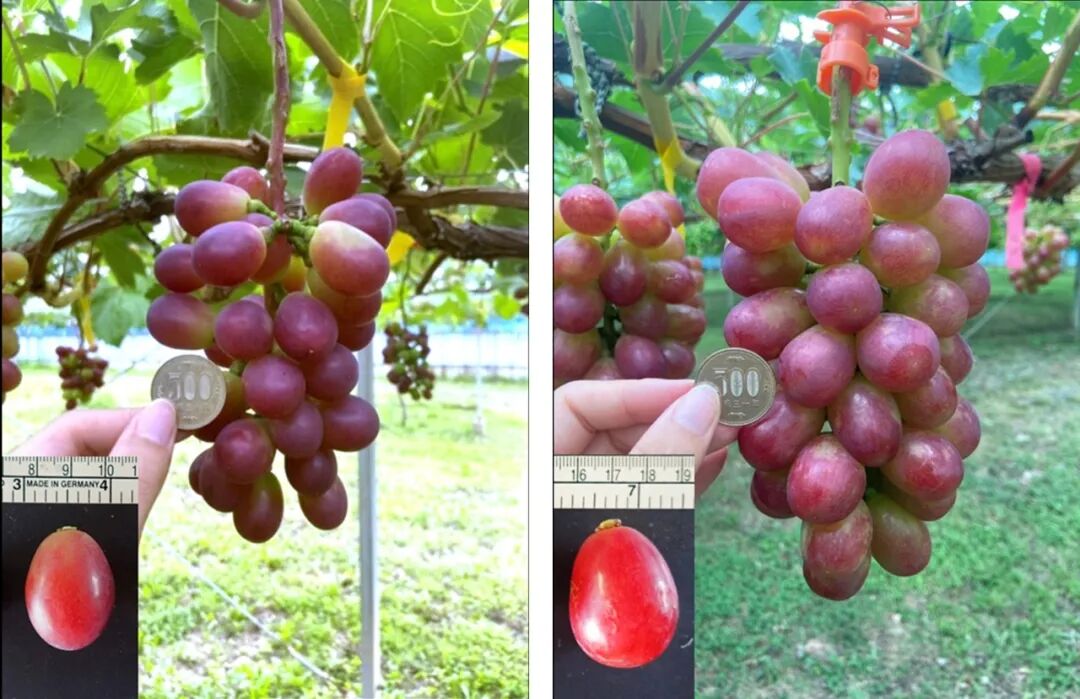
Amethyst grapes are an early-ripening variety, maturing in open-field cultivation in late July. The fruit is dark purplish-red, rich in flavor, with a sugar content exceeding 19°Brix, soft flesh, and can be eaten with the skin. Ruby grapes are also early-ripening, with an open-field harvest period in early August. The berries are large and plump, with a strong Muscat aroma and a sugar content exceeding 18°Brix, and the flesh is firm and tolerant of storage and transport. Both can be grown seedless, with outstanding marketable traits.
II. Growth Characteristics
Amethyst and Ruby have inherited the excellent genes of Shine Muscat while also showing a marked heat-tolerance advantage. Under the sustained high temperatures of the summers of 2024 and 2025, both varieties still colored evenly with smooth fruit surfaces, without the coloration stagnation or sunburn spots commonly seen in traditional varieties such as Kyoho and Aki Queen.
The main growth characteristics are as follows:
- Strong heat tolerance: During the fruit coloration period, it can withstand temperatures above 35°C, with stable anthocyanin synthesis and good skin coloration.
- Early ripening and high yield: It can be harvested from late July to early August, avoiding the risks of late typhoons and autumn rain, with a market window that matches the summer consumption peak.
- Seedless cultivation: Seedlessness can be achieved through treatment with plant growth regulators, improving the eating experience and market value.
- Excellent sugar-acid ratio: Sugar content 18-20°Brix, moderate acidity, rich flavor, with no astringency when eaten with the skin.
- Relatively good disease resistance: It has a certain tolerance to white rot and downy mildew, but routine prevention is still required.
III. Cultivation History
Grape cultivation can be traced back to the Caucasus region of West Asia in 6000 BC, and was later introduced to China via the Silk Road, with a cultivation history of more than two thousand years. Modern Japanese grape breeding began in the Meiji period, with Kyoho (bred in 1937) as a milestone that established the breeding direction of Japanese table grapes centered on "large berries, seedlessness and high sugar." After that, varieties such as Pioneer, Shinshu Raku and Shine Muscat emerged one after another, driving the continuous upgrading of the Japanese grape industry.
Aichi Prefecture is located in the central part of Honshu, Japan, with a warm climate and abundant water resources, and is one of Japan's important grape-producing regions. In 2024, Aichi Prefecture's grape planting area was 373 hectares, with a yield of 3,070 tons, both ranking 9th in Japan. The local Agricultural Research Center has long been committed to stress-resistant grape breeding, and in response to the frequent summer high temperatures and coloration disorders in recent years, launched a heat-tolerant variety breeding project starting in the 2010s.
The research team crossed Shine Muscat, with its high sugar and aroma, as the female parent, with Beni Ballard, with its stable coloration and strong heat tolerance, as the male parent, obtaining a total of 255 primary lines. After multi-location adaptability trials and multi-generation stability testing, the two best lines, Amethyst and Ruby, were finally identified in 2024, and a variety registration application was submitted on April 1, 2025 under Japan's Plant Variety Protection and Seed Act. According to the plan, the Aichi Prefectural Agricultural Research Center will supply nursery stock to grape growers within the prefecture starting in December 2027, with commercial fruit expected to reach the market around 2031.
IV. Cultivation Methods
The cultivation methods for Ruby and Amethyst grapes are basically the same as those for traditional Eurasian grape varieties, but vineyard establishment, pruning and temperature control need to be optimized in line with their early-ripening and heat-tolerant characteristics.
1. Vineyard establishment and soil preparation
Choose flat terrain with convenient drainage and irrigation and sufficient sunlight, on sandy loam or gravelly loam, with a soil pH of 6.0-7.5 as suitable. Before planting, deep plow 60-80 cm, and apply 3,000-5,000 kg of decomposed organic fertilizer and 50 kg of superphosphate per mu to improve soil structure and fertility. High-ridge cultivation or root-restriction cultivation is recommended to enhance drainage and root regulation.
2. Trellis system and planting
The two varieties have moderate to vigorous growth and are suitable for "H"-shaped horizontal pergola or "T"-shaped bird trellis cultivation, with a trellis surface height of 1.8-2.0 m, row spacing of 2.5-3.0 m, plant spacing of 1.5-2.0 m, and 110-150 plants per mu. Planting should preferably be done before spring bud break, with the graft union 5-10 cm above the ground; after watering thoroughly to settle the roots, cover with plastic film to conserve moisture.
3. Fertilizer and water management
Fertilization throughout the year follows the principle of "promoting early, controlling late." At bud break, nitrogen fertilizer is the main type, combined with phosphorus and potassium fertilizer to promote shoot and leaf growth; 7-10 days before flowering, apply high-phosphorus fertilizer to increase the fruit-setting rate; during the fruit enlargement period, apply potassium and calcium fertilizer to promote cell division and skin toughness; after harvest, apply base fertilizer to restore tree vigor. In terms of water management, control water during flowering to prevent flower and fruit drop, keep the soil moist during the fruit enlargement period (field water-holding capacity 60%-70%), and appropriately control water during the color-change and ripening period to increase sugar.
4. Pruning and flower and fruit management
Winter pruning is mainly medium and long cane pruning, retaining strong fruiting mother canes, with 8-12 buds left per cane. In summer, promptly remove buds, set shoots and pinch tips to control excessive growth and improve ventilation and light penetration. For cluster shaping, retain 4-5 cm of the cluster tip, and remove secondary clusters and shoulder branches; after fruit set, thin the berries, with the standard cluster weight controlled at 400-600 g and single berry weight at 12-15 g. Seedless treatment is carried out 10-15 days after flowering, using gibberellin (GA3) at 25-50 ppm by dipping or spraying, with streptomycin as an auxiliary treatment.
5. Pest and disease control
Focus on controlling downy mildew, white rot, anthracnose, as well as green plant bugs, thrips and red spider mites. Before bud break, spray 3-5 degrees Baumé lime sulfur for orchard sanitation; during the growing season, follow the policy of "prevention first, integrated control," rotating protective and systemic fungicides such as mancozeb, azoxystrobin and pyraclostrobin; carry out thorough control once before bagging the fruit, using white or yellow wood-pulp paper bags, and remove the bags 10-15 days before harvest to promote coloration.

V. Key Care Points
1. Summer high-temperature management
Although Amethyst and Ruby are heat-tolerant, protective measures are still needed during sustained extreme high temperatures (≥38°C). A shade net with 20%-30% shading rate can be covered on top of the pergola, or reflective film can be hung on the southwest side of the fruit to lower the fruit surface temperature. At the same time, increase foliar spraying of calcium and monopotassium phosphate to enhance fruit heat tolerance and skin hardness.
2. Harvest and post-harvest handling
The best harvest period is late July for Amethyst and early August for Ruby. Maturity is judged by soluble solids content; harvest when it reaches above 18% and the skin color is uniform. Harvesting should be done in the early morning or evening, with light cutting and gentle handling, to avoid berry drop. After harvest, pre-cool to 0-2°C, and with modified atmosphere packaging the shelf life can be extended to 30-45 days.
3. Winter pruning and renewal
Complete winter pruning after leaf fall and before bud break, cutting out diseased and pest-damaged canes, thin weak canes and overly dense canes, and keeping the trellis surface well ventilated and lit. Renew fruiting mother canes that have fruited for 3-4 consecutive years, selecting appropriately positioned new shoots to replace them, to prevent the fruiting position from moving outward and tree vigor from declining.
4. Soil improvement and crop rotation
Continuous cropping vineyards easily accumulate nematodes and soil-borne pathogens, so it is recommended to deep plow once every 3-5 years, increase the application of bio-organic fertilizer and soil conditioners, and regulate the soil microbial community. Green manure crops such as white clover and ryegrass can be planted between rows, and after mowing and incorporation, the soil organic matter content is increased.
In summary, with their outstanding traits of early ripening, heat tolerance, seedlessness and high sugar, Amethyst and Ruby grapes provide a high-quality solution for grape production against the backdrop of climate warming. By mastering scientific cultivation methods and care points, abundant and high-quality fruit can be obtained in the orchard.