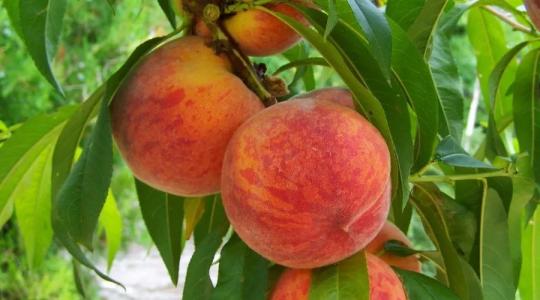
Key Points and Precautions for Organic Peach Tree Cultivation
Fruit trees are perennial crops. After planting, their growing period lasts at least several years, and at most fifty years. Therefore, the quality of environmental conditions is closely related to fruit tree cultivation. The environment for fruit tree cultivation broadly relates to climate (temperature, rainfall, sunlight, wind), soil (moisture, aeration, terrain, soil temperature, etc.), biological factors, pollinating insects, pests and diseases, etc., while labor and transportation are inseparable from orchard harvesting and management.
Organic Cultivation of Peach Trees
In the 86th year of the Republic of China (1997), when we purchased 310 ping of farmland (located beside Zhongxing Ridge in Taichung), the only crops in the field were 28 old peach trees (about seven years old), of which three were peach trees and twenty-five were March peaches. At that time, we lacked knowledge of peach tree management and cultivation, and our understanding of the concept of organic cultivation was only half-baked; all we could insist on was not using chemical pesticides and chemical fertilizers. At that time, the peach trees in the orchard bloomed, and I was truly overjoyed, thinking that in the near future there would be sweet and delicious peaches to enjoy. However, due to problems such as diseases, pests, and shaping and pruning, as well as improper fertilization, the following year only fourteen March peaches remained. The ripe fruit, bitten by fruit flies, looked extremely beautiful and delicious on the outside, but inside it was completely rotten and full of worms, unfit for consumption. Only then did I realize that bagging was needed, but it was too late. This situation made me understand the truth of what farming friends said: without using pesticides, there can be no harvest. Facing this adversity only spurred on my desire to produce organic fruit.
In fact, the peach tree is a fruit tree with extremely strong vitality, and its growth rate is the fastest among all fruit trees. Seedlings that generally sprout in July and August, after being grafted at the winter solstice of that year, can bloom and bear fruit the following year. With good fertilizer management, producing 30 jin is absolutely no problem. However, its diseases, pests, fertilization, and pruning (shaping the tree form) require much thought. The following points are the practical experience and discussion from more than six years of producing organic peaches.
1. Make good use of the blowtorch (burning method)
(1) In autumn and winter, termites multiply in large numbers on peach tree trunks, especially old trees. At this time, the termite-eaten parts should be dug out, the termites burned to death with a blowtorch, and the eaten parts of the trunk carbonized;
(2) When reishi mushrooms grow on the part of the trunk near the ground, they should be dug out, and the local part of the trunk should also be carbonized. Observe for a period of time; if they no longer grow, there is no problem;
(3) Scale insect pests: when this insect is first discovered, apply fire locally for quick results. The above burning method does not take much time, requires no pesticide spraying throughout the orchard, and has no impact on the ecology.
2. Make good use of water sprouts
Farming friends generally deal with water sprouts by pruning them off, but organic growers must keep the vast majority of water sprouts, and the bigger the better, because they are the branches with the strongest vitality. Old branches are prone to scale insects and gummosis, while water sprouts rarely have these shortcomings. When pruning around the winter solstice, branches from the year before last should all be cut off (they have begun to age), leaving only a few branches from last year (the fruit is larger). Among the current year's water sprouts, the thick and strong ones should be given priority to keep, and all branches should be pressed flat evenly. Only if they are too dense should the smaller branches be cut off. In this way, they are strong and full of vitality year after year. Although new branches bloom a little more slowly and a little less, organic peaches in natural farming are truly rare. In particular, bagged fruit harvested at nine-tenths ripe is a delicacy on earth.
3. Multi-line planting
In addition to the main lines in the orchard, all current lines can also be grafted onto a single tree, so that the peach blossoms in the orchard crossbreed. Although a single line is not bad, it is believed that multiple lines can produce eugenic results. (This concept was provided by farming friend Mr. Liu Tianhao, and after practical implementation it proved to be truly feasible.)
4. Plant other fruit trees between peach trees, so that if one peach tree develops pests or diseases, it is less likely to spread and transmit, and treatment and prevention are relatively simpler.
5. Use bacterial fertilizer made from beneficial microorganisms, so that beneficial bacteria become the dominant group in the orchard and diseases naturally occur less.
6. Deliberately cultivate it into an ecological orchard, so that pests in the orchard will be naturally eliminated by natural enemies, and there will be no situation of caterpillars crawling all over the trees.