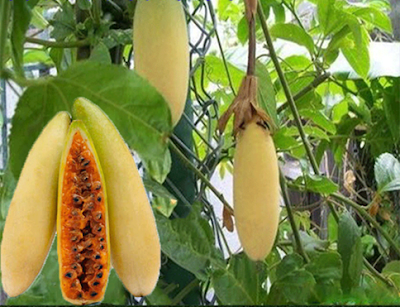
Banana passionfruit is a highly invasive vine native to the tropical Andes. It invades disturbed areas, smothers trees, reduces biodiversity, and assists other invasive species, such as wild boars that eat its fruit. Biological control trials in Hawaii have
Banana passionfruit is a highly invasive vine native to the tropical Andes. It invades disturbed areas, smothers trees, reduces biodiversity, and assists other invasive species, such as wild boars that eat its fruit. Biological control programs trialed in Hawaii have achieved very encouraging results, and New Zealand is now studying the introduction of biological control agents. Banana passionfruit is a new species, so older reports about Passiflora mollissima may in fact actually refer to banana passionfruit.
Species description
A climbing vine with trilobed serrated leaves, the undersides of the leaves bearing soft hairs, the upper surface always hairless; small, nearly kidney-shaped, needle-like, shrubby stipules, pendulous flowers, sepals and petals pale pink, pale green, the flower green comes from the United States.
Banana passionfruit is a new species. It was previously included in P. mollissima, and many references still use this scientific name. The two species have many differing characteristics. The petals and sepals of Passiflora tarminiana open horizontally, or in some cases bend backwards, with the sepals near the end of the floral tube. The nectar chamber is noticeably larger than the floral tube. The petals and sepals of P. tripartita var. mollissima do not open beyond a bell shape, and the sepals are shorter relative to the length of the floral tube (Owen, 2003). Its bracts form a narrow tube. Its stipules are much larger, clasping the stem, and persistent. The fruit and leaves of banana passionfruit have a high tolerance or resistance to anthracnose, which affects P. tripartita var. mollissima, and it regenerates more easily from the base. It appears more susceptible to attack by butterfly larvae at the juvenile stage.
Habitat description
It occurs in disturbed habitats. It can tolerate high light and low light, although seedlings cannot tolerate dense shade. It can tolerate occasional frost. It occurs naturally in the Andes, growing between 2000 and 3600 m in altitude, with average annual rainfall of 800-1300 mm and average annual temperature of 11.4-15.0°C. Once it reaches canopy height it spreads laterally.
In its native range, banana passionfruit only grows on farmland, where it is a fruit crop, and a few plants escape from cultivation areas, but it has never formed significant wild populations.
General impact
Banana passionfruit can rapidly grow to the canopy and smother it, when the understory is subjected to natural disturbance such as hurricanes and other strong winds, or disturbance by humans and wild boars. Banana passionfruit (banana passionfruit) [Passiflora, 1997]
Uses
It is usually grown for its fruit, and also as an ornamental plant because of its attractive flowers. On Kauai, people weave baskets from banana poka vines.