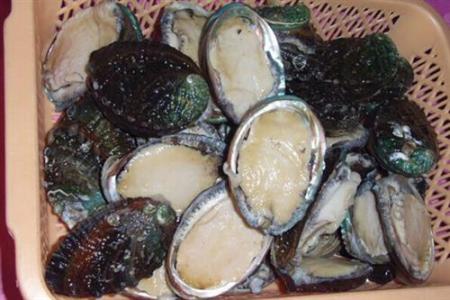
Protect the domestic nine-hole abalone industry: ban imports of fresh Chinese abalone and raise the inspection rate
In March this year, the Gongliao abalone season was extended due to weather factors, and sales were also blocked by low-priced Chinese abalone, sparking protests from local farmers; Premier Su Tseng-chang also inspected the area in person and directed relevant agencies to respond. Recently, the Bureau of Foreign Trade of the Ministry of Economic Affairs announced that imports of Chinese live, fresh, and chilled abalone are banned from November 1 each year to March 31 of the following year, in order to protect the rights and interests of domestic nine-hole abalone farmers; the Food and Drug Administration also announced in early April that for the next year it will raise the sampling inspection ratio for Chinese live, fresh, chilled, and frozen abalone to 20% to 50%.
Lin Limei, secretary-general of the Gongliao District Fishermen's Association, said on the 1st that fishermen who learned of the news all affirmed the government's measures, but that one piece is still missing in protecting the domestic abalone industry. The association will review how the policy is implemented this year and then suggest whether further total-volume controls on frozen abalone can be introduced.
Lin Limei explained that in the past, because there was no control on imports of fresh abalone during the production season, some fresh Chinese abalone was sold under the name of Gongliao abalone, affecting the rights and interests of domestic farmers, so the current announcement banning imports is a great help. "Fishermen feel that the government is paying attention to this industry." As for whether banning fresh abalone will cause imports of frozen abalone to increase, Lin Limei said it is still necessary to observe how the policy is implemented this year. "Of course, if there is total-volume control on imports of frozen abalone, protection for the industry would be more complete."
In addition, regarding border inspection rules, Zheng Weizhi, deputy director of the Food and Drug Administration's Northern Regional Management Center, explained that not long after Premier Su Tseng-chang's instruction, the Food and Drug Administration announced that from April 3 to April 2, 2020, the sampling inspection ratio for Chinese live, fresh, chilled, and frozen abalone would be raised from the previous 2% to 10% to 20% to 50%, while the drugs tested would remain the same: 48 animal drugs that must not be detected, heavy metal contamination, and other items. Since the policy was announced and implemented, 28 batches of imported fresh, frozen, and chilled abalone have all met inspection requirements, with no violations. The Chinese live abalone recently released in Taoyuan in violation of the prior release against a letter of undertaking also passed inspection, but the handling of the Food Safety Act violation, including suspension of eligibility for prior release against a letter of undertaking or imposition of a fine, is still under discussion.