The origin story of the yew, its anticancer substances, and an introduction to breeding and cultivation methods
The yew is a relict plant; relict means remaining, referring to organisms that already existed in ancient times and still have surviving populations today. From the fossil record of the yew, it can be traced back to 200 million years ago in the Jurassic Period, contemporary with the dinosaurs, distributed across Eurasia. Tai
The yew is a relict plant; relict means remaining, referring to organisms that already existed in ancient times and still have surviving populations today. From the fossil record of the yew, it can be traced back to 200 million years ago in the Jurassic Period, contemporary with the dinosaurs, distributed across Eurasia.
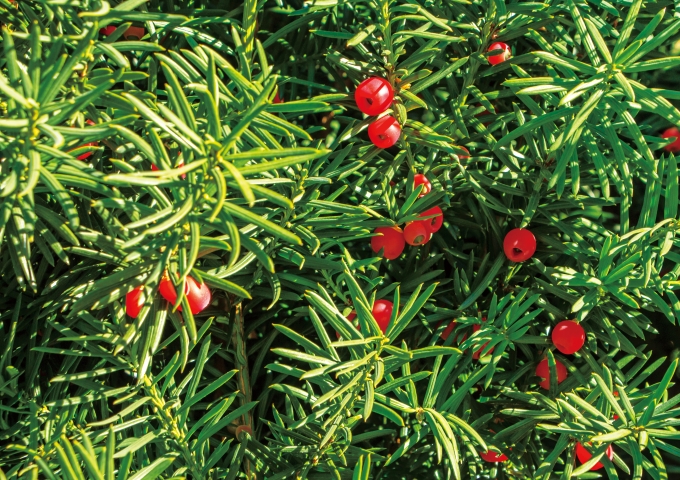
Taiwan Island formed 5 million years ago. About 1.1 million years ago during the Ice Age, China's southern yew (Taxus mairei) migrated southward by seed from the icy continental environment to the warmer Taiwan. During the Ice Age, because sea levels dropped, Taiwan was connected to the mainland, so it could reach Taiwan smoothly for refuge. But when the Earth warmed, the glaciers melted, and sea levels rose, the yews that had come to Taiwan for refuge settled in Taiwan's high mountains and began to differentiate. Taxonomically they still belong to the same species as China's southern yew, but there are already some slight differences in DNA.
The yew growing in Taiwan was first called Taiwan yew. Later, the Flora of Taiwan called the yews distributed from the Malay Peninsula to South China, Taiwan, and the Philippines all Sumatra yew (T. sumatrana). Then taxonomists treated this species as a variety of the Himalayan yew (T. wallichiana), with the scientific name T. wallichiana var. mairei. However, recent studies of chloroplast DNA and nuclear DNA indicate that the earlier scientific name for the Taiwan yew (T. mairei) should be considered more correct.
Paclitaxel was first discovered in the bark of the Pacific yew in the United States, and in 1992 it was approved for treating ovarian cancer. The new anticancer drug formed by combining paclitaxel with human albumin allows paclitaxel to enter tumors more easily, and can treat 3 types of cancer: metastatic breast cancer, non-small cell lung adenocarcinoma, and metastatic pancreatic cancer. In 2010, a new drug synthesized from 10-DAB was also approved for treating metastatic prostate cancer. The demand for paclitaxel-class raw materials is growing, with global demand estimated at about 3,000 kilograms. In the production of anticancer raw material drugs, Taiwan's biotechnology industry has not been absent. Taiwan-made raw materials for paclitaxel and docetaxel account for 21% and 38% of the global total respectively, but all raw materials rely on imports.
Breeding and Cultivation
Can the Taiwan yew serve as a source for producing paclitaxel or 10-DAB? In 1993, natural Taiwan yew mother trees scattered in the high mountains were collected, and asexual propagation methods such as cuttings, grafting, and tissue culture were used to propagate and preserve the mother trees. These natural mother trees are estimated to be several hundred to a thousand years old, and the seedlings produced by asexual propagation all retain the physiological age of the original mother trees, growing slowly. But through continuous grafting onto seedling stock and tissue culture methods, these seedlings can be rejuvenated and restored to youth.
In addition, seeds were collected from various mountainous areas of Taiwan to cultivate seedling stock, and 10 superior seedlings with good growth were selected from each, and cultivation areas were established with asexual seedlings of native mother trees in Wulai, Nantou, Kaohsiung, and Taitung, to monitor the growth of these varieties and the stability of paclitaxel content over the long term, and from these, 3 lines were selected and named Taiwan Red Yew No. 1, 2, and 3 respectively. Cutting orchards have been established for all 3 varieties, which can produce tens of thousands of cuttings each year for mass propagation of cutting seedlings. 1. A 5-year-old cutting seedling about 25 cm tall can be planted on a farm and cultivated in the manner of tea garden management. After 3 years, the seedling is about 1 meter tall, and a tea plucking machine is used to harvest branches above 50 cm in tree height.
At present, Taiwan Red No. 1 has the largest cultivation area, and its paclitaxel yield is 2 times that of the Med Himalayan yew, so an industry for cultivating Taiwan yew in Taiwan to produce paclitaxel has already been established. Due to the limitation of cultivable area in Taiwan's mountains, it cannot be cultivated on a large scale like continental countries such as Europe, America, and India, and at the same time, in response to the increasingly frequent extreme climates Taiwan often faces, such as typhoons, torrential rain, and drought, an agroforestry system has been developed, that is, cultivating yew under the forest. After 10 years of cultivation, having endured more than a dozen typhoons, including the August 8 Flood, and abnormal droughts, the branches and leaves and paclitaxel can all maintain stable production.