Silver-edged Cymbidium sinense blooming pictures and introduction to origins and prices
Silver-edged Cymbidium sinense is one of the varieties of Cymbidium sinense orchids. The leaves of silver-edged Cymbidium sinense are wide and thick. On large plants, the leaf-edge variegation is pale yellow and wraps nearly half of the leaf, and on new shoots the leaf variegation is even more obvious and wider, appearing pale white, commonly known as the “silver edge.” It is glossy and very grand, the flower scape rises above the shelf and above the leaf surface, the flower color is pure, and it is fragrant. The flower color is brown, the fragrance is rich, it is easy to keep alive, and it is suitable for planting in both the south and the north; it is very easy to grow. The flowers of the silver edge all bloom somewhat later than those of other Cymbidium sinense varieties, generally blooming after the New Year.
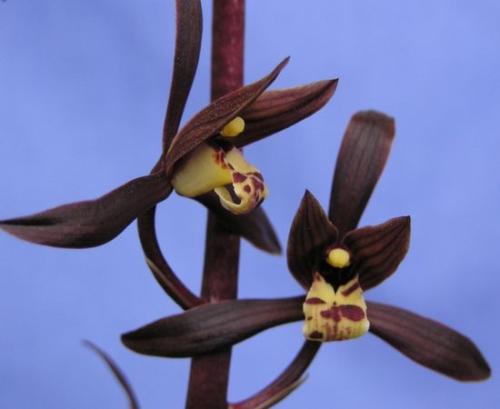
Silver-edged Cymbidium sinense belongs to the orchid family of flowers. Orchids dislike small plants being placed in large pots. Cymbidium sinense does not grow very fast; generally it is enough to repot once every 1-2 years in spring.Choose seedlings of good quality, with well-developed roots, wide and thick leaves, dark green leaf color, robust, no disease spots, and large pseudobulbs; generally they cost 30 yuan to 50 yuan per seedling.For planting Cymbidium sinense, the humus soil from under the forest in its place of origin is mostly used. This kind of soil is rich in humus, loose and non-sticky, and is often slightly acidic, making it an excellent soil for cultivating Cymbidium sinense. For watering Cymbidium sinense, rainwater or snow water is best. If tap water must be used to water Cymbidium sinense, it must be exposed to the sun for a day before it can be used. Fertilizing Cymbidium sinense “should be light and avoid heavy concentration,” generally starting in late spring and stopping in late autumn. When fertilizing, an air temperature of 18-25 degrees Celsius is suitable, and fertilizing is not suitable on cloudy and rainy days.