How to plant red jujube saplings and train their tree shape, and what are the common pests and diseases?
How should red jujube saplings be planted and trained into a tree shape? What are the common diseases in red jujube cultivation and how are they controlled?
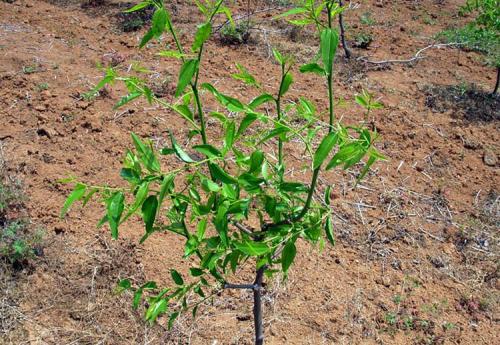
At present, red jujube trees are mostly grown with dwarfing cultivation, with tree height 1.5 to 2.5 m, which makes it convenient to pick fruit in pick-your-own orchards. Therefore, after the saplings are planted, the branches should be gradually pulled down to dwarf the tree, using either the open-center natural form or wire trellises to help set the tree shape. This can also prevent the jujube tree from toppling in strong winds because of its shallow root system.
The ideal row and plant spacing is generally 3×4.5 m or 4.2×4.2 m, and the most suitable average number of plants per hectare is 600 to 740. If the planting density is too high and the planting is too deep, both will affect tree growth, causing the canopy to become closed, increasing the relative humidity in the orchard, reducing light, and making the growing branches thin, which lowers disease resistance. After planting, water once every 7-10 days until the saplings survive. To prevent the saplings from lodging, stakes should be set up to secure them, and weeds should be removed every 1-2 months to control weed growth. The best time for transplanting is after the winter solstice, when fruit trees enter dormancy, so the root system is less likely to be damaged.
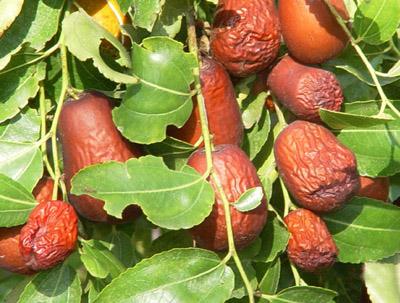
In the first year after planting, remove vegetative buds that sprout below 30 cm. For the multi-trunk training system, keep as many new buds above that as possible to help the branches extend. To cultivate a single-trunk natural open-center tree shape, remove vegetative buds below 45 cm during the growing season, and among those sprouting above, keep 3-4 buds with good growth angles and let them extend to help train the main trunk branches. For 2-4 year old plants, when they enter the budbreak and flowering stage, remove the overly long primary shoots sprouting from the main buds of each short fruiting mother branch 2-3 weeks earlier; in principle, it is best to keep 3 fruiting branches at the base. If vegetative shoots sprouting from the main buds on branches or terminal buds have no space to extend, it is better to pinch them early or remove them to avoid severe fruit drop caused by nutrient competition and to avoid disrupting the tree shape. Therefore, after budbreak, techniques such as bud removal, bud thinning, pinching, and branch pulling should be used to regulate the growth of the main trunk branches; for vigorous branches, an extension angle of 50-60 degrees is best, and for weak branches 70-90 degrees, so that after the branches extend to 2.5-3.5 m, branch pulling, branch hanging, or branch propping methods can be used to build a dwarfed tree shape.
The most common pests and diseases in red jujube cultivation are: jujube rust, scale insects, sooty mold, yellow squash beetle, cotton leafworm, tussock moths, anthracnose, oriental fruit fly, scarab beetles, coffee wood borer, stink bugs, red spider mites, and so on. Prevention methods include paying attention to field sanitation and regular pruning, keeping the orchard with sufficient sunlight and good ventilation, and regularly removing diseased branches. Methyl eugenol and other attractant baits or yellow sticky traps can be used against fruit flies to avoid harming the fruit trees.