Nandina Growing Methods, Planting Conditions and Cutting Propagation
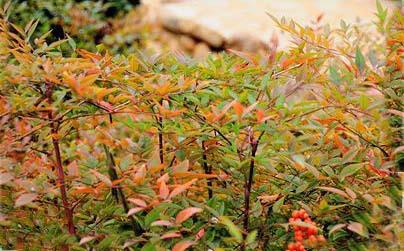
Although the name "nandina" contains the character "bamboo," it has nothing to do with bamboo at all. It is an evergreen shrub of the family Berberidaceae, and can grow up to 2.5 m in height. Its leaves are smooth and papery; new leaves are orange-red and closely resemble maple leaves, and before they drop in winter they turn yellow-red. In summer it bears small white flowers; after blooming, the petals curl back slightly. The fruit is spherical and as red and lustrous as a pearl.
Water: It has a high water requirement; in summer water about once every 2 to 3 days, while in winter simply water again once the soil is dry.
Soil: Humus-rich loam is best.
Propagation: It can be propagated by sowing, cuttings or division, with spring cuttings having the highest success rate.
Sunlight: A bright indoor spot, such as a sunny windowsill or balcony, is fine.
⟦NL> Pruning: The plant grows very vigorously and its shape easily becomes misshapen, so it needs frequent pruning to maintain its form.
Fertilizing: In February, May, August and November each year, apply a solid slow-release fertilizer as a top dressing every 3 months.