What is jelly fig (Ficus pumila var. awkeotsang) and how is it grown, and what new variety seeds are available?
Where does jelly fig usually grow, and can it also be planted at low altitude? Let's take a look. What characteristics does it have? It seems jelly fig has been bred into new seeds, so let's find out about that too.
Jelly fig is a plant unique to Taiwan, mainly distributed in the mid-to-low altitude mountain areas of the Central Mountain Range at 800-1,800 m. Its plants are not heat-tolerant and are difficult to grow on flat land. In addition, due to the lack of rearing technology for the jelly fig wasp, artificial cultivation has never been possible, and farmers can only go up into the mountains to collect wild jelly fig fruit. The main harvest period for jelly fig is in January and August, and the pollinating insect is the "jelly fig wasp." At present, the national jelly fig production area is about 500 hectares, with production areas concentrated in Nantou, Chiayi, Kaohsiung and Taitung.
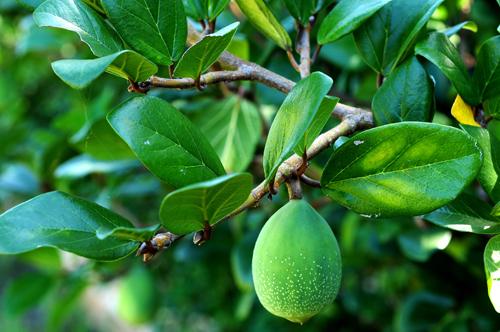
Leaves are oblong-ovate, 7-12 cm long and 3-5 cm wide, with the underside densely covered in rusty-colored soft hairs; the syconium is oblong, 6-8 cm long and 3-4 cm in diameter, with a hairy surface, a tapering apex and a raised umbilicus; the peduncle is short, about 1 cm long, and densely covered with coarse hairs.
Wu Deng-chen, deputy director of the Miaoli District Agricultural Research and Extension Station (abbreviated as "Miaoli Station"), said that superior male plants were initially selected from wild jelly fig varieties and an ideal male plant system was established so that jelly fig wasps could reproduce inside them. After the wasps mature, they bore out of the fruit and enter the female plants to help with pollination. Miaoli Station spent fifteen years and finally bred jelly fig varieties suitable for artificial cultivation, officially named "Miaoli No. 1" and "Miaoli No. 2." Technology transfer was completed three years ago, and this year they are expected to reach mass-production level and begin promotion.
Lin Meng-chun, an associate researcher at Miaoli Station who is responsible for testing the growing conditions of jelly fig and providing guidance on jelly fig wasp pollination technology, pointed out that "Miaoli No. 1" has good insect resistance, a reduced chance of scale insect infection, and larger fruit; while "Miaoli No. 2" focuses on producing a large number of fruit and has an early-maturing characteristic, allowing harvest one month earlier than jelly fig of the same period. At the same time, both varieties have higher yields, with an average jelly fig tree producing 20-25 kg of jelly fig fruit per year, three times that of ordinary flatland varieties, making them very suitable for organic and eco-friendly cultivation.