What are the techniques and tips for growing dragon fruit? A detailed guide
To grow dragon fruit, we first need to understand its characteristics and growing environment.
Because the dragon fruit's root system is shallow and spreads flat over the soil surface, its soil organic matter should be supplemented by fully applying low-nitrogen, coarse organic fertilizer when clearing the field and preparing the land, in order to raise the soil organic matter content of the top 20 cm layer to 4-5% or more, so as to facilitate the full development and extension of the root system later, as well as to buffer the adsorption and release when organic liquid fertilizer is applied. In addition, its fruit development period from flowering to harvest is only about 33-35 days, and it has more than 8 flowering batches each year; therefore, by selecting and retaining flowering periods and combining this with the supply of high-nitrogen or low-nitrogen organic liquid fertilizer, dragon fruit yield can be stabilized and fruit quality improved.
Dragon fruit belongs to the cactus family, genus Hylocereus, and is a perennial climbing succulent plant. The varieties introduced to Taiwan, China in the early days had self-incompatibility, low yield, and small fruit with no market value, so there was little commercial cultivation. In recent years, varieties with large fruit, high yield, high sweetness, and self-compatibility have been bred, and because they can be harvested within one year of planting, together with their tolerance to pests, diseases, and adverse environments, their cultivation value has greatly increased.
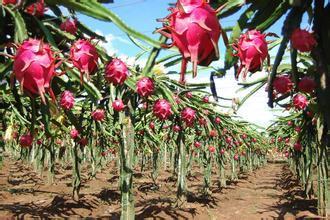
The total cultivated area across Taiwan, China is about more than 1,000 hectares, with a yield of 23-27 metric tons per hectare, and the central and southern regions are important production areas. However, because the production period is overly concentrated in summer, it has created considerable sales pressure; although cold storage is already used to partially regulate shipments during the peak season, summer fruit is mostly small and
low in sweetness, and the quality after cold storage is not ideal, so consumers generally regard dragon fruit as a cheap fruit of poor quality. They do not realize that the autumn and winter fruit of November-December each year, because of the large day-night temperature difference during development, the low load on the tree, and the absence of the stress of excessive rain, is both large and sweet, and with its brilliant red color, is quite attractive to the market. However, because it is near the end of the production season, its yield is very small and the price is high; ordinary consumers at hypermarkets can only buy cold-stored fruit from the summer peak season, or imported goods that have undergone long-distance transport, and have no chance to taste the true high-quality essence of dragon fruit.
In recent years, because some farmers have devoted themselves wholeheartedly to management, they can produce high-quality, high-priced dragon fruit even during the summer peak season, prompting the dragon fruit industry to gradually move into the ranks of high-value crops; in addition, the research and development benefits of winter fruit production regulation technology have made dragon fruit rapidly become a popular emerging crop in the country. Because domestically grown dragon fruit is not only attractive in appearance, but also sweet, juicy, and rich in vitamins, fiber, glucose, and minerals, and because pesticides are rarely used during the growing period to control pests and diseases, it can be called a fruit that is both healthy and delicious.
⟦NL> Under the hot, humid island climate of Taiwan, China, among all kinds of commercial crops, fruit trees are the least suited to organic cultivation; dragon fruit, however, is one of the very few fruit tree crops that can be chosen for planting. Its characteristics are not limited to advantages such as vigorous plant growth and few pest and disease problems; rather, dragon fruit itself is a symbol of healthy fruit and a high-income commercial crop; moreover, domestic management technology for producing high-quality fruit has gradually matured, so now is the best time to consider switching to organic cultivation.
Contents 1. Supplementing and maintaining soil organic matter
Dragon fruit prefers a climate that is warm year-round, with evenly distributed rainfall and sufficient sunshine. The soil must have good aeration and drainage, and fertile sandy loam is best, while the soil pH should be between 5.5 and 7.5. Areas prone to frost in winter and low-lying land with poor drainage are not suitable for growing dragon fruit, and good drainage is the primary consideration in preparing a dragon fruit orchard. Therefore, farmland converted from paddy fields or with a high water table should be cultivated on high ridges, and the hardpan that does not easily allow water to pass through should be broken to facilitate smooth drainage. Before land preparation, evenly broadcast sufficient compost rich in coarse fiber; the amount should depend on the soil organic matter of the 20 cm soil layer
1
content; generally, when the organic matter content is below 2%, the amount used is 30-40 metric tons per hectare; when it is between 2-3%, the amount is changed to 20-30 metric tons; if it is above 3%, the amount is reduced to 10-15 metric tons per hectare. The above amounts are intended to maintain sufficient organic matter content of 4-5% or more in the surface soil layer where dragon fruit roots grow. Because soil organic matter content decreases year by year due to microbial mineralization and decomposition, after winter pruning each year, apply organic fertilizer with a high nitrogen content so as to immediately supply the nutritional growth needs of subsequent new shoot sprouting and elongation. At the same time, to protect the vitality of the shallow root system, the ridge surface can be appropriately mulched to suppress weeds and conserve and support root growth.
2. Plant pest and disease protection measures (1) Protection against anthracnose
During the nutritional growth period after winter pruning, lime sulfur mixture diluted 800-1,200 times or neem oil diluted 300-500 times can be used to prevent the spread of anthracnose. Once the reproductive growth period begins, the use of the above materials should be reduced or avoided as much as possible to maintain the appearance quality of the fruit. Infected branches that are pruned off should be removed from the orchard immediately to avoid re-infecting healthy plants.
(2) Protection against the Oriental fruit fly
The Oriental fruit fly causes damage starting at the young fruit stage of dragon fruit; therefore, bagging should be carried out early to protect the fruit, and at the same time, because the shading protection of bagging can enhance the bright, vivid red color of the peel and effectively improve fruit quality. If for some reason bagging cannot be done early, citronella oil or peppermint oil diluted 800-1,000 times can be sprayed for repellent protection; however, bagging early is still necessary to help the fruit skin be complete and glossy. In addition, hanging methyl eugenol traps around the orchard can also appropriately reduce the damage density of the Oriental fruit fly.
(3) Pay attention to the occurrence of cactus virus X
Cactus virus X is currently the main viral pathogen commonly infecting plants in dragon fruit production areas; its symptoms are chlorotic spots, mottling, necrosis, and yellowing on the surface of the climbing stems, which affect normal plant growth and cause a decline in fruit quality. For this viral disease
there is currently no control agent, and one can only select and plant healthy virus-free seedlings and use correct
2
use of farm tools (pruning shears) to avoid mechanical spread of the harm, so as to maintain the health and safety of dragon fruit.
(4) Protection against sooty mold during the bud stage
Red-fleshed varieties of dragon fruit are more prone to sooty mold, which occurs during high-temperature periods when the scales on the flower buds secrete honeydew; generally, plants can be sprayed with water mist, or water can be sprayed to wash the flower buds one by one, which can reduce the degree of damage. On severely affected fruit, the tips of the scales (sepals) wither and break, greatly affecting the fruit's appearance.
3. Pay attention to nutritional regulation of the plant
April to October is the reproductive growth period when dragon fruit flower buds form; depending on the cultivation area, different batches of buds form. Generally, white-fleshed varieties produce about 6-9 batches of main high-yield flower buds, while red-fleshed varieties produce about 10-12 batches. Because the interval between the appearance of each batch of flower buds is only about 15 days, the period from flower bud to flowering is about 17-18 days, and the fruit development period is only 33-35 days; therefore, to avoid overly dispersed nutrient supply during fruit development, which leads to poor fruit quality, the following nutritional regulation must be carried out:
(1) Thin buds early: carry out the first bud-thinning operation when the flower buds are about 2-3 cm long, with the principle of keeping 1 flower bud per fruiting branch, and select and keep buds of uniform size while removing the rest. Although the above bud selection treatment has been carried out, the flowering periods may still differ by as much as 3-4 days at flowering; therefore, a second flower bud thinning operation is still necessary, at which time select and keep those whose flowering period differs by only 1 day and which have a larger number of flowers (generally the flower buds that open on the 2nd and 3rd days). In this way, at harvest, the maturity (days) between fruits differs by only 1 day, which can avoid the occurrence of uneven quality.
(2) Keep fruit in alternate batches: because the interval between each flowering batch is about 15 days, in order to avoid the simultaneous nutritional competition among growth stages such as the flower bud stage, flowering stage, green fruit stage, and color-turning stage during the same fruit-bearing period, which causes a decline in fruit quality or inconsistency in fruit quality, the practice of retaining flower buds in alternate batches should be adopted to improve this; that is, regulate the original possible production each month
of two batches of fruit, now changed to produce only one batch. Through this regulatory treatment, there will be
3
benefits for the protection of organic materials for pest and disease control, as well as fertilizer management for fruit quality regulation
operations. Although this treatment method reduces the number of fruits harvested, it can increase the large-fruit rate and improve quality; therefore, the annual total yield decreases only slightly, but total revenue can increase. In addition, keeping fruit in alternate batches also has the effect of staggering batch production periods, which helps improve market supply and demand and selling prices.
(3) Full branches: during the reproductive fruiting period, if the Hylocereus branches become thin and weak, appearing flat or withered, it warns that the plant is already in a stage of nutritional deficiency; this may be caused by too much fruit set or insufficient organic topdressing, and at the same time the root system should be checked for damage caused by waterlogging or improper application of organic materials.
4. Strengthen fertilizer management of the plant
Fertilizer management for dragon fruit must place special emphasis on maintaining soil moisture and diligently supplementing the application of organic liquid fertilizer.
(1) Water management: the root system of dragon fruit is completely intolerant of waterlogging, so heavy rain and poorly drained areas will damage the roots. Generally, soaking the ground-level part in water for 24 hours will damage most of the root system, causing the plant to gradually wither; therefore, good drainage is a necessary condition for establishing an orchard. But because its root system is shallow and widely distributed in the surface soil layer, the surface must be kept moist year-round to ensure the vitality of the shallow root system; therefore, the ridge surface should be mulched, while the furrow surface (that is, the working path) should use sod culture, which can fully take into account the moisture maintenance needs of dragon fruit. If spray (sprinkler) pipes can be installed under the orchard canopy, they can not only regulate soil moisture supply, but also effectively and evenly regulate the spraying of organic liquid fertilizer.
(2) Fertilization management: considering the physiological characteristics and morphology of dragon fruit, it is recommended to use less foliar (branch) fertilizer and instead strengthen soil fertilizer management. The soil fertilization techniques are as follows:
1. Base fertilizer: mainly apply organic fertilizer containing relatively high nitrogen, phosphorus, potassium, and high organic matter content, broadcasting it over the whole orchard after harvest and pruning from late November to December. After applying the base fertilizer, the ridge surface under the canopy can be mulched with second-crop rice straw, while the furrow surface (working path) can be subjected to 10-15 cm deep intercultivation to ensure the physical and chemical functions of the applied base fertilizer.
4
2. Topdressing: the main topdressing method is irrigation with soil organic liquid fertilizer, and the points to note are as follows: (1) During the nutritional growth period of shoot elongation: choose organic liquid fertilizer with a balanced ratio of the three elements nitrogen, phosphorus, and potassium. (2) During the green fruit period from flower drop to before color turning: choose organic liquid fertilizer with high nitrogen and low potassium, such as mushroom liquid fertilizer and fish essence fertilizer. (3) During the coloring period from color turning to harvest: choose organic liquid fertilizer with low nitrogen and high potassium (phosphorus), such as soybean liquid fertilizer plus plant ash, or seaweed liquid fertilizer. Using soil organic liquid fertilizer irrigation during the above fruit-bearing period can simultaneously provide sufficient soil moisture to facilitate fruit enlargement and development. As for topdressing frequency, it should be determined by changes in branch morphology; generally, during the fruit-bearing period, if branches gradually appear dry and flat, it means the topdressing amount is insufficient, and the topdressing amount or application frequency should be strengthened to maintain a strong tree vigor.
5. Regular soil fertility analysis
Every year, during the fixed period from after harvest to pruning, take surface soil from the ridge surface between planting rows (a soil layer about 15 cm thick) for soil fertility analysis. Its purposes are: (1) to pay attention to changes in EC value (soil electrical conductivity), pH value (soil acid-base reaction), and OM value (soil organic matter), so as to ensure safe regulation of the applied organic materials without affecting normal plant growth. (2) to self-check the residual content of phosphorus, potassium, calcium, and magnesium, in order to confirm whether the quality and quantity of organic materials applied over the past year were appropriate, and whether there has been excessive cumulative residue or a year-by-year insufficient decline.