-

Spring-planted watermelon flowering and fruit setting are affected by weather, how should melon farmers respond?
This year the temperature in early spring was relatively low, and there was a late spring cold spell. In some areas there were many cloudy days and relatively little sunlight. These factors all affect the problem of spring-planted watermelon flowering and fruit setting. So when encountering this situation, how should melon farmers respond? In response to these issues, preparations must be made in advance
-
Spring-planted rice D You 68, a variety recommended by the Ministry of Agriculture
D You 68 is a three-line hybrid mid-season rice bred by the Rice Research Institute of Sichuan Agricultural University. It was approved by the Sichuan Provincial Crop Variety Approval Committee in 1997. Its whole growth period is 4-5 days longer than that of Shanyou 63, and it belongs to the late-maturing medium indica combination. Plant height 120 cm, growth uniform, plants luxuriant, tillering ability relatively strong, high ear-bearing rate, large panicles with many grains, panicle length about 23 cm, grains per panicle 187-194, seed setting rate about 80%, 1000-grain weight 26.3-27.7 g. Wide adaptability, strong stress resistance, good color at maturity, relatively great flexibility in seedling age
-
How to grow spring-planted soybeans in Northeast China? A detailed explanation of the technical guidance
In the autumn and winter of last year, precipitation in Northeast China was lower than normal, soil moisture was insufficient, and drought was relatively severe. This spring there has been more rain and snow, temperatures began to rise rapidly in early April, and temperature and precipitation are close to normal. The Soybean Expert Steering Group of the Ministry of Agriculture, together with the National Agricultural Technology Extension Service Center, based on full investigation, proposed the following technical guidance for spring soybean planting: 1. Strictly select excellent varieties. Because of the dry climate last autumn, soybeans may not have matured normally physiologically at harvest, and mechanical threshing increased the possibility of damage to the seed embryo
-
Introduction to the spring-planted potato variety Yunshu 201
Characteristics and traits: Bred by the Yunnan Academy of Agricultural Sciences; passed Yunnan Province crop variety approval in 2004; growth period 100 to 110 days, medium-late maturing; growth period comparable to "Zhongdianhong" and "Mira", 13 to 19 days earlier than "Hezuo 88"; tubers long oval, skin relatively rough, eyes relatively shallow, yellow skin and yellow flesh, short dormancy period; marketable tuber rate 78.3 percent; plants moderately resistant to late blight; dry matter content 28.6 percent, starch content 22.30 percent, protein content 2
-
Detailed Explanation of High-Yield Cultivation Techniques for Spring-Planted Potatoes
Potatoes have the characteristics of being nutrient-rich, serving as both food and vegetable, high-yield and efficient, and having a short growth period. In recent years, with the adjustment of agricultural structure, the potato planting area has increased year by year. The main high-yield cultivation techniques are: selecting improved varieties. Our province belongs to the spring-autumn double-cropping potato region, so early-maturing varieties should be selected that tuberize early, have fast tuber expansion, a short dormancy period, high yield, good quality, and disease resistance, such as Yu Potato No. 1, Yu Potato No. 2, etc. These varieties are best as virus-free seed potatoes. Virus-free potato seedlings emerge early, have robust plants, large leaves, and a
-
What are the cultivation and management techniques for spring-planted potatoes?
Spring Planting Cultivation Techniques for Potatoes. Potatoes have the characteristics of high yield, early maturity, multiple uses, and wide distribution. In recent years, the spring planting area in our region has expanded year by year. 1. Land preparation. Potatoes prefer sandy loam and loam. Deep plowing and winter irrigation can be carried out before winter, with 2500-3000 kg of organic fertilizer applied per mu, and the land leveled before sowing with sufficient bottom moisture irrigation. Through the shallow plowing and fertilizing method, 25 kg of potassium sulfate, 25 kg of diammonium phosphate, and 15 kg of urea per mu are broadcast on the surface and incorporated into the soil with a rotary tiller. When ridging, the ridge
-
Key Techniques for Summer Management of Spring-Planted Oyster Mushrooms
For oyster mushrooms sown in early spring, once summer arrives, rising temperatures and increased humidity not only inhibit the formation of mushroom buds but also encourage the breeding and spread of pests and diseases, making summer management essential. 1. Choose a location with higher ground and good drainage, dig a trench 60-80 cm deep and 50 cm wide, pack the four walls firm, and spread lime powder in the trench, or spray a lime emulsion with 800 times carbendazim solution. If pests or diseases have already appeared in the growing substrate, they should be dealt with first. For those already infected with contaminating microorganisms, scrape off the contaminated areas and soak the mushroom bags or blocks in lime emulsion or 800 times carbendazim solution; for those harmed by insect pests, soak them in 800 times dichlorvos, and after drying, arrange and stack them in the trench to a height of about 40 cm, then fill the trench with sandy loam soil at about 60% moisture content. The covering soil should be 20 cm above ground level, then pat it so that it is moderately firm, with the surface forming an arch shape.
-
How to grow spring-planted garlic for high yields? Master these four cultivation points
Garlic planted in spring and harvested in summer has a shorter seedling stage and less nutrient accumulation, so both yield and quality are inferior to autumn-planted garlic. To improve the yield and quality of spring-planted garlic, you must select good varieties and focus on management. The key is to do well in the following four aspects: 1. Choose suitable varieties: spring-planted garlic takes about 100 days from planting to harvest, and the whole growth period is very short, so choose short-growing-period purple-skin garlic as seed garlic. 2. Apply heavy base fertilizer: before sowing, while preparing the land, apply 3000 kg of high-quality human and livestock manure or barnyard manure per mu, 15:
-
How to increase the yield of spring-planted shiitake mushrooms? Master these tips for high yields
Raise the temperature of the mushroom bed to create conditions for mushroom growth. Since the mushroom yard is still cold in early spring, natural air temperature can be used together with artificial regulation. The method is: cover the film tightly to increase the ground temperature, and at the same time choose sunny days to spread the shading materials on the shed surface thinly, letting sunlight penetrate into the mushroom yard, increasing the heat source and raising the mushroom bed temperature; at night, cover the film tightly to protect against the cold. The large day-night temperature difference in early spring can promote the occurrence of mushroom buds. Pat the mushroom logs to promote the recovery of mycelial growth. Because the climate is cold in early spring, the mycelium is mostly in a dormant state, producing no mushrooms or very few mushrooms. Generally, patting can be used
-
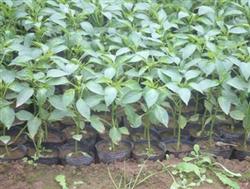
How to raise seedlings for spring-planted peppers? Key technical points explained
(1) Preparing the cold frame Select a plot with fertile soil, sheltered from the wind and facing the sun, where eggplants and tomatoes have not previously been grown, and build a cold frame. For each mu to be planted, raise seedlings using 150 grams of seed, and the cold frame should be more than 10 sq m. Apply plenty of base fertilizer, water heavily to build up soil moisture, and use a small amount of urea, phosphate fertilizer and active potassium fertilizer. Because the cold frame is sealed...
条件筛选