-
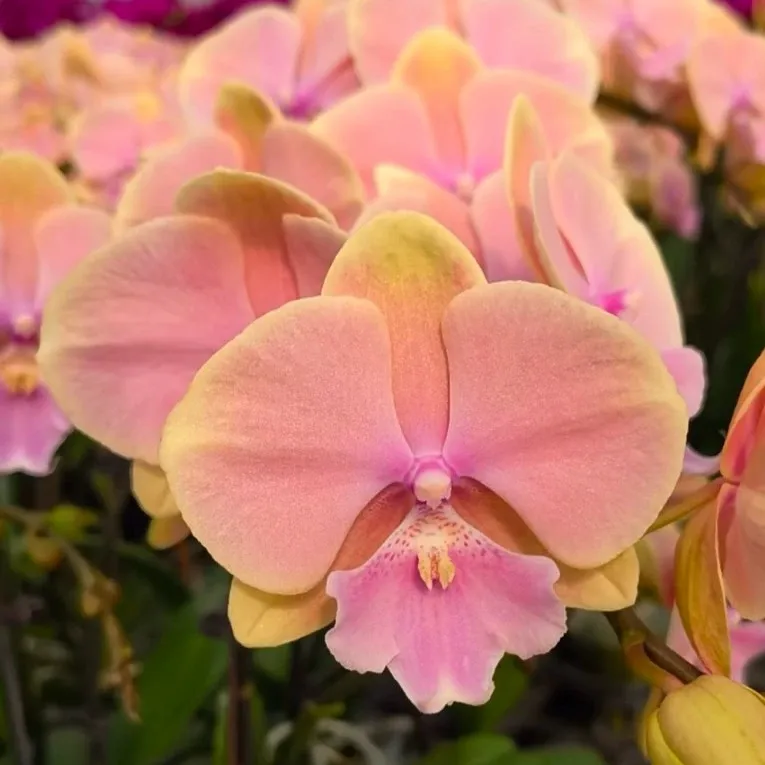
Is the Phalaenopsis Beauty Legend the same as the Beauty Rainbow?
Today, I would like to introduce a Phalaenopsis orchid deeply loved by flower enthusiasts - Fangmei Rainbow. Also known as Fangmei Legend, the Phalaenopsis
-
Is Phalaenopsis Fangmei Legend the same as Fangmei Rainbow, and is it a large-flowered variety?
Today I'd like to introduce you to a Phalaenopsis that is deeply loved by flower enthusiasts - Fangmei Rainbow. Phalaenopsis Fangmei Rainbow, also called Fangmei Legend, is a medium-to-large-flowered Phalaenopsis, with large pink-and-yellow gradient blooms that can reach 8 - 9 cm in diameter, and it looks grand and elegant when in full bloom. In sunlight it also shows a pearly luster, with light pink
-

What are the flower language, legends and care management methods of Queen Anne's lace?
Legend has it that Queen Anne's lace was discovered in the wild by Anne, the wife of the King of Scotland, so Anne specifically asked her maids to make delicate lace using Queen Anne's lace as a model, and later everyone called this plant Queen Anne's lace, but because the name was too long it was simply called lace. Its flower language is endearing
-

What Kind of Animal Is the Tapir? Understanding the Characteristics and Habits of This Mammal
There are many legends about the tapir. It is said that the tapir is an animal that feeds on dreams, also known as the dream tapir. So what kind of animal is the tapir really? Is it truly that magical? 1. What kind of animal is the tapir? The tapir is the most primitive surviving odd-toed ungulate, retaining
-
Latest Analysis of the Flower Language and Legends of the Balloon Flower
Anyone who has seen Inuyasha knows that Kikyo is the name of the female protagonist in it. In everyday life, the balloon flower is an ordinary flower, yet it is also a medicinal herb used in traditional Chinese medicine. Among the people, the flower language and legends of the balloon flower have always been passed down, and a thought-provoking story unfolds just like this.
-
The Latest Detailed Guide to the Flower Language and Legends of the Dandelion
Dandelions grow by the roadside and beside ponds, and are flowers we see all the time. When autumn comes, dandelions drift away with the wind, looking especially beautiful. But do you know what the flower language of the dandelion is? What stories and legends surround the dandelion? Let us take a look together below.
-
The Story and Legend of Agrimony: Latest Roundup
Agrimony (Agrimonia pilosa) is a perennial herbaceous plant of the genus Agrimonia in the Rosaceae family, often growing by streams, roadsides, grasslands, thickets, forest edges and open woodlands, and is a traditional excellent hemostatic medicine, while Yellow Crane Tower is a famous scenic spot in Jiangnan known at home and abroad; the two seem unrelated, but one story and legend reveals the close relationship between them.
-
Latest Analysis of the Flower Language and Legend of the Kalanchoe
The flower language of the kalanchoe is great fortune and prosperity, longevity, and auspicious blessings; it means blessing and good luck, and is an ideal potted flower for gifting to relatives, friends and elders. Besides its blessing flower language, the kalanchoe also has a beautiful legend. Legend says that long ago, this mountain was
-
The Latest Detailed Guide to Narcissus Flower Meanings and Legends
Narcissus is one of China's top ten famous flowers and a fine offering for the Chinese folk custom of qinggong (pure offerings). Every New Year, people like to display narcissus as a festive New Year flower. The Chinese narcissus is a perennial herbaceous plant, and its bulbs look quite like onions and garlic, so it was called "elegant garlic" during the Six Dynasties and "heavenly scallion" in the Song Dynasty.
-
The Legend and Origin of the Night-Blooming Cereus That Blooms but Once for Weituo
The night-blooming cereus was originally a flower goddess; she bloomed every day and was radiant through all four seasons. She also fell in love with the young man who watered and weeded for her every day. Later, when the Jade Emperor learned of this, he flew into a rage and resolved to separate the lovers. The Jade Emperor seized the flower goddess and banished her to become the night-blooming cereus, which can bloom only for an instant each year, forbidding her ever to see her beloved again, and he also sent the young man to Mount Lingjiu to become a monk, granting him the name Weituo, so that he would forget his past and forget the flower goddess.
条件筛选