-

Which cucumber varieties are disease-resistant? 6 recommended high-yield varieties with few pests and diseases
Cucumber is a common vegetable and fruit in daily life, with a crisp texture and high edible value, and is deeply loved by people. Anyone who knows cucumbers knows that there are many varieties, so what varieties of cucumber are there exactly? Below is a rundown of cucumber varieties on the market with good disease resistance. 1. Zhongnong
-
Detailed Explanation of Key Techniques for Growing Cabbage in Greenhouses
First treat disease-resistant, early-heading seeds with warm water or chemicals, then sow them in nutrient pots. Transplant in a timely manner after seedlings emerge. When transplanting, apply fertilizer and form ridges, and add a small arch tunnel inside the greenhouse. Finally, just carry out watering, fertilizing, and pest and disease control.
-
Where is Yanshu 25 produced? A look at the main production areas
Yanshu 25 is a type of sweet potato with strong disease resistance. It is a new variety bred by the Yantai Academy of Agricultural Sciences through hybridization technology. So where is Yanshu 25 produced? 1. Where is Yanshu 25 produced? Yanshu 25 is produced in Shandong, Shanxi, Hebei, Henan, Anhui,
-
How to grow yam (Chinese yam) to prevent diseases effectively? Growing experience shared
1. Selecting disease-resistant varieties is an effective method for preventing and controlling yam diseases and pests. For example: choosing Taigu hairy yam can resist stem rot. When cultivating disease-resistant varieties, rational layout is needed, rotate varieties every 2-3 years, and pay attention to variety purification and rejuvenation. 2. Crop rotation can reduce or avoid yam
-
Control methods for soybean mosaic virus in soybean cultivation
1) Select disease-resistant varieties: Different soybean varieties have different resistance to soybean mosaic virus, so selecting disease-resistant varieties suited to the local area is the most effective measure for controlling soybean mosaic virus. Disease-resistant varieties include Qihuang No. 22, Ludou No. 4, Ludou No. 1, Ludou No. 7, Ludou No. 6,
-
How to prevent and control soybean root rot? These methods you need to master
1. Select disease-resistant varieties. 2. Rotate with non-host crops such as corn, millet, and sweet potato. 3. When sowing, apply more farmyard manure, potassium fertilizer, phosphate fertilizer, etc. 4. When sowing, apply metalaxyl granules so that soybean roots can absorb them to prevent root infection. 5. Before sowing, use seed weight
-
Methods and Technical Key Points for Controlling Powdery Mildew in Melons
1. Select disease-resistant varieties. There are obvious differences in disease resistance among different melon varieties, so selecting disease-resistant varieties is the key to controlling the degree of disease occurrence. 2. Clean the field. After the crop is harvested, weeds and residues should be removed promptly. During the melon growing period, weed promptly, remove ⟦4 <p>1. Select disease-resistant varieties. There are obvious differences in disease resistance among different melon varieties, so selecting disease-resistant varieties is the key to controlling the degree of disease occurrence.</p><p></p><p>2. Clean the field. After the crop is harvested, weeds and residues should be removed promptly. During the melon growing period, weed promptly, remove diseased leaves, and take weeds, residues, and diseased leaves outside the field to be burned in a centralized manner.</p><p>3. Scientific management to enhance plant disease resistance. Apply sufficient basal fertilizer, especially heavily apply decomposed organic fertilizer, and plow deeply and harrow finely; prevent excessive vegetative growth and premature senescence of plants, organize branches and vines promptly, and strengthen ventilation and light penetration; during the mid-growth stage, pay attention to topdressing phosphorus and potassium fertilizers, and use foliar fertilizer well to cultivate strong branches and vines and enhance the disease resistance of the population.</p><p>4. Scientific irrigation. Create environmental conditions suitable for melon growth but unfavorable for the occurrence and development of powdery mildew. Irrigation should follow 4 principles: do not water on cloudy days but water on sunny days, do not water in the afternoon but water in the morning, do not water heavily but water lightly, do not water on the surface but water under the surface (that is, subsurface irrigation under film).</p><p>5. Chemical control. Use 15% triadimefon wettable powder at 1000-1500 times dilution, or 40% Daconil suspension concentrate at 800-1000 times dilution, or 40% Fuxing emulsifiable concentrate at 6000 times dilution, or 10% Shigao water-dispersible granules at 2000 times dilution, or 30% Tefuling wettable powder at 5000 times dilution, or 50% thiophanate-methyl wettable powder at 1000 times dilution, etc., alternating sprays for control, spraying once every 7-10 days, for 2-3 consecutive sprays. Medication is prohibited 7 days before melon harvest to allow safe harvesting.</p>
-
How to Grow Autumn Delayed Cucumbers? Detailed Explanation of Key Cultivation Techniques
1. Select heat-resistant and disease-resistant varieties. The main heat-resistant varieties include Jinyan No. 7, Jinza No. 2 and No. 4, Xiafeng No. 1, Xiaqing No. 4, Lu Cucumber No. 9 and No. 4, as well as Zhongnong No. 8, Jinyou No. 1, Zhongnong 1101, etc. 2. Sow at the right time. In Shandong, Hebei, Tianjin and other places, sowing generally starts from late July
-
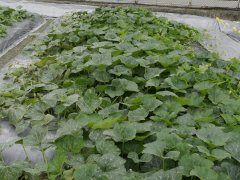
Introduction to the High-Yield and Disease-Resistant Characteristics of the New Pumpkin Variety Hualien AVRDC No. 2 - Youwang
The Hualien District Agricultural Improvement Station of the Council of Agriculture, Executive Yuan, together with the internationally renowned AVRDC - The World Vegetable Center, has developed a new disease-resistant pumpkin variety "Hualien AVRDC No. 2 - Youwang," which is resistant to two viruses. One of its parents is the strongly virus-resistant variety "Hualien AVRDC No. 1 - Taishan.
-
New sesame variety Zhongzhi 12: high yield, disease-resistant and high quality
Zhongzhi 12 was developed by the Oil Crops Research Institute of the Chinese Academy of Agricultural Sciences through crossing the introduced foreign sesame variety "CLSU-9" as the female parent with "Yiyangbai" as the male parent, followed by multiple generations of directional selection, and was approved by the Hubei Provincial Crop Variety Approval Committee in 2003. Characteristics: This variety is of the single-stem type, with three flowers per leaf axil and four-angled capsules. The plant is relatively tall, generally about 160 cm in height, and can reach more than 2 m at its tallest. The leaves are green, relatively large, with longer petioles, and the stem is greenish-yellow at maturity
条件筛选