-

What should be noted during the process of growing Gastrodia elata?
What should be noted when growing Gastrodia elata? We ask netizens to help explain. Zhongdi Web has compiled the points to note when growing Gastrodia elata, listed below for netizens' reference. 1. Suitable cultivation time for Gastrodia elata: Gastrodia elata cultivation is generally from late October of the current year to April of the following year. From late October to early December, the soil freezes...
-
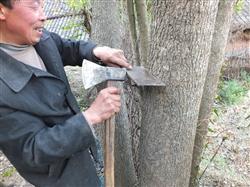
What are the harvesting and processing methods for Eucommia ulmoides?
How is Eucommia ulmoides harvested and processed? Please explain the methods. Eucommia ulmoides is a commonly used traditional Chinese medicine, and harvesting is done by the bark-stripping method. In our province, the more suitable time for bark stripping is from June 20 to July 31. The climate is suitable during this period, and after stripping, Eucommia ulmoides readily regenerates new bark, with a high survival rate. When stripping bark, first make a ring cut around the upper and lower ends of the section of the trunk to be stripped...
-

What issues need attention during the process of growing Gastrodia elata
What issues need attention when growing Gastrodia elata
-

A Detailed Guide to the Artificial Cultivation and Processing of Litsea cubeba
Artificial Cultivation and Processing Techniques for Litsea cubeba
-

What should be noted during the process of planting dwarf lilyturf (Ophiopogon japonicus)?
What should be noted when planting dwarf lilyturf
-

-

Detailed Explanation of the One-Year Three-Harvest Cultivation and Processing Technology for Pinellia (Pinellia ternata)
I. Land Selection and Preparation For planting Pinellia, loose and fertile soil is best. When preparing the land, apply 3000-5000 kg of farmyard manure per mu, 25-30 kg of phosphate fertilizer, and 100 kg of plant ash; do not apply ammonium bicarbonate. Plow deeply and harrow finely, with beds 1.3 m wide and 0.17 m high, and ditches 0.3 m wide; tall crops such as wheat, corn, sorghum, or kenaf can be intercropped in the ditches. II. Sowing Method Usually tuber propagation is used, allowing three plantings and three harvests in one year, namely planting in April and harvesting in July; planting in July and harvesting in October; planting in October and harvesting in April of the following year. The amount of seed tubers used per mu varies with
-
A Detailed Guide to the Harvesting Standards and Processing Methods for Goji Berries
1. Harvesting requirements: Medicinal goji berries (Lycium barbarum) ripen successively from June to November and should be harvested at the right time. They can be picked when the fruit turns from green to red or orange-red and the fruit stalk and flesh become slightly soft. If picked too early, the fruit is not plump and its color after drying is dull; if picked too late, the sugar content is too high and the fruit easily drops off, becoming dark purplish-black after sun-drying or oven-drying (commonly known as oil seeds) and losing its commercial value. Picking is best done after 10 a.m. on a clear day. Never pick fruit after rain or when covered with dew. Handle it gently when picking and remove it together with the fruit stalk. Otherwise, the juice will flow out and affect its internal quality.
-
What are the processing methods for goji berries? A detailed explanation
The harvested fruit is usually sun-dried or oven-dried. ① Sun-drying: Spread the fresh fruit on a bamboo mat or bamboo sieve to a thickness of 2-3 cm. During the first two days of drying, it should not be exposed to strong direct sunlight; dry it in the sun before 10 a.m. and after 3 p.m., and at noon place it in a sunny, well-ventilated spot to air-dry. By the third day, it can be placed in the sun to dry completely. Do not turn it with your hands while drying; generally dry for 8-10 days. ② Oven-drying: Spread the fresh fruit in a bamboo mat or bamboo sieve and place it in a drying room. First dry at 40-50°C for 24-36 hours, until
-
Detailed Explanation of the Processing Technology for Ganoderma Health Tea
Developing Ganoderma health tea can enhance the competitiveness of tea. A brief introduction to the processing technology of Ganoderma health tea is given below. Its process flow: Ganoderma slicing, extraction, filtration, concentration, spray blending (tea leaves must first be re-fired), drying. 1. Ganoderma slicing: Considering overall benefits and the use of mid-to-low-grade tea, it is ideal to select mid-to-low-grade Ganoderma without deterioration as the raw material. After washing the Ganoderma clean with water, cut it into thin slices of about 5 mm, and set aside. 2. Extraction and filtration: Take the prepared thin Ganoderma slices, at a ratio of 100 grams of Ganoderma to 10
条件筛选