-
Analysis of the causes of orchid root rot and prevention methods
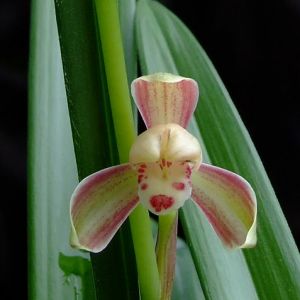
Cymbidium ensifolium 'Shuanglong Hongmei', with a dignified flower form, large blooms, and vivid colors. It originates from Ya'an and has won a gold award.
-
Introduction to the Characteristics and Care Methods of the Honghe Die Cymbidium goeringii Variety
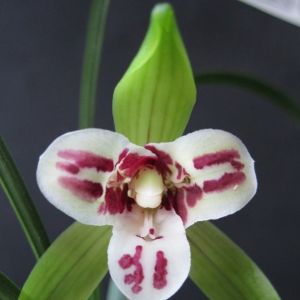
Honghe Die, originating from Zhoushan, Zhejiang, has an elegant grass-like form, large and brightly colored flowers, and symmetrical butterfly-like transformations. The overall beauty of the flowers and leaves is excellent, a marvel of nature's exquisite craftsmanship! It won the gold award at the 2011 Zhejiang Province Cymbidium goeringii Exhibition!
-
Introduction to the Characteristics and Care Methods of the Rongzhou Hexian Jianlan (Cymbidium ensifolium) Variety
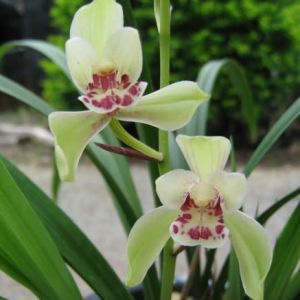
A new variety discovered in Liuwang, Rong County. Its cupped petals resemble those of the Chunlan (Cymbidium goeringii) variety Wang Xiaochun. The flowers are large, the blooming form is stable, and the flower holds well. It is likened to one of the four great beauties of Jiangnan, "Feizi Xiao" (Yang Guifei, a native of Rong County), hence the name "Rongzhou Hexian (Feizi Xiao)". The large flowers stand above the foliage, yet the flower form remains unchanged. The flowers are very large, a full size bigger than some Hexian varieties, and what is even more rare is their stability.
-
Introduction to the Characteristics and Care Methods of the Taohime Orchid (Cymbidium sinense) Variety
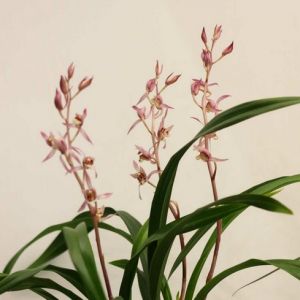
Origin: Taiwan, China. Discovered in 1963, registered in Taiwan, China in 1977 as a new "variety"; in 982 it was entered into the "Record of Famous Chinese Orchid Varieties," and was named Taohime by Mr. Peng Shuangshong (a representative of the red-flower series), beloved for its vivid flower color, delicate pink beauty, and elegant, graceful foliage. Taohime once won a special gold award in Japan and gained wide...
-
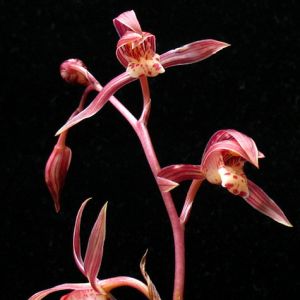
A Brief Introduction to the Variety Characteristics and Care Methods of the Bride Cymbidium sinense
The Bride, a representative colored-flower variety of Cymbidium sinense, also known as Jinshanji, has peach-pink bamboo-leaf-shaped petals, bean-pod-shaped cupped center petals, and a white lip edged with fine red spots. Ghost buds, an intermediate leaf posture, and a medium-to-long leaf width.
-
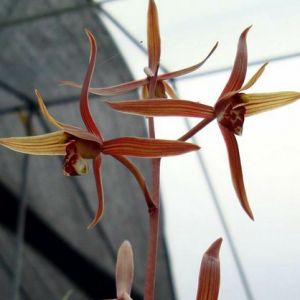
An Introduction to the Characteristics and Care Methods of the Cymbidium sinense 'Huangzhongwang' Variety
The registrar and namer of Huangzhongwang is Mr. Hu Yingdong, vice president of the Guangdong Province Orchid Association and president of the Shunde Cymbidium Association. This variety made its first public appearance at the orchid exhibition of the 1997 Yunnan Expo, where it won a bronze award. Brief introduction to the characteristics of Huangzhongwang: the leaves tend toward pinkish yellow, and the flower stems and flower color are red.
-
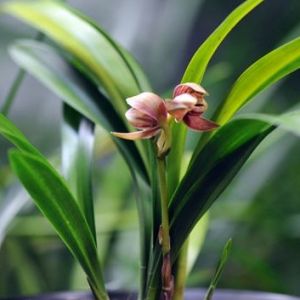
Introduction to the Cymbidium ensifolium variety 'Zhuangyuan Honghe' and Its Care Methods
This plant was collected in 2009 in the Fuzuo forest area of Langshui Township, Rong County. When collected, it was only a single seedling of dragon-root grass, and its plant form showed fairly pronounced lotus-petal characteristics. Looking at the flower as a whole: its contracted base and flared corners, its arched, embracing shape, and the vividness of its red color are all better than those of Hongheguan, and its well-contracted base is a standout feature that lotus-petal varieties from Rong County have found hard to surpass. This is another high-end lotus-petal variety after Hongheguan, Lianzi He, and Tedah He...
-

What are the propagation methods for orchids? Beginners can master them easily too
Shen Yuanru, "Orchids," Part Twelve: Orchid Propagation Methods (1). Orchid propagation falls into two types: asexual and sexual. Propagation using part of the vegetative body is called asexual propagation; propagation using seeds is called sexual propagation. In China, the division method within asexual propagation has traditionally been most commonly used, while sexual propagation, due to the pollination, seed collection, sowing, and seedling raising process...
-
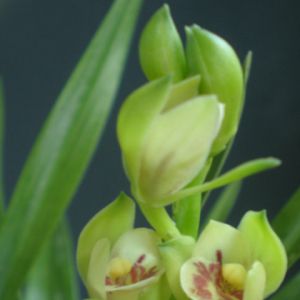
Introduction to the Characteristics and Care Methods of the Ju Cui He Jianlan (Cymbidium ensifolium) Variety
Namer: Lai Xuanyi. Origin: Meixian. A directly grown seedling collected from the wild, cultivated for five years, first bloomed in 2009 and bloomed again in 2010, jade-green in color, blooming in clusters.
-
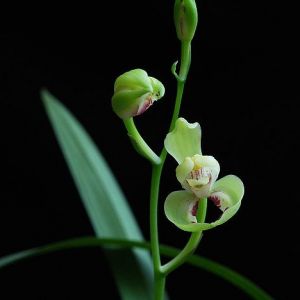
Introduction to the Characteristics and Care Methods of the Taiji Xiandie Jianlan (Cymbidium ensifolium 'Taiji Xiandie') Variety
Taiji Xiandie, discovered in Muchuan County, Leshan, Sichuan, exact year unknown, is a relatively new narcissus-type variety with excellent flower retention, the flower does not lose its shape after fading, and it is fragrant. This variety has medium-soft drooping leaves, the flowers rise above the foliage, and the flowers are large. The three outer petals are narcissus petals, the two inner petals are soft pouches, and the tongue is a dragon-swallowing tongue! The two side petals often carry butterfly markings, the butterfly transformation is vivid, and the contrast is good! The overall color is plain and clean, and the flowers...
条件筛选