-

Yuánmíng chrysanthemums and space lotus help Jiangxi farmers make money
Yuánmíng chrysanthemums and space lotus help Jiangxi farmers make money
-

Big market space for agricultural machinery leasing, still awaiting deep cultivation
The big market for agricultural machinery leasing still awaits deep cultivation
-
-
Maker Chen Jizhu: The biggest maker space is in the countryside
Maker Chen Jizhu: "The biggest maker space is in the countryside"
-
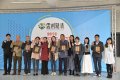
Yunlin Cultural and Creative Premium Certification and Distinctive Space Shops Award Ceremony Held
The "Yunlin Cultural Creative Highlight" premium certification event in Yunlin County held its award ceremony and results exhibition opening press conference on the afternoon of the 17th. This year, a total of 13 premium certifications were announced, and for the first time, 20 Yunlin distinctive space shops were selected. In addition to inviting...
-
Introduction to the Space Sesame Jinzhi No. 8 Variety
Jinzhi No. 8 is a new super-high-yield sesame variety recently developed by Chinese research experts using high-tech space breeding technology. It is disease-resistant and waterlogging-tolerant, with a high oil yield, and has great promotional value. Its main characteristics are introduced as follows: Super-high yield: Jinzhi No. 8 is an indeterminate-growing sesame variety per plant, with an average plant height of about 2 m, reaching 2.5 m in plots with good fertilizer and water conditions. Due to a series of high-tech breeding methods such as space radiation, the plants are exceptionally sturdy, with large leaves and a low capsule-bearing position. The average number of capsules per plant is about 150, with a maximum of 27
-
Hangzhi No.1, a new sesame variety, is the only variety in China developed through spaceflight technology.
Variety origin: "Hangzhi No.1" originated from the key project "Ninth Five-Year Plan Crop Spaceflight Technology Breeding" supported by the Ministry of Agriculture. In 1996, parent sesame seeds provided by the Oil Crops Research Institute of the Chinese Academy of Agricultural Sciences were carried aboard China's 17th recoverable satellite, stayed in space for 15 days and then returned to Earth. Since 1997, continuous multi-year ground selection was carried out. Through comparative trials on genetic stability, yield, quality and resistance, it was significantly superior to the control. From 2001 to 2002, it was advanced to the national sesame
-
Miniature bonsai are petite and exquisite, revealing the beauty of nature within a tiny space.
For the selection of small stumps, choose plants with strong vitality that are easy to tame into trunks and twisted, varied forms. Also pay attention to selecting varieties with small leaves, strong sprouting ability and shade tolerance. 1. Seek out old trunks and small branches of varied forms on a certain tree stump for air layering (that is, sleeve propagation), mostly carried out in early to mid-March during the plum rain season. 2. Seek out tree stumps with well-developed bare roots, and near their root area select crooked, ancient-looking, robust ones with small branches and bare roots, and separate them from the tree stump (best done in late autumn), but do not transplant them immediately; wait until the following spring when the separated plants sprout and grow branches.
-
Camellia uraku is a top choice for evergreen trees that bloom in winter in the green spaces of the Yangtze River Delta region
Camellia uraku, of the family Theaceae and the genus Camellia. An evergreen small tree. The plant can reach 5 m in height. The leaves are glossy, the flowers are single-petaled and pink, and the flowering period runs from December to March of the following year. Plants of the genus Camellia mostly prefer acidic soil, so when planting camellias in Shanghai, the soil often has to be replaced with acid soil such as hill soil. Camellia uraku is highly adaptable to the slightly alkaline soil of Shanghai, growing and flowering well, and is worth promoting.
-
Cultivation Techniques for the Space Red Rice Variety Weihong Jingjing Rice
The only Weihong Jingjing rice in China that has passed space breeding and been approved (approved name: Ganwanxian 33) is a high-quality red rice new variety developed by rice breeding expert researcher Li Yuanxiang together with the Institute of Genetics of the Chinese Academy of Sciences by sending 1000 seeds of the dual-purpose mid-late indica genetic engineering rice "GER-3" aboard a recoverable satellite, selecting mutants after mutagenesis, and then carrying out 3 years of directional breeding. It is also the only red rice variety among China's space rice varieties. After introduction and planting at our base, the plants perform well, show no photoperiod sensitivity or thermosensitivity reactions,
条件筛选