-

Control Methods and Application Tips for Mango Scale Insects
Control Methods for Mango Scale Insects
-

Morphological Characteristics and Damage of the Jujube Turtle Wax Scale
The jujube turtle wax scale belongs to the order Homoptera, family Coccidae, and is also known as the Japanese turtle wax scale or jujube louse. The adult is pale red, with a body length of 0.9 mm, black compound eyes and whip-like antennae. The wings are white and transparent, with two main veins. The female is oval, resembling a turtle shell; the egg is oval, pale yellow at first and purplish red later; the nymph is oval and pale red, and in its early stage spreads by wind before soon settling on leaves to cause damage; the pupa, only the male pupates beneath the scale cover. The pupa is oval. The insect, as nymphs and female adults, fixes itself on branches, leaves and fruit to suck sap, and its excretions induce
-
What are the control methods for the jujube tree tortoise wax scale?
(1) Manual removal of the pest source: during winter and in early spring in March of the following year, use a stiff-bristled brush to scrape the insects off the branches and collect and kill them. If snow or fog freezes on the branches with a thick layer of ice, you can directly strike the branches to shake off the ice, and the insects will fall with it. (2) Protect and utilize natural enemy resources: this pest has many natural enemies; a single predatory Chilocorus kuwanae can prey on thousands of these insects in its lifetime; the larvae of the long-shield golden small wasp can parasitize under the pest's abdomen and feed on the scale eggs. The larvae of the long-shield golden small wasp can parasitize under the pest's abdomen and feed on the scale eggs. (3) Chemical control:
-
Harm and Control Methods of the White Peach Scale
Distribution area: Morphological characteristics: The female adult is orange-yellow, broadly oval, with a body length of 1-1.3 mm; the body surface is covered by a scale cover, which is 2-2.5 mm long, grayish white, nearly circular, convex on the back, with the shell point yellowish brown. The male adult is 0.65-0.7 mm long, orange, with grayish white wings. The male scale cover is about 1 mm long, grayish white, long cylindrical, with 3 ridges on the back; the shell point is orange-yellow and located at the front end. Eggs are oval, orange. Nymphs are flat and round, orange.
-
How to control the Japanese wax scale on goldenrain tree? First understand its occurrence pattern
The Japanese wax scale (Ceroplastes japonicus Gr.) belongs to the order Homoptera, family Coccidae. Also known as the Japanese wax scale and the jujube armored wax scale, commonly called the jujube louse. When it breaks out over large areas on goldenrain trees, in severe cases the entire tree's branches and leaves are covered with the insects, and female insects attached to the twigs look like snow from a distance. The nymphs suck sap on the leaves, and their excrement covers the whole tree, weakening the tree's vigor and seriously affecting the landscaping appearance. Through two years of investigation and study, the occurrence pattern of this pest was clarified, and a satisfactory control method was found. This pest
-
Occurrence Characteristics and Control Methods of Pear Orchard Armored Scale
Pear orchard armored scale belongs to the order Homoptera, family Diaspididae, and is a pest that is relatively difficult to control on pear trees. In recent years, through observation, we have basically grasped the occurrence pattern of pear orchard armored scale in the Korla region, and through several years of control trials, we have developed a set of effective control methods. I. Damage Characteristics Pear orchard armored scale mainly damages fruit trees and forest trees. Among fruit trees, it mainly damages the branches, fruits and leaves of pear, apple, jujube, grape, apricot, plum, etc. Branches are often densely covered with many scale insects, and the damaged areas show red round spots; in severe cases, the cortex splits and even dies.
-
How Does the San Jose Scale Spread? A Full Analysis of Control Measures
I. Distribution and Damage The San Jose scale (Quadraspidiotus perniciosus) in the Korla region mainly damages pear, apple, apricot, peach, hawthorn, grape, and white poplar, among other fruit trees and forest trees. The insects cluster densely on the branches and trunk in the upper canopy and inner part of the crown, with more on smooth-barked areas and the sunny side. Population density is highest on 2- to 5-year-old branch sections, and on 1-year-old branches they mainly gather around the bud bases. The San Jose scale sucks the sap of branches, leaves, and fruit as female adults and nymphs. Young branches and leaves dry up and fall off after being damaged; damaged fruit develops purplish-red
-
What are the control methods for the peach globular scale?
In recent years, the peach globular scale has occurred severely in the nectarine orchards of our town. In mild cases, tree vigor weakened and yields declined; in severe cases, there was total crop loss and even tree death. To address this, we carried out two consecutive years of pesticide screening and control, with very good results. We summarize them as follows: 1. Strengthen comprehensive fertilizer and water management measures, keep the trees vigorous, ensure ventilation and light penetration, and pay attention to protecting natural enemies. 2. Before bud break, in early to mid-March, when overwintering nymphs emerge from dormancy, their body surface wax is still sparse, so timely control can achieve good results. Choose 5-degree lime sulfur
-
How to control the San Jose scale? Control methods and technical key points
(1) Quarantine control. Inspect nursery stock, scions and fruit to prevent spread. (2) Manual and agricultural cultivation control. In combination with scraping bark in winter and spring, brush off and destroy the overwintering generation on branches; also carry out comprehensive control in nearby apple, pear and other orchards to prevent spread by wind and large insects, and pay attention to pruning out infested branches. (3) Protect and make good use of natural enemy resources. Where conditions permit, jujube orchards can rear and release natural enemies artificially. The main natural enemies include: Chilocorus rubidus, Chilocorus kuwanae, encyrtid wasps and birds.
-
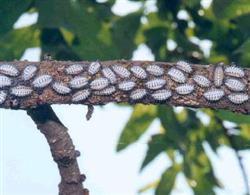
How to control scale insects on plum trees? Practical methods here
How to control scale insects on plum trees? Please introduce methods. Plum tree scale insect control methods: 1. Do a good job of winter pruning and orchard cleaning to reduce the population density the following year, and spray 5-degree lime sulfur mixture before bud break. 2. Trunk smearing method for control: ① Apply a 5-fold dilution of commercially available laundry detergent evenly to the infested trunk. ② Mix 5 parts commercially available kerosene, 1 part laundry detergent, and 6 parts water, and apply evenly to the infested trunk...
条件筛选