-

Are Clothes Moth Larvae Harmful to Humans? Learn How to Get Rid of Them Fast
The clothes moth larva is a small brown caterpillar, usually hidden inside a silken bag-like or web-like structure (called a case). The adult is a pale yellow moth that shuns light. If you crush it, it gives off an unpleasant odor. So are clothes moth larvae harmful to humans? How
-
What are the methods for farming maggots (headless larvae)?
Maggots, also called headless larvae, are the eggs of flies. They are rich in nutrients and highly palatable, making them one of the nutritional feeds for many poultry. So today, the editor will share with you the farming methods for maggots. 1. Fly house construction To farm maggots, you first need flies, so that maggots will be produced. Therefore, the first thing we need to do is build a fly house for raising flies. Flies are creatures that escape very easily, so the house needs a sealed walkway, and it is best to set it up in a semi-basement style. Black curtains should be hung on the doors. First, this can prevent the flies from escaping; second, the black curtains have a warming effect, which can promote the growth rate of the flies, allow rapid reproduction, and increase maggot production.
-
What Are Ticks and How to Use Medication to Exterminate Tick Larvae on Dogs and Cattle at Home
In recent years, news of tick bites has been common, so what exactly are ticks? How do you kill tick larvae clean on your home, dogs, and cattle? What medication can exterminate them? Ticks (p) are also called wall ticks, turtle bites, commonly known as dog ticks, grass ticks, cattle ticks, grass ticks, dog beans, cattle ticks. In Sichuan dialect, they are called bi sha (pronounced shà), etc. They lie dormant in the grass and plants of low hills, or lodge in the fur of livestock and other animals. When not engorged with blood, the small ones are only as big as a shriveled mung bean, and some are as fine as a grain of rice; after engorging with blood, they are as big as a plump soybean, and the large ones can reach the size of a fingernail. The anaplasmosis transmitted by tick bites is an infectious disease, and humans are generally susceptible to it. Medical staff or their caregivers who have close contact with critically ill patients or directly contact patients' blood and other body fluids may also become infected if they do not pay attention to protection.
I. Tick Classification
1. By morphological characteristics
1) Hard ticks
The body is oval; when not engorged with blood, the abdomen and back are flat, with the back slightly raised; adult body length is 2-10mm; after engorging with blood, it swells up like a red bean or castor bean, and the large ones can reach 30mm in length.
2) Soft ticks
The capitulum is on the ventral side of the body and cannot be seen from the dorsal side; there is no porose area on the dorsal surface of the basis capituli. The dorsal surface of the body has no scutum; the body surface is mostly granular small tubercles, or has wrinkles and disc-shaped depressions.
2. Main species
1) Ixodes persulcatus: the scutum is brown, the palps are slender and cylindrical, and the auricular processes of the basis capituli are bluntly toothed.
2) Dermacentor nuttalli: the scutum has enamel-like spots, with eyes and festoons; the palps are wide and short, the basis capituli is rectangular, and the dorsal spur of tarsus I is short and blunt.
3) Hyalomma asiaticum kozlovi: the scutum is reddish brown, with eyes and festoons; the palps are long and cylindrical, and the second segment is notably elongated; the legs are pale yellow, with obvious pale rings at each joint; the cervical grooves of the male are obvious and deep-grooved, and the spiracular plate is pipe-shaped.
4) Ornithodoros papillipes: the body surface is granular, and the intersection of the postanal transverse groove and the postanal median groove is almost a right angle.
II. How to prevent tick bites?
1. To eliminate ticks on the body surface of livestock and in livestock sheds, insecticides such as trichlorfon and dichlorvos can be sprayed. Housing should be ventilated and dry; fill and plaster wall cracks, seal caves, and clean livestock and poultry sheds thoroughly or spray them with medication to eliminate tick breeding sites.
2. Strengthen personal protection. When entering forest areas or working in the field, wear long-sleeved clothing, tighten the belt, cuffs, and trouser legs, tie a towel around the neck, and apply ointment to the skin surface to prevent tick bites. Take a bath and change clothes after returning from outings to prevent bringing ticks home.
In addition, it is summer now, which is a good season for people to travel. Here I want to remind everyone that when playing in the wild, in addition to the above two points to note, do not go to scenic areas that have not yet been well developed, and try to go less to forests and wild places with dense grass. In this way, we will avoid tick bites.
III. What medication is used to kill ticks?
After a certain pesticide is used for a long time, ticks will develop resistance, so pesticides should be mixed or used in rotation.
There are mainly two ways to eliminate ticks on livestock: one is direct capture, and the other is using chemical drugs to kill ticks. When ticks are found, they should be pulled off and then killed together. When pulling, the tick body should be perpendicular to the skin, then pulled upward, to avoid the tick's false head breaking off in the skin and causing inflammation. However, this method can only be used when there are few livestock and sufficient manpower.
For eliminating ticks with chemical drugs, commonly used ones include pyrethroid insecticides, organophosphorus insecticides, amidine insecticides, etc. According to the season and application target, methods such as spraying and dipping can be selected. However, it should be noted that after these pesticides are used for a long time, ticks will develop resistance, so pesticides should be mixed or used in rotation.
In recent years, genetic control and biological control have begun to be used to kill ticks. The former uses radiation or chemical sterilants to make male ticks lose reproductive ability, causing the tick population to continuously decline; the latter uses ticks' natural enemies to kill ticks. Some parasitic wasps in the family Encyrtidae of the order Hymenoptera have now been found to lay eggs in some nymphal ticks, and the adults emerge from the nymphal ticks only after becoming adults; the nymphal ticks die shortly after parasitism. Insects in the family Reduviidae can also cause tick death.
-
What are the larvae of flies, cicadas, mosquitoes, butterflies, and dragonflies called?
In our daily lives, we often see five kinds of small flying animals: flies, cicadas, mosquitoes, butterflies, and dragonflies. The larval names of these five animals are all quite obscure, so what are these larvae called? According to sources, fly larvae are commonly known as maggots (qu, first tone).
-
What are the methods for selecting soil insects for breeding and hatching soil insect larvae?
The soil insect, also called the ground beetle or soil turtle insect, is an insect that tolerates cold and heat, likes to live in groups, and grows in remote, moist, loose, and fertile soil. It has the habit of hiding by day and coming out at night to feed. With the development of the medicinal value of the soil insect, many farmers are now artificially
-
-
-
Detailed Explanation of the Artificial Cage-Rearing Method for Sterile Fly Larvae
Artificial Cage-Rearing of Sterile Fly Larvae
-
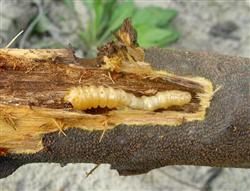
How to control longhorn beetle larvae? Detailed explanation of control methods and technical key points
How to control longhorn beetle larvae? Longhorn beetle larvae cause very severe damage to fruit trees. How should they be controlled? Please provide methods. Damage caused by longhorn beetles: larvae of the bark-girdling longhorn beetle girdle the bark (gnawing the green surface layer of the trunk); larvae of the Miezi ridge tiger longhorn beetle damage branches and trunks, boring the xylem into crisscrossing tunnels and boring toward the center of the stem, damaging the pith, then boring downward to damage the roots. This seriously affects water transport, causing weakened tree growth, withered yellow branches and leaves, and symptoms of fertilizer and water deficiency.
-
How to prevent and treat luminous bacterial disease in white shrimp (Penaeus vannamei) larvae
Prevention and treatment of luminous bacterial disease in white shrimp (Penaeus vannamei) larvae
条件筛选