-
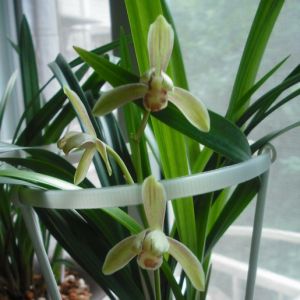
Introduction to the Jinxianmei Jianlan (Cymbidium ensifolium) Variety and Its Care Essentials
Origin: Sichuan... quantity unknown
-
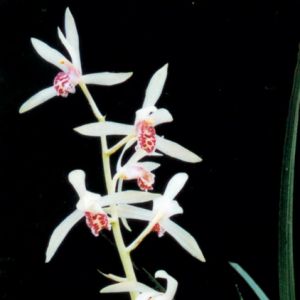
Variety Characteristics and Care Essentials of the Lingnan White Crane Cymbidium
"Lingnan White Crane" Cymbidium white flower
-
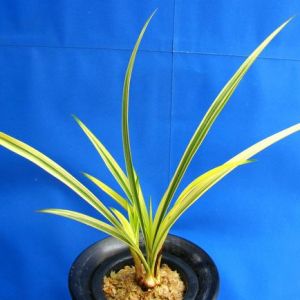
Introduction to the Grand Slam Jianlan (Cymbidium ensifolium) Variety and Its Care Essentials
Jianlan Grand Slam, an evolving striped-art Cymbidium ensifolium
-
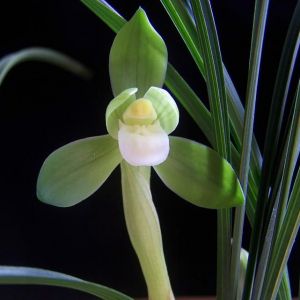
Cymbidium goeringii 'Yangshi Suhe': Variety Characteristics and Care Essentials
In the Gengshen year of the Republic of China (1920), it was selected by the master of Chenyi Studio; another account says it was bred by Yang Zuren of Ningbo, Zhejiang Province. The leaves are emerald green, with fine serrations along the leaf margins. The two outer leaves are short and semi-drooping with blunt tips, while the central leaf stands erectly with a slightly pointed tip. The three outer sepals are short and round with tightly rolled edges, narrowed at the base and flared at the corners. The petals form shallow cupped mussel-shell holds, with a pure white large round lip, slightly...
-

Cultivation Techniques and Care Management Essentials for Cymbidium ensifolium
Cymbidium ensifolium, commonly known as the Four Seasons Orchid, is a member of the Chinese orchid family and has a long history of cultivation in our country. Its merits of being enjoyed both for its flowers and its foliage have made Cymbidium ensifolium widely favored by orchid growers and enthusiasts throughout the ages. The process of artificial large-scale cultivation of Cymbidium ensifolium requires tissue-culture seedling propagation before it can enter the stages of small seedling, medium seedling, and commercial seedling cultivation... ⟦3 Cymbidium ensifolium, commonly known as the Four Seasons Orchid, is a member of the Chinese orchid family and has a long history of cultivation in our country. Its merits of being enjoyed both for its flowers and its foliage have made Cymbidium ensifolium widely favored by orchid growers and enthusiasts throughout the ages. The process of artificial large-scale cultivation of Cymbidium ensifolium requires tissue-culture seedling propagation before it can enter the cultivation stages of small seedlings, medium seedlings, and commercial seedlings; during cultivation, there are many finer points to observe in technical aspects such as the water quality used for irrigation, the method of watering, and pest and disease control. This episode introduces the cultivation techniques for Cymbidium ensifolium.
-
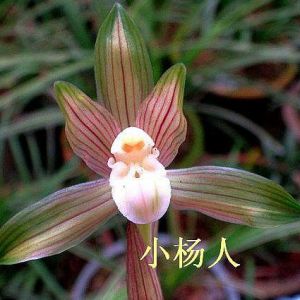
Introduction to the Cymbidium goeringii cultivar Caijinsu and Its Care Essentials
A wild-collected Cymbidium goeringii, a premium multi-variation plant.
-
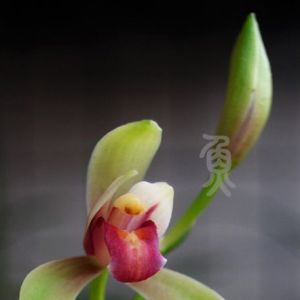
Introduction to the Cymbidium ensifolium cultivar 'Zui Hongyan' and Its Care Essentials
The plant form is elegant, with leaves and flowers in harmony and strong color contrast; the lip is red without being murky, the center of the flower is white tinged with red, and the three outer sepals have a green base with red speckling, broad and imposing. When the cloud-like petals first open they are the color of warm jade, yet the rosy blush cannot hide the shyness of the flower's heart. Gazing afar over the rippling waves, my lord has not returned; a single sheet of poetry and prose retains its burning passion.
-
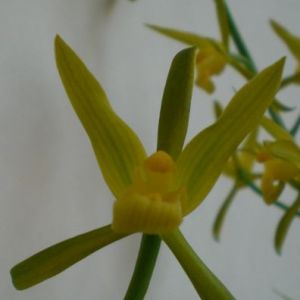
Characteristics and Care Essentials of the Qijian Baimo Cymbidium sinense Variety
Qijian Baimo, of the genus Cymbidium in the orchid family, is mainly produced in the Pearl River Delta area and is one of the four traditional varieties of Cymbidium sinense. Its pseudobulbs are plump and oval-shaped; its leaves are emerald green, glossy, broad and upright, rather long, slightly drooping, and dark green; its flower stalks are tall, imposing and powerful, with a subtle, serene fragrance, and the flowers are jade white...
-
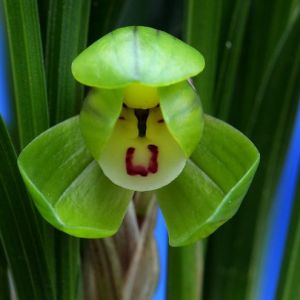
Introduction to the characteristics of the Cymbidium goeringii 'Xiwang' variety and its care essentials
Discovered in the wild on Jintang Island, Zhoushan, Zhejiang, China. Selected and named by Xu Xianjun. When it was collected from the wild, it was a few beautiful small seedlings with dragon roots, showing promise of blooming as a lotus-petal type. It bloomed in March 2012, and the plant lived up to expectations, so it was named 'Xiwang' (Hope).
-
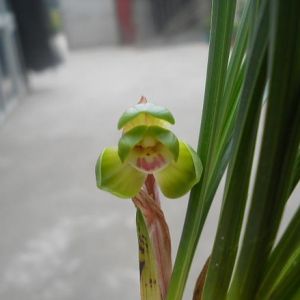
Introduction to the Characteristics and Care Essentials of the Chunlan 'Xingli He' Variety
Originated in Hubei, discovered by Hu Xingli in Tangdi, Zhejiang; the five petals are round, tight and broad, the lip is large and the stem is tall.
条件筛选