-

What is the difference between mallow and hollyhock? A quick guide to telling the two flowers apart
The difference between mallow and hollyhock
-
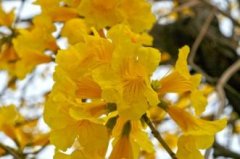
Differences and Characteristics Between Golden Trumpet Tree and Pink Trumpet Tree and Their Propagation Methods
The genus Tabebuia consists of tropical trees. After being introduced to Taiwan, China, they grow well on the plains of the central and southern regions. In recent years, horticultural landscape cultivation has been increasingly on the rise. Winters in the north are damp and cold, so protection against cold damage must be strictly maintained. There are mainly two varieties: the Golden Trumpet Tree and the Pink Trumpet
-

What is the difference between Japanese euonymus (Euonymus japonicus) and Jiaodong euonymus (Euonymus kiautschovicus)?
Japanese euonymus and Jiaodong euonymus are evergreen plants of the same genus but different species, both good materials for hedges. The leaves of both are leathery, and there is no obvious difference in leaf shape, so many people lump them together. The main differences between the two are described below: 1. Plant form. Japanese euonymus has a compact form, the branches are relatively upright, and the natural branching point of the side branches is relatively high; Jiaodong euonymus has a loose form, the natural branching point of the side branches is relatively low, and the branches at the base are prostrate and can take root. 2. Leaves. Although the leaves of both are leathery, the fine serrations on the leaf margin of Japanese euonymus are more
-
What is the difference between the azalea varieties Wubaozhu and Wubao Luzhu
Comrade Tongqing, Wubaozhu is a precious variety among Western azaleas, with a flowering period in August, large double flowers, the outer ring of large petals slightly embryonic in shape, the flowers opening in an expanding form, multicolored, in colors such as red, white, and pink. Its main bud sport varieties include Pink Wubao, Pink Tianhui, Huan Tian Xi Di, and others. If the plant grows vigorously, when the flowers reach a late stage the flower center protrudes, and it is also called Gutou Wubao. The general growth pattern is that flowers and leaves emerge together, the leaves are ovate, thick and glossy, with obvious veins, the branches and leaves are sparse, and the branches are sturdy. Wubao Luzhu belongs to the summer azalea varieties, also called Chinese azalea, and is
-
What is the difference between Torreya grandis and Taxus? This article teaches you to tell them apart quickly
Torreya grandis, also known as Chinese torreya, Yu torreya, and torreya seed, is an evergreen tree of the genus Torreya in the family Taxaceae, and is an economic tree species unique to China. It mainly grows in Zhejiang, Anhui, Fujian, Jiangsu, Guizhou, Hunan, Jiangxi and other provinces south of the Yangtze River in China, among which Zhejiang's Fengqiao Chinese torreya, Anhui's Taiping Chinese torreya, and Jiangxi's Yushan Chinese torreya (nut) are the most famous. Its fruit is a treasure among dried fruits, containing rich protein and a variety of trace elements. In addition, Chinese torreya is also a precious Chinese medicinal material, with the effects of killing parasites, relieving food stagnation, and moistening dryness.
-
What is the difference between French plane tree, paulownia, and Chinese parasol tree?
The Chinese parasol tree is a deciduous tree of the family Sterculiaceae. It is not related to the tung tree (Euphorbiaceae), the paulownia of the family Scrophulariaceae, or the French plane tree (Platanaceae), despite sharing the name "tong." The Chinese parasol tree is tall and imposing, with a trunk free of knots that rises straight upward, holding aloft a great emerald-green umbrella of foliage with a spirited bearing. Its bark is smooth and jade-green, its leaves dense, and from trunk to branch it is lush throughout, appearing exceedingly elegant and clean - no wonder people also call it "qingtong" (green paulownia). "A single green jade stands upright, a thousand leaves like green clouds piled up" - these two lines of poetry capture to the fullest the charm of the Chinese parasol tree's green leaves and jade trunk, and the graceful shade it casts.
-
Differences Between London Plane, Chinese Parasol Tree and Paulownia - A Quick Guide to Telling Them Apart
In the vigorous development of urban greening and landscaping, identifying and selecting tree species is an important task. The London plane, paulownia and Chinese parasol tree may look like three sisters in urban landscaping, but in fact they belong to different families and genera, and differ greatly in morphology. The London plane is a large deciduous tree of the genus Platanus in the family Platanaceae. Its name comes from its leaves resembling those of the Chinese parasol tree; it was introduced from abroad in old China and was first planted in the French concession of Shanghai, hence the name "fa tong" (French plane). The London plane is actually a collective name for Platanus orientalis and Platanus acerifolia of the genus Platanus. Platanus orientalis reaches 30 m tall, with dark gray bark that peels off in thin flakes, revealing a greenish-white inner bark. Young branches are covered with yellow-brown stellate hairs. Leaves are 8 to 16 cm long and 9 to 18 cm wide, with 5 to 7 deep lobes reaching to or below the middle, the lobes narrow and long, covered with gray-yellow stellate hairs when young and later shedding. The common stalk bears spherical fruit heads 2 to 2.5 cm in diameter, with spiny styles 3 to 4 mm long; flowering in May, fruiting in September to October. Platanus acerifolia is a hybrid of Platanus orientalis and Platanus occidentalis, bred in London, England. It reaches 35 m tall, with bark peeling off in thin flakes and a pale greenish-white inner bark. Young branches and leaves are densely covered with pale brownish-yellow stellate hairs. Leaves are 10 to 24 cm long and 12 to 25 cm wide, with a flat or slightly heart-shaped base, 3 to 5 deep lobes, the middle lobe nearly equal in length and width, with entire or sparsely coarse-toothed margins. Fruit heads are about 2.5 cm in diameter, with spiny styles 2 to 3 mm long. Flowering in April to May, fruiting in September to October.
-
Differences Between Herbicide Damage and Fertilizer Damage in Azaleas and How to Tell Them Apart
When azaleas suffer herbicide damage and fertilizer damage, they share some characteristics but also differ in their manifestations. What they have in common is that both are physiological injuries, causing leaves to wither and drop within a short time, but the patches do not slowly expand, nor do pathogens appear on them. The differences between herbicide damage and fertilizer damage are as follows: when azaleas suffer herbicide damage, they show sensitivity to a certain pesticide or a certain class of pesticides. For example, after a pesticide is sprayed on the leaves, within a few days the parts of the leaves touched by the spray solution turn yellow, wither and drop, seriously affecting the plant's growth, but it will not
-
What is the difference between Yulan magnolia and purple-flowered Yulan magnolia
Yulan magnolia, also known as white Yulan magnolia, is a deciduous tree of the Magnolia genus, with an oval or flattened-spherical crown and grayish-brown bark. Its single leaves are alternate, obovate-rounded, with a abruptly pointed tip. The flowers are terminal, with flower buds formed in the previous autumn, blooming before the leaves. The flowers are white, fragrant, 10-16 cm in diameter, upright bell-shaped, with 9 tepals, obovate, white, arranged in whorls of three, and numerous stamens and pistils. Its main variety is the purple-flowered Yulan magnolia (var. FurFurascens), whose tepals are purplish-red outside and clear white inside. Both magnolias are highly favored by people. Yu
-

What is the difference between Chinese rose and rugosa rose? A quick guide to tell them apart
The difference between Chinese rose and rugosa rose
条件筛选