-

How to Grow Button Mushrooms? Latest Cultivation Techniques and Methods Tutorial
The button mushroom, also known as the white mushroom, is the edible fungus with the highest yield and the largest consumption in the world. In China, cultivation is mainly for export, but as domestic consumption grows, the market prospects are good. In addition, the button mushroom has high nutritional value and health benefits, with strong market demand
-
What to pay attention to when watering the latest button mushrooms
The button mushroom (Agaricus bisporus) belongs to the fungi kingdom, has relatively high nutritional value, and is grown over a fairly wide area. When growing button mushrooms, they are not as easy to manage as ordinary vegetables, especially when it comes to watering. Each growth stage of the button mushroom has different watering
-
What are the precautions for button mushroom cultivation? A full breakdown of the latest key points
The button mushroom is a universally recognized global agricultural product, with high nutritional value, delicious flavor and high cultivation returns. In recent years, more and more people have been cultivating it in northern regions, and it is one of the important projects for developing the agricultural economy in many areas. However, there are many
-
The latest cultivation techniques and methods tutorial for button mushrooms
The button mushroom (Agaricus bisporus) is one of the common edible mushroom species, with thick flesh and white, firm mushroom tissue. It originated in Europe and North America, and we began cultivating it artificially in the 17th century; today it is widely cultivated around the world. So how should button mushrooms be grown? Let's take a look.
-
What to Do When the Leaves of a String of Buttons Plant Are Shriveled? Cause Analysis and Solutions
The full name of the string of buttons is Crassula perforata, also known as string of coins and star maiden, a succulent plant in the Crassulaceae family, named because its plant resembles strings of ancient coins, and it is a very popular succulent plant. String of buttons can be planted in small pots to make
-
How to Propagate the String of Buttons? A Detailed Guide to Common Propagation Methods
The String of Buttons (Crassula perforata) is a perennial succulent plant of the genus Crassula in the Crassulaceae family, also known as a succulent. It gets its name because the plant closely resembles strings of ancient coins, and it is one of the small succulents much loved by people. So, how do you propagate the String of Buttons? 1. How to Propagate the String of Buttons
-
How Do Button Corals Reproduce? These Methods Are Simple and Easy to Learn
Button coral colonies are a class of zoantharians; they are relatives of corals and sea anemones, attaching to rocks or coral reefs in shallow seas. Some varieties of button coral secrete a highly toxic substance, palytoxin. Therefore, great care must be taken during keeping. Today we bring you
-
How do button corals reproduce quickly? Introduction to practical methods
We do not hear about button corals very often; they are a type of zoanthid, relatives of corals and sea anemones. Today the editor will introduce to you how button corals reproduce quickly, let us take a look together! 1. How do button corals reproduce quickly Button corals mainly
-
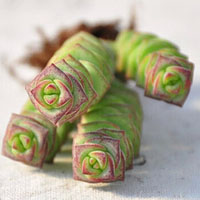
String of Buttons
String of Buttons gets its name because the plant closely resembles strings of ancient coins, and it is one of the small succulents much loved by people. Its plant form is unusual and dainty and cute, suitable for planting in small decorative pots and for decorating desks, windowsills and other places, fresh and elegant, full of charm.
-
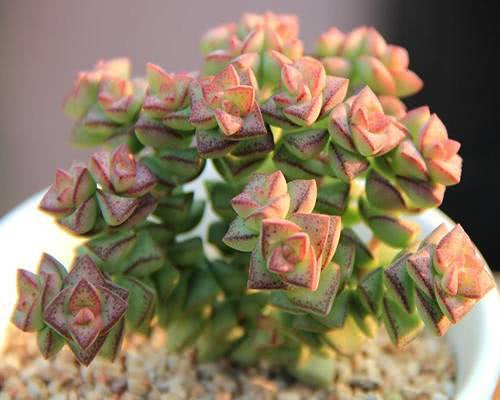
How to grow and care for the String of Buttons succulent
String of Buttons (Crassula perforata) is a perennial succulent herbaceous plant, with upright and clumping growth, many small branches, and fleshy stems; the perennial stem base gradually becomes semi-woody. The flesh is green to pale green, about 0.5 cm long and about 0.4 cm wide; the leaf edges are slightly red, in late autumn and early spring, especially at T time. The temperature difference is relatively large. Leaves are alternate, opposite, elliptical, triangular, with petioles, linked at the base; new leaves stack at the top and bottom, with the leaves slightly up and down. The flowering period lasts 4-5 months, white, star-shaped, with 5-6 petals, clustered, usually filling the branches, quite showy; it does not die after flowering. A small variety, the flowering plant is only about 12 cm tall.
条件筛选